





So, what exactly is a loan signing agent?
At its core, a loan signing agent is a specialized notary public who walks borrowers through their massive stack of mortgage loan documents. They are the final checkpoint in the home buying or refinancing journey, making sure every signature, date, and initial is exactly where it needs to be so the loan can be funded without a hitch.
The Director of the Closing Ceremony
Think about one of the biggest financial moments in a person’s life—buying a home. The loan signing agent is the trusted guide in the room for that final, crucial step. This isn’t just about witnessing signatures; it’s about making sure the entire closing process for a real estate deal goes off smoothly and without any errors.
A great way to picture it is to think of the loan signing agent as the ‘closing ceremony director.’ Just as a film director makes sure every actor hits their mark and every scene flows perfectly, a signing agent orchestrates the final act of a loan agreement. They’re handed a complex set of documents, often well over 100 pages, and their job is to get the borrowers, lenders, and title companies all on the same page.
More Than Just a Notary
Here’s a critical distinction: while every loan signing agent must first be a commissioned notary public, not every notary is qualified to handle loan signings. This is a big deal.
A general notary public might handle all sorts of paperwork, but a loan signing agent has gone through specialized training to really understand the ins and outs of mortgage documents. To get a feel for the variety of work a general notary does, you can check out this list of the most commonly notarized documents.
This specialized knowledge isn’t just a “nice-to-have”—it’s essential. One simple mistake, like a missed signature on the Note or an incorrect date on the Deed of Trust, can blow up a closing. It can cause serious funding delays that cost everyone involved a lot of time and money. The entire purpose of a loan signing agent is to stop those problems before they ever start.
Their role is defined by precision and impartiality. They are not there to offer legal or financial advice but to ensure the integrity and accuracy of the document execution itself.
To better understand the differences, let’s break them down side-by-side. While both roles are built on the foundation of a notary commission, their day-to-day functions, training, and the stakes involved are worlds apart.
Loan Signing Agent vs General Notary Public Key Differences
| Aspect | General Notary Public | Loan Signing Agent (LSA) |
|---|---|---|
| Primary Role | Verifies identity and witnesses signatures on a wide variety of documents (wills, contracts, affidavits). | Guides borrowers through mortgage loan documents, ensuring all forms are executed correctly per lender instructions. |
| Training | Basic state-required notary training and exam. | Requires additional, specialized training in handling loan packages and understanding mortgage documents. |
| Typical Assignments | Single-document notarizations like power of attorney, consent forms, or vehicle titles. | Full loan packages for home purchases, refinances, HELOCs, or reverse mortgages (often 100-200 pages). |
| Key Documents | Varies widely. | The Note, Deed of Trust/Mortgage, Closing Disclosure, Notice of Right to Cancel. |
| Liability/Risk | Generally lower; mistakes impact a single document. | High; errors can delay or prevent the funding of a large real estate transaction, leading to significant financial consequences. |
| Typical Fee | State-regulated fee per signature (e.g., $5-$15). | Flat fee per signing appointment (e.g., $75-$200+), reflecting the specialized knowledge and higher responsibility. |
As you can see, the LSA role is a significant step up in complexity and responsibility, which is also reflected in the earning potential.
The Guardian of the Transaction
Ultimately, the loan signing agent acts as an impartial third-party witness. They confirm who the signers are and make absolutely sure that all documents are executed according to the lender’s specific, detailed instructions.
This responsibility is the bedrock of the real estate closing process. It provides confidence and security for everyone—the buyer, the seller, the lender, and the title company. Without their meticulous oversight, the risk of costly errors and even potential fraud would skyrocket, making a skilled signing agent an indispensable partner in the industry.
A Day in the Life of a Signing Agent
So, what does a loan signing agent actually do all day? If you’re picturing someone chained to a desk, think again. The role is a dynamic mix of careful preparation, face-to-face client work, and logistical hustle. A typical day isn’t about clocking in and out; it’s a series of orchestrated moves to make sure a real estate deal closes without a hitch.
It all kicks off with a new assignment. A notification pops up from a signing service or title company, laying out the details for an upcoming loan closing. That first message triggers a crucial pre-appointment checklist where being organized isn’t just a suggestion—it’s everything.
Pre-Appointment Preparation
First things first: accept the job and get the loan documents printed. These aren’t just a few pages; we’re often talking stacks of 100 to over 200 pages. You’ll need a solid dual-tray printer to handle both letter and legal-sized paper without breaking a sweat. This is more than just hitting “print”—it’s the very first quality control check.
With the docs in hand, the agent goes through them page by meticulous page. They aren’t looking for legal errors (that’s the attorney’s job), but for completeness. Are there missing pages? Any special instructions from the lender? Spotting these potential hiccups now can save a world of trouble later. Think of it as a chef doing mise en place before dinner service—every ingredient has to be perfect before the main event.
Next up is a quick but vital call to the signer. This is where the agent locks in the time and place, answers any last-minute questions, and sets a professional, reassuring tone for the meeting.
The Signing Appointment Itself
Whether it’s at the borrower’s kitchen table, a local coffee shop, or an office, the signing agent arrives ready to guide the closing. The first order of business, and it’s non-negotiable, is verifying the signer’s identity with a government-issued photo ID. This is a fundamental step in any notarial act.
From there, the agent walks the signer through the mountain of paperwork. They’ll give a brief, clear explanation of key documents like the Note, the Deed of Trust, and the Closing Disclosure, pointing out exactly where to sign, date, and initial.
A professional loan signing agent has to walk a fine line. You need to know the documents well enough to guide someone confidently, but you are strictly forbidden from giving legal advice or your own opinion on the loan terms. The script is all about precision and neutrality.
This part of the job demands patience, excellent communication, and an almost obsessive eye for detail. Every signature has to match the ID, every date must be correct, and not a single field can be overlooked.
The entire workflow is a structured process built on careful review, clear guidance, and accurate notarization.
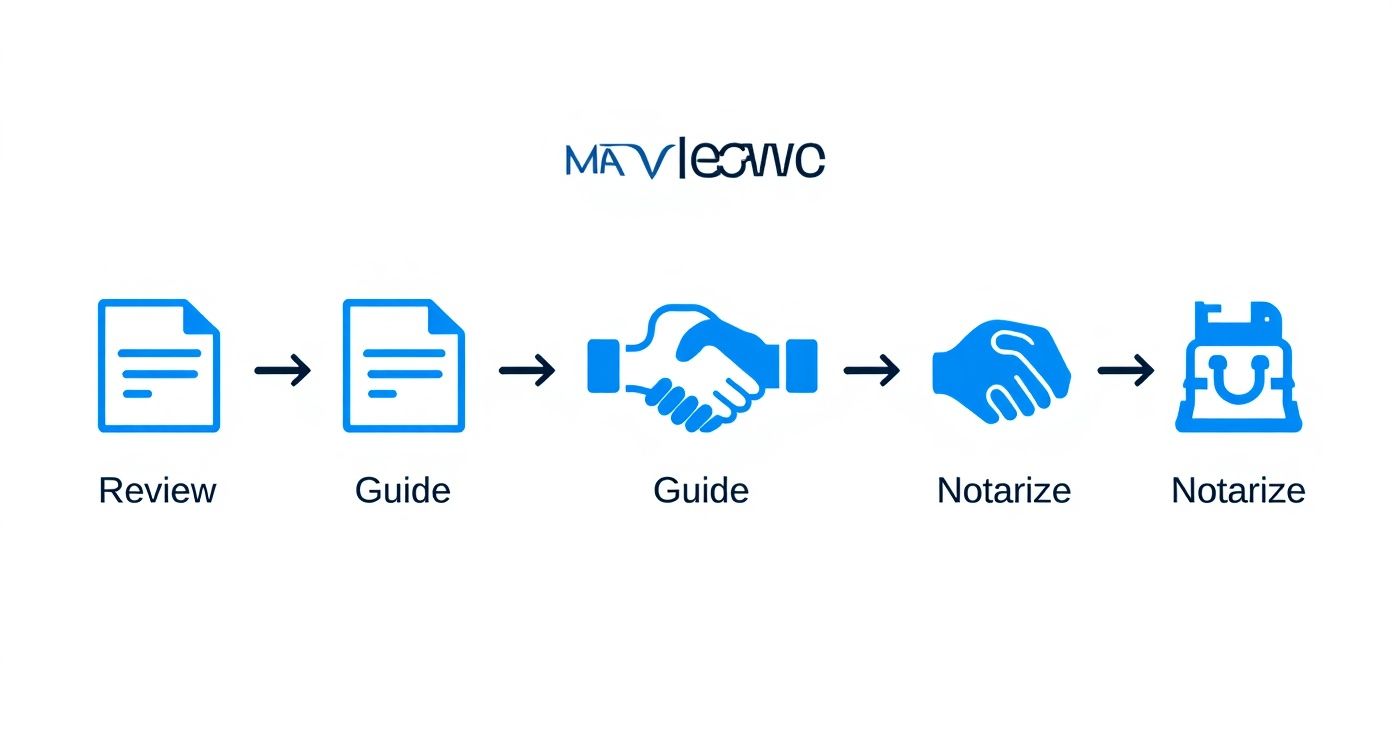
This visual breaks down how each step builds on the last, creating a smooth, error-free closing for everyone involved.
Post-Signing Duties
The work isn’t done just because the last signature is on the page. In fact, what happens next is just as important. Before even leaving the appointment, the agent does a final quality check, triple-reviewing the entire stack for any missed signatures or mistakes.
Back in the office, the agent often has to scan the complete signed package and securely upload it for the title company or lender to review. This is what we call a “scanback.” Finally, they package up the original physical documents and rush them to a courier like FedEx or UPS to make the daily cutoff. This final “doc drop” ensures the originals get where they need to go, allowing the loan to fund on time and wrapping up the agent’s part in the transaction.
Your Step-by-Step Path to Certification
Becoming a loan signing agent isn’t something you just jump into; it’s a structured path. You start with the basics, then layer on specialized training and the right business protections. Think of it like building a house—you pour a solid foundation before you ever think about putting up the walls and roof.

Following these steps ensures you’re not just qualified on paper. It makes you a trusted and prepared professional, ready for the high-stakes world of real estate closings. Each requirement is a building block for a career that lasts.
Step 1: Become a Notary Public
First things first: before you can specialize, you have to master the fundamentals. The absolute first step is to become a commissioned Notary Public in your state. This is the bedrock of your entire career as a signing agent.
The process usually involves an application, a state-approved course, an exam, and filing a bond. But every state does it a bit differently. You’ll need to check with your state’s commissioning authority (typically the Secretary of State’s office) to get the exact roadmap. This commission is what gives you the legal power to witness signatures and administer oaths.
Step 2: Get Specialized Training and Certification
Just having a notary commission won’t cut it. The mortgage industry is a different beast, and handling complex loan packages requires a much deeper level of expertise. This is where specialized Loan Signing Agent training is non-negotiable.
This kind of training takes you deep into the anatomy of a loan package. You’ll learn to confidently identify and explain critical documents like the Note, Deed of Trust, and Closing Disclosure—all without crossing the line into giving unauthorized legal advice. A solid certification program gives you the skill to navigate a signing flawlessly, which is exactly what lenders and title companies are paying for.
“A notary commission makes you an official witness. A Loan Signing Agent certification makes you an industry professional. The former is a license to operate; the latter is a signal of competence that secures you work.”
Step 3: Pass a Background Check
In the real estate world, trust is everything. Lenders and title companies are legally on the hook to vet any third-party vendor who handles sensitive borrower information. That means a comprehensive annual background check isn’t just a good idea; it’s mandatory.
This screening is typically done through a third-party vendor that’s approved by the signing services and title companies you want to work with. Think of a clean background check as your passport to getting assignments. It proves you’re a professional who can be trusted.
Step 4: Secure Errors and Omissions Insurance
Let’s be real: even the most careful agent can make a mistake. An error during a loan signing can cause serious financial damage, leading to funding delays or worse, legal trouble. To shield yourself and your business from liability, you absolutely need a strong Errors & Omissions (E&O) insurance policy.
Your notary commission might include a small bond, but that’s there to protect the public, not you. An E&O policy protects you.
- Standard Coverage: Most clients will require you to have at least $25,000 in coverage.
- Industry Best Practice: If you want to be competitive and land jobs with top-tier companies, a policy of $100,000 or more is the way to go.
This insurance isn’t just a safety net. It’s a professional credential that tells clients you’re serious about your responsibilities and prepared for the high stakes involved. With digital closings on the rise, you can see why having adequate protection is more important than ever. You can learn more about the security measures in remote online notary platforms to see how the industry is adapting.
Step 5: Invest in the Right Tools
Finally, your professionalism shows in the tools you bring to the table. Showing up prepared with the right equipment is key to being efficient and making a great impression. Your starter toolkit should include:
- Dual-Tray Laser Printer: This is a must-have for handling the mix of letter and legal-sized paper found in every loan package.
- High-Quality Scanner: You’ll need a fast, reliable scanner to send “scanbacks” (scanned copies of key documents) back to the title company right after the signing.
- Professional Supplies: This means a well-organized briefcase, plenty of blue and black ink pens, your official notary journal (or “record book”), and of course, your notary stamp or seal.
Investing in these tools from day one means you can handle assignments smoothly and meet the high expectations of the companies that hire you.
How Much Do Loan Signing Agents Actually Make?
Let’s get right to it—the money. When you’re looking at becoming a loan signing agent, you have to think differently about income. This isn’t a salaried 9-to-5 job; your earnings are built one signing at a time.
Think of yourself as the owner of a small business. Instead of a predictable paycheck, you get paid a flat fee for every loan closing you successfully handle. It’s an entrepreneurial path that puts you squarely in control of your finances, but it also means your income will rise and fall with the market and your own hustle.
The fee you collect for a single signing isn’t set in stone. It’s a moving target, influenced by a few key variables that determine what you can charge and, ultimately, what you pocket.
What Shapes Your Per-Signing Fee?
Your earning potential is a dynamic mix of where you work, who you work for, and the nature of the job itself. A signing agent navigating the traffic of a major city is going to have a completely different fee structure than one serving a quiet, rural community.
Here are the main things that will move the needle on your fee for each appointment:
- Geographic Location: Big cities with a higher cost of living and a non-stop real estate market naturally command higher signing fees.
- Loan Package Complexity: A straightforward refi package is one thing; a sprawling commercial loan or a reverse mortgage is another beast entirely. More pages, more signatures, and more notarizations mean a higher fee. It’s that simple.
- Client Type: Working directly with title companies and lenders is where the bigger money is, since you’re keeping 100% of the fee. Signing services are great for volume, but they act as the middleman and take a cut for finding you the work.
- Last-Minute Requests: Got a call for a same-day signing that needs to happen ASAP? That urgency comes with a premium.
Getting a handle on these factors helps you set realistic goals and smartly pursue the jobs that will best build your bottom line.
The sweet spot for a successful business is often a blend of both worlds: the consistent, high-volume work from signing services and the higher-paying, relationship-driven assignments from direct clients.
Realistic Income Expectations
While you might hear stories of six-figure incomes, it’s vital to anchor your expectations in today’s market. The loan signing world has always ridden the waves of the real estate and mortgage industries. A few years ago, when demand was through the roof and competition was lower, some agents absolutely cleared $100,000 annually. Things have gotten a bit more crowded since then.
These days, most signing agents in the U.S. bring in between $27,874 and $56,677 a year. Top earners in high-demand cities can push that average closer to $62,968, with typical per-signing fees falling in the $75 to $200 range. Agents who get creative and diversify their services can see their gross annual income hit the $50,000–$75,000 range, but remember, that’s before you subtract your business expenses. You can get a real feel for how the loan signing market has evolved by reading discussions on NotaryCafe.
The Impact of the Mortgage Market
Your phone rings when the mortgage industry is humming, and that hum is almost entirely dictated by interest rates. This direct link means the demand for your services will always be cyclical.
Here’s how that plays out in the real world:
- Low-Interest Rates: When rates drop, the refinance market explodes. Homeowners line up to lock in better deals, creating a massive wave of work for signing agents. These are the feast times.
- High-Interest Rates: When rates climb, the refi frenzy cools down fast. The work doesn’t disappear, though—home purchases still happen. This provides a steadier, though smaller, stream of assignments.
Veteran signing agents know how to navigate these cycles. During the boom times, they’re saving, investing in better equipment, and banking profits. When things slow down, they pivot to marketing, nurturing those direct relationships with title companies, and maybe even adding a new skill to their toolkit. That’s how you build a business that can thrive no matter which way the market winds are blowing.
How to Stay Ahead in a Changing Industry
The world of real estate closings doesn’t stand still, and neither can a successful loan signing agent. If you want to build a career with real staying power, you have to be more than just good at your job—you have to keep an eye on what’s coming next. The ground is shifting beneath our feet, thanks to some major trends in tech and demographics that are changing how deals get done.
https://www.youtube.com/embed/ryuOlRRm_rc
The key is to see these changes as opportunities, not threats. Agents who learn to master new digital tools and serve a more diverse group of clients are the ones who will not just survive, but thrive. Think of your business less as a fixed service and more as a living practice that adapts and grows with the market.
The Rise of Remote Online Notarization
The single biggest game-changer for today’s loan signing agent is the shift to digital closings, led by Remote Online Notarization (RON).
Picture RON as taking the classic, in-person signing and moving it into a secure, virtual conference room. Instead of spending hours driving to a client’s home, you meet them face-to-face over a live video call on a specialized, secure platform. It’s a fundamental change to the old way of doing things.
With RON, your client base is no longer limited by how far you’re willing to drive. You can now serve clients anywhere in the world who need U.S. documents notarized. This technology also brings an incredible new layer of security through advanced ID verification and a digital, tamper-evident seal.
RON is more than just a new tool; it’s a turning point for our industry. Getting skilled in RON isn’t just about adding another service—it’s about future-proofing your business and making it clear you’re a professional who’s ready for what’s next.
Jumping into RON means more than just learning some new software. You’ll need to get up to speed on your state’s specific laws for online notarization, as every state has its own rulebook. But the time you invest in training and technology opens up a whole new, incredibly efficient way to make money.
Responding to Market and Demographic Shifts
Technology isn’t the only thing shaking things up. The clients themselves are changing, which creates fresh demand and new openings for savvy agents.
The move to digital is undeniable, with online notarization projected to grow at a staggering 18.4% compound annual growth rate through 2033. At the same time, the Mortgage Bankers Association (MBA) expects that nearly half of all new U.S. households will soon come from Hispanic and Asian communities. This demographic wave makes bilingual agents more valuable than ever. You can dig deeper into these industry trends shaping the notary profession on Texas Notary Guide.
To stay on top of your game, you need to:
- Never Stop Learning: Keep your skills sharp, especially when it comes to new digital platforms and ever-changing state laws.
- Serve Diverse Communities: If you’re bilingual, make sure everyone knows it. This is a huge competitive edge in many parts of the country.
- Stay Flexible: Be ready to adjust your business strategy when things like interest rate swings change the flow of assignments.
By leaning into these trends, you stop being just another service provider and become a resilient business owner who’s built for the long haul.
Building and Scaling Your Signing Business

Alright, you’ve got your certification and your toolkit is ready to go. Now, the real fun begins. It’s time to shift your mindset from simply being a notary to becoming a business owner. The name of the game is building a steady pipeline of signing assignments and turning this new venture into a reliable stream of income.
So, how do you do that? By actively finding clients. When you’re just starting out as a loan signing agent, work generally flows from two main channels: signing services or direct relationships with title companies and lenders. Getting a handle on the pros and cons of each is crucial for building a business that lasts.
Signing Services vs. Direct Work
Think of signing services as the volume players in this industry. They’re third-party companies that title companies and lenders hire to find and schedule agents for closings—similar to how staffing agencies handle talent placement in other industries, connecting professionals with companies that need their services.
Then there’s direct work. This is all about forging personal connections with the folks who make the decisions—escrow officers, mortgage brokers, and real estate agents. These gigs almost always pay better because you’re cutting out the middleman and keeping the entire fee. But, as you can imagine, landing these jobs takes a lot more hustle in the networking and marketing department.
A smart growth strategy usually blends both. Use signing services to keep your calendar full and your skills sharp, while you’re simultaneously networking to land those higher-paying direct clients that will be the bedrock of your business long-term.
The key is to adopt a business mindset from day one. When you’re the new kid on the block, prioritize experience over immediate profit. Taking on those lower-fee jobs or driving a little further—the ones veteran agents might pass on—is your chance to prove you’re reliable and build a flawless reputation.
Actionable Steps to Find Work
Getting those first few assignments requires you to be proactive. You can’t just sit back and wait for the phone to ring; you have to put yourself out there and get in front of the people doing the hiring.
Here’s a straightforward game plan to get you started:
- Register Everywhere: Make sure you’re listed on all the major signing agent databases. I’m talking about places like SigningAgent.com, SnapDocs, and Notary Cafe. Signing services live on these platforms to find available agents every single day.
- Sign Up Directly: Don’t just stop at the big databases. Do your homework and register directly with as many individual signing services as you can find. The more lists you’re on, the more opportunities will come your way.
- Make a Personal Connection: After you register somewhere, give them a follow-up call. A quick, professional introduction can be the thing that moves your name from just another line on a spreadsheet to the top of their call list.
Building Your Reputation and Online Presence
Your long-term success really boils down to your professional reputation. Every single signing is an opportunity to show you’re competent and dependable, which is what leads to repeat business and priceless referrals.
To truly stand out and attract a steady flow of work, you need to get a handle on your digital footprint. Learning some key strategies for building a strong online presence can make a huge difference and set you apart from the competition. A polished website, a current LinkedIn profile, and a collection of positive online reviews all tell potential clients you’re a serious professional.
Consider adding a professional QR code to your business cards that potential clients can scan a QR code to instantly access your website, online reviews, and booking information—making it effortless for title companies and lenders to connect with you on the spot.
If you’re wondering how to set your rates and what clients might expect to pay, we have a detailed guide on what a mobile notary costs that can help.
Your Top Questions Answered
Jumping into the world of a loan signing agent always brings up a few practical questions. Let’s dig into the most common ones I hear from aspiring agents and get you the straightforward answers you need to start with confidence.
How Much Does It Really Cost to Get Started?
Plan on an initial investment somewhere between $500 and $2,000 to get your loan signing business off the ground. Think of this not as a single fee, but as your startup toolkit.
This budget covers a few essentials you just can’t skip:
- State Notary Commission: This is your foundational cost—the official license to operate as a notary.
- Specialized Training: A high-quality loan signing agent course and certification is a must. This isn’t the place to cut corners.
- Background Check: Nearly every hiring company will require this mandatory screening. It’s standard procedure.
- E&O Insurance: You’ll need a solid Errors & Omissions policy. The industry standard is a $100,000 policy, so aim for that.
- Essential Tools: A dual-tray laser printer and a reliable scanner are non-negotiable. You’ll be handling professional loan packages, and these tools are the workhorses of the business.
Investing in quality gear and training from day one tells the world you’re a professional and sets you up for success from your very first signing.
Can I Realistically Do This Full-Time?
Absolutely. Plenty of people have built successful, full-time careers as loan signing agents. But let’s be real—whether it’s a viable full-time gig for you comes down to a few things that are totally in your control.
Your success really hinges on local market demand, how much effort you put into networking, and your ability to build a rock-solid reputation for getting the job done flawlessly, every single time. A lot of agents start this as a side hustle, then ramp up to a full-time business as they build a steady client list. It’s one of those careers where your hustle directly impacts your income.
The biggest hurdle for new agents is often breaking into the market and securing that first steady stream of assignments. It’s a competitive field, and getting on the preferred vendor lists for busy title companies takes persistence.
What Is the Biggest Hurdle for New Agents?
Honestly, the toughest part is pushing through that initial quiet period. When you’re the new kid on the block, you haven’t yet built the trust and reputation that bring in consistent work. It’s a test of patience and persistence.
The key is to market yourself relentlessly, treat every single signing like it’s the most important one you’ll ever do, and deliver incredible customer service. Focus on racking up experience, even if that means taking the lower-fee or last-minute jobs that seasoned agents might pass on. This is how you build the professional track record that ultimately opens the door to bigger and better opportunities.
Ready to manage your signings and explore the future of notarization? With BlueNotary, you can connect with clients on-demand through a secure RON platform, streamline your workflow, and grow your business. Discover how BlueNotary can support your career as a loan signing agent.