



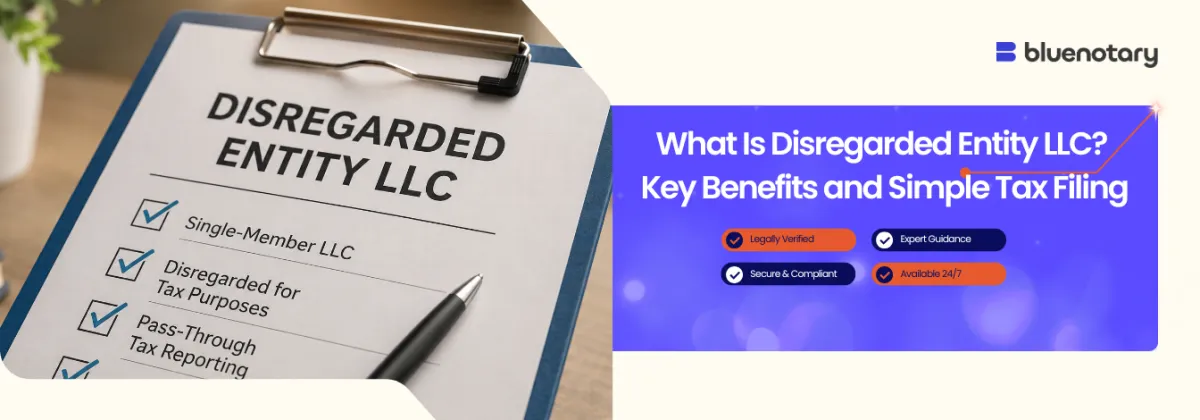

Quick answer: A disregarded entity LLC is a single-member LLC that the IRS does not treat as separate from its owner for federal income tax purposes. The owner reports the business income on their own tax return, while the LLC still keeps its legal liability protection.
Starting a business raises a lot of questions about taxes and legal structure. One of the first things many new owners ask is: what is a disregarded entity LLC? Simply put, it is a single-member LLC that the IRS treats as inseparable from its owner for income tax purposes. In practice, that means simpler tax filing without giving up the legal protection an LLC provides. Understanding this status from day one helps you make smarter, more informed decisions for your business.
What Is a Disregarded Entity LLC?
A disregarded entity LLC is a single-member LLC that the IRS does not recognize as a separate taxable entity. So for federal income tax purposes, the IRS treats the business and the owner as one. That does not mean the LLC disappears legally. Instead, it means income and expenses flow directly to the owner’s personal tax return.
The term comes from IRS regulations that classify certain businesses as not separate from their owners for tax purposes. According to the IRS single-member LLC guide, a single-member LLC is automatically a disregarded entity. You need no additional filing to receive this status. However, you can change it by filing Form 8832 to elect a different classification.
How the IRS Classifies It
The IRS uses a default classification system for all LLCs. When you form a single-member LLC, the IRS automatically treats it as a disregarded entity. You do not need to request this status. However, you can change it by filing the correct election form.
Classification options for an LLC:
- Disregarded entity (default for single-member LLCs): Income passes through to the owner’s personal return. No separate business tax return is required.
- Partnership (default for multi-member LLCs): Income passes through to each member based on ownership share. Requires Form 1065.
- C corporation: The LLC files a separate corporate tax return. Requires Form 8832 to elect this status.
- S corporation: Income passes through to owners, but the LLC must also file Form 1120-S and pay owner-employees a reasonable salary.
To switch from the default classification, file Form 8832 with the IRS. Once elected, the classification stays in effect for 60 months unless the IRS approves an earlier change.
Key Benefits of a Disregarded Entity LLC
Understanding what is a disregarded entity LLC also means understanding why so many single-member owners choose this structure. The advantages are real and practical for most small business owners.
Benefits include:
- Simplified tax filing: You report all business income and expenses on Schedule C of your personal Form 1040. Additionally, you avoid filing a separate business return, which saves both time and money.
- Pass-through taxation: The IRS taxes profits only at the individual level. So there is no double taxation as there would be with a C corporation.
- Liability protection: Even though the IRS disregards the LLC for tax purposes, state law still treats it as a separate entity. That means your personal assets stay protected from business debts and lawsuits.
- No corporate formalities: Unlike corporations, a disregarded entity LLC does not require a board of directors or annual shareholder meetings. That significantly reduces administrative burden.
- Lower compliance costs: Fewer reporting requirements mean you spend less time on paperwork and more time running your business.
How to File Taxes as a Disregarded Entity LLC
Tax filing as a disregarded entity LLC is straightforward. According to IRS guidance for single-member LLCs, you report all business activity on your personal tax return.
Here is what you report and where:
- Schedule C (Form 1040): Report business income and deductible expenses from a trade or business.
- Schedule E (Form 1040): Report supplemental income such as rental income from property the LLC holds.
- Schedule F (Form 1040): Report income if your LLC operates in farming or agriculture.
- Schedule SE (Form 1040): Calculate and pay self-employment tax on your net profit. The 2025 self-employment tax rate is 15.3% on the first $176,100 of net income.
Importantly, you still owe self-employment taxes as a disregarded entity LLC. That covers both Social Security and Medicare contributions. For payroll and excise taxes, however, the IRS treats the LLC as a separate entity. So if you hire employees, you must use the LLC’s own EIN for all payroll filings.
Does a Disregarded Entity LLC Need an EIN?
This is one of the most common questions about what is a disregarded entity LLC. The answer depends on your specific situation.
You do not need an EIN if:
- The LLC has no employees
- The LLC has no excise tax liability
- You use your Social Security number for all tax filings
You do need an EIN if:
- The LLC hires even one employee
- The LLC owes excise taxes
- A bank requires one to open a business checking account
Applying for an EIN is free and takes only minutes on the IRS website. Most business owners get one regardless, since banks typically require it to open a dedicated business account. Additionally, Wolters Kluwer’s disregarded entity guide recommends getting an EIN early to clearly separate personal and business finances.
When to Change Your LLC Disregarded Entity Status
Knowing what is a disregarded entity LLC also means knowing when this structure no longer fits your situation. As income grows, electing a different tax status can reduce your total tax burden meaningfully.
Consider changing your status if:
- Net profit consistently exceeds $75,000 per year. At that level, S corporation status can reduce self-employment taxes. Specifically, only your reasonable salary triggers payroll taxes. Remaining profits paid as dividends do not.
- You want to add a second member. Adding another owner automatically converts the LLC from a disregarded entity to a partnership for federal tax purposes.
- You want outside investors. C corporation status is often required by venture capital firms and angel investors.
- Your state taxes disregarded entities differently. Some states do not follow the federal disregarded entity treatment, so always check local rules.
To elect S corporation status, file Form 2553 with the IRS. You must generally file within 75 days of the start of the tax year for which it applies.
LLC Documents That May Need Notarization
Forming and operating a disregarded entity LLC often involves documents that require notarization. Operating agreements, real estate leases, commercial loan agreements, and certain state filings commonly fall into this category.
Notarizing these documents confirms the identity of all signers and adds legal weight to important agreements. Our guide to what documents require notarization covers the most common business documents that need a notary’s seal. For LLC owners who want speed and convenience, remote online notarization lets you complete the process entirely via a secure video session. Our remote online notarization guide explains how it works step by step. We also offer a full range of LLC formation and compliance services to help new owners start correctly.
Conclusion
Understanding what is a disregarded entity LLC gives you a clear picture of how the IRS treats your single-member business. As the default status, it offers pass-through taxation, simplified filing, and legal liability protection all in one structure. Over time, you can always elect a different tax classification using Form 8832 or Form 2553 if your business needs change. When your LLC documents need notarization quickly and legally, we are ready to help at BlueNotary.
Frequently Asked Questions
What is a disregarded entity LLC exactly?
A disregarded entity LLC is a single-member LLC that the IRS treats as inseparable from its owner for income tax purposes. The business does not file a separate federal tax return. Instead, all income and expenses appear on the owner’s personal Form 1040. However, state law still recognizes the LLC as a separate legal entity, so liability protection remains fully intact.
What is a LLC disregarded entity versus a sole proprietorship?
A sole proprietorship and a disregarded entity LLC are taxed the same way at the federal level. Both report income on Schedule C of Form 1040 and pay self-employment taxes on net profit. However, the key difference is legal protection. A disregarded entity separates your personal assets from business liabilities under state law. A sole proprietorship offers no such separation.
How does a disregarded entity LLC file taxes?
A disregarded entity does not file a separate federal income tax return. Instead, the owner reports all business income and expenses on their personal Form 1040, typically on Schedule C. Self-employment taxes apply and are calculated on Schedule SE. For payroll and excise taxes, however, the LLC must file separately using its own EIN and name.
Does a disregarded entity LLC need an EIN?
Not always. If the LLC has no employees and no excise tax liability, the owner can use their Social Security number for income tax filings. However, most business owners obtain an EIN anyway. Banks typically require one to open a business checking account, and having it helps keep personal and business finances clearly separated from the start.
What is LLC disregarded entity status and how do I change it?
LLC disregarded entity status is the IRS’s automatic default classification for single-member LLCs. To change it, file Form 8832 to elect C corporation treatment, or file Form 2553 to elect S corporation treatment. The election generally takes effect at the start of the tax year. Once elected, you cannot change again for 60 months without IRS approval.
Can a disregarded entity LLC have employees?
Yes. A disregarded entity can hire employees at any time. However, once it does, the IRS treats it as a separate entity for all payroll tax purposes. The LLC must use its own name and EIN for all payroll filings and employment tax payments. Income taxes still pass through to the owner’s personal return as usual.
Does a disregarded entity LLC protect my personal assets?
Yes. The “disregarded” label applies only for federal income tax purposes, not for legal liability. Under state law, the LLC remains a distinct entity. As a result, creditors generally cannot pursue the owner’s personal assets to satisfy business debts, as long as the owner maintains proper separation between personal and business finances.
What documents does an LLC need notarized?
Common LLC documents that may require notarization include the operating agreement, real estate leases, commercial loan agreements, and certain state registration filings. Notarization confirms the identity of signers and adds legal validity to these important business agreements. Our guide to how to notarize a document walks through the full process from start to finish.