



So, are electronic signatures for legal documents actually valid?
The short answer is a resounding yes. But the story of how a click on a screen gained the same legal muscle as a pen-and-ink signature is what really matters for anyone doing business today. This guide will pull back the curtain on how digital agreements became ironclad.
How E-Signatures Became Legally Binding

It helps to think of an electronic signature as a supercharged, digital handshake. While a traditional handshake seals a deal in person, a digital one is backed by layers of evidence that make it far more secure and traceable. This isn't just about speed; it's about building a solid, court-admissible record proving an agreement happened.
Of course, this trust wasn't built overnight. It took a powerful combination of technological leaps and landmark legislation. The real game-changer was the U.S. Electronic Signatures in Global and National Commerce Act (ESIGN Act) in 2000, which gave e-signatures the federal stamp of approval.
Since then, adoption has exploded. Today, it’s estimated that between 60% and 80% of organizations have woven e-signatures into their daily operations. You can find more on this trend and its expected adoption in 2025 on textcontrol.com.
The Pillars of a Valid E-Signature
For an electronic signature to hold up in court, it has to be more than just a name typed on a screen. It must meet a few core requirements that build a foundation of trust and prevent someone from later denying they signed—a concept known as non-repudiation.
These pillars are what separate a casual email sign-off from a binding legal signature.
To ensure an e-signature is legally sound, it must contain several key components. This framework is what gives digital agreements their strength and reliability in the eyes of the law.
Core Components of a Legally Binding Electronic Signature
| Component | Description | Why It Matters for Legal Documents |
|---|---|---|
| Intent to Sign | The signer must clearly show they mean to sign the document, often by clicking an "I Agree" button or drawing their signature. | This proves the signature wasn't accidental. It's the digital equivalent of putting pen to paper with purpose. |
| Consent to Do Business Electronically | All parties must agree upfront to use electronic formats for the transaction instead of paper. | This ensures everyone is on the same page and willingly participates in a digital process, preventing future disputes. |
| A Verifiable Audit Trail | A secure, unchangeable log must capture the entire signing process: who signed, when, their location (IP address), and every action taken. | This digital paper trail provides undeniable evidence, making it far stronger than a wet signature that can be forged or disputed. |
This comprehensive audit trail is what gives an electronic signature for legal documents its true power. It's a built-in history log that settles "he said, she said" arguments before they even start.
A secure electronic signature is not just a replacement for ink; it's an upgrade. It provides a level of security, verification, and detailed record-keeping that paper documents simply cannot match.
This legal framework is the bedrock of modern commerce, allowing industries from real estate to law to execute critical agreements with confidence. And as we'll see, this technology gets even more secure with services like remote online notary, which adds another layer of identity verification. Understanding these fundamentals is the first step to bringing secure, efficient digital solutions into your own workflow.
Giving Your Digital Handshake Legal Muscle
When you sign a document on a screen, you're doing more than just putting your name on a file. You're engaging in a legally sound process, backed by a solid framework of laws built for our digital world. Think of these laws as the universal rulebook that gives your digital handshake the exact same weight as a traditional, pen-on-paper one.
These regulations make it crystal clear: an electronic signature for legal documents can't be tossed out in court just because it's not made with ink. For anyone doing business or handling personal affairs in the United States, two major laws are the bedrock of this whole system.
ESIGN and UETA: The Rules of the Road
The legal power behind e-signatures comes from two landmark acts:
The ESIGN Act: Short for the Electronic Signatures in Global and National Commerce Act, this federal law was passed way back in 2000. It established on a national level that electronic signatures are just as legally valid as handwritten ones for pretty much all interstate and international business.
UETA: The Uniform Electronic Transactions Act is a state-level counterpart adopted by 49 states (plus D.C. and some U.S. territories). It aligns state laws with the federal ESIGN Act, creating a consistent and reliable legal environment for digital transactions within those states.
Working together, ESIGN and UETA form a powerful one-two punch. This isn't just a U.S. thing, either. Similar laws are in place all over the globe, from the European Union's eIDAS regulation to rules in the United Kingdom. If you're curious about the global scene, you can explore the legal standing of e-signatures worldwide.
It's not enough for these laws to just say e-signatures are valid. They lay out a specific set of criteria that must be met to make sure an agreement is enforceable. This structure is what gives everyone confidence in the process.
To turn a simple click into a legally binding act, the process has to check three essential boxes.
The Three Pillars of Legal Validity
For an electronic signature to stand up in court, it needs to satisfy three core requirements laid out by laws like ESIGN and UETA. These pillars guarantee the entire process is intentional, transparent, and can be proven later.
You Have to Mean It (Intent to Sign): The person signing must show they clearly intend to sign the document. This usually means taking a specific action, like clicking a button that says "I Agree" or "Accept," or physically drawing their signature with a mouse or finger. The system has to be set up so there's no question about their deliberate choice to sign.
Everyone Has to Be Onboard (Consent to Do Business Electronically): You can't force someone into a digital process. All parties have to agree to use electronic records and signatures instead of paper. This is typically handled upfront, often with a checkbox or notice where the user agrees to the platform's terms before they even see the document.
There Must Be a Paper Trail (A Permanent, Accessible Record): After signing, the final document has to be stored securely and be available to everyone involved. Every signer needs the ability to view, save, or print their own copy. This permanent record, along with a detailed audit trail tracking every step, is the ultimate proof of what was agreed to and when.
When these three conditions are met, an electronic signature for legal documents goes from being a handy shortcut to a powerful, legally enforceable tool—often with more security and a clearer history than its paper predecessor.
Choosing the Right Type of Digital Signature
Not all digital signing methods are created equal, and when you're dealing with an electronic signature for legal documents, the distinctions matter—a lot. Picking the wrong one can be the difference between a rock-solid, enforceable agreement and one that’s just asking for a legal challenge down the road.
Think of it in tiers. A simple electronic signature is the most basic version, almost like pasting a digital image of your signature onto a document. It signals your intent to sign but comes with minimal security.
Step it up a notch and you get a digital signature. This is like taking that same signature and sealing it inside a tamper-proof digital envelope, secured with powerful cryptography. It's a serious security upgrade that locks the document down tight.
At the very top, you have Remote Online Notarization (RON). This is the equivalent of having a licensed notary public watch you seal that cryptographic envelope, all through a secure, live video call. For your most critical documents, this method provides the highest possible level of identity verification and legal muscle.
Unpacking the Three Main Tiers
Each signature type is a tool built for a different job, striking a unique balance between speed and security. Simple Electronic Signatures (SES) are perfect for low-risk, everyday agreements where you just need to get things done quickly. Digital signatures, often called Advanced Electronic Signatures (AES), bring the robust security needed for important business contracts.
RON, however, is the undisputed heavyweight champion. It’s built for documents that traditionally demanded a face-to-face meeting with a notary and a wet-ink signature, like real estate deeds, wills, and powers of attorney.
The infographic below breaks down the legal pillars that make any electronic signature valid. As you move up the tiers from a simple e-signature to RON, these pillars get reinforced with stronger and stronger layers of security and verification.
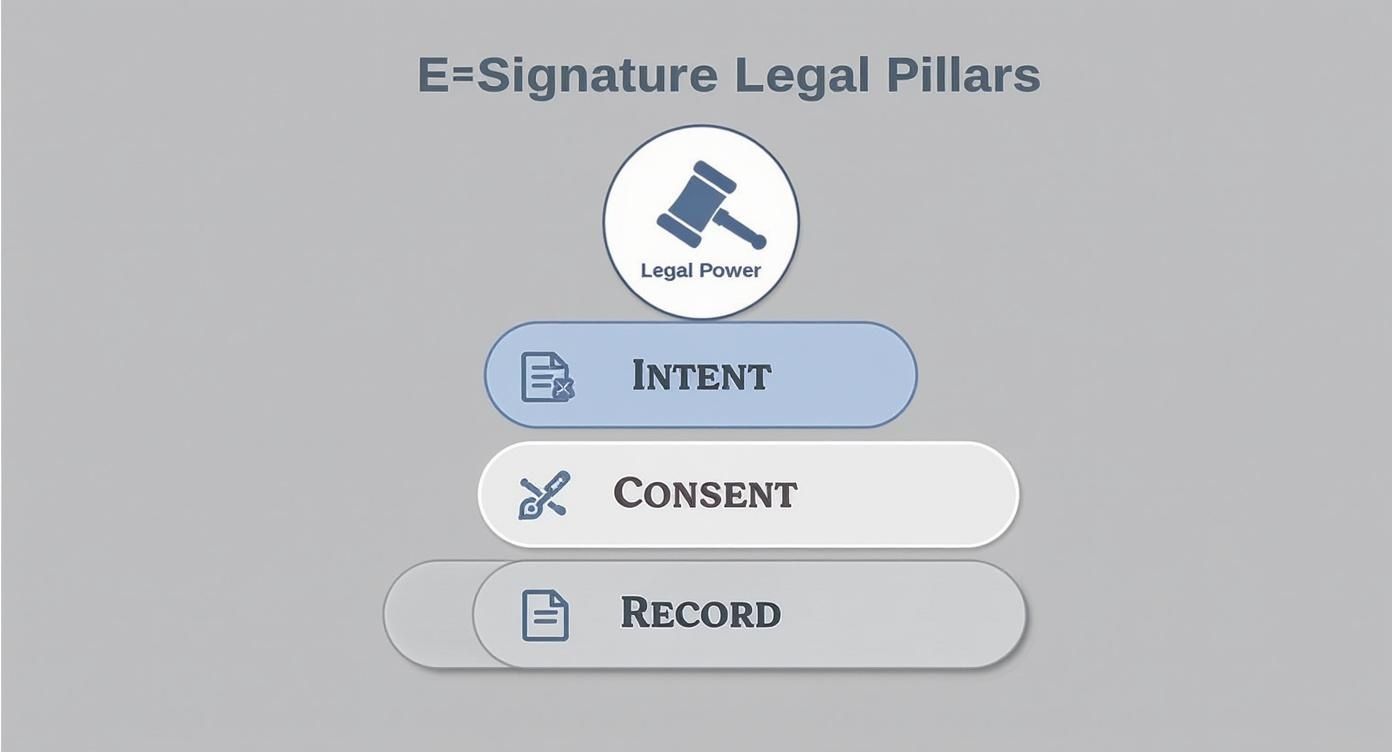
As you can see, every legally binding signature needs to show intent, consent, and a clear record. The more advanced methods simply make that proof indisputable.
A Head-to-Head Comparison
To help you match the right tool to the task, let’s put these three methods side-by-side. After all, a simple permission slip for a school trip doesn't need the same ironclad security as a multi-million dollar merger agreement.
Comparing Electronic Signature, Digital Signature, and RON
| Feature | Electronic Signature (SES) | Digital Signature (AES/QES) | Remote Online Notarization (RON) |
|---|---|---|---|
| Security Level | Basic; relies on email verification | High; uses encryption and digital certificates | Highest; includes notary verification and tamper-evident seals |
| Identity Verification | Minimal (e.g., email link) | Stronger (e.g., login, multi-factor) | Rigorous (ID analysis, KBA, live video with notary) |
| Best Use Cases | Internal approvals, consent forms, simple service agreements | Business contracts, NDAs, high-value sales agreements | Real estate closings, wills, trusts, legal affidavits, powers of attorney |
| Legal Standing | Legally binding for many uses, but easier to dispute | Strong legal standing, with a clear audit trail | Equivalent to a traditional in-person notarization |
The key takeaways from the table are all about identity and integrity. The real difference between these methods comes down to how rigorously a signer's identity is confirmed and how well the document is shielded from tampering after it's been signed. Both Digital Signatures and RON build on the foundation of a simple e-signature, adding those crucial layers of trust and security.
The core principle is straightforward: the higher the risk associated with a document, the more robust your signing method should be. Mismatching the signature type to the document can expose you to unnecessary legal and financial risks.
Platforms like BlueNotary are designed to provide this flexibility, offering a spectrum of solutions so you can always select the right tool for the job. You can learn more about how to create a secure electronic signature that fits your specific needs. Ultimately, choosing the right type of signature isn’t just a technical choice—it’s a strategic decision that protects the integrity and enforceability of your most important agreements.
What Makes an Electronic Signature Secure
It's a fair question. When you're dealing with an electronic signature for legal documents, two things probably come to mind: How can you really prove who signed it? And how do you know the document wasn't tweaked after the fact?
The answer isn't a single magic bullet but a fortress of security built from multiple layers of technology. In many ways, these digital safeguards make an e-signature far more verifiable than its old-school, pen-and-paper cousin.
After all, a "wet" signature relies on handwriting analysis—a process that can be subjective and slow. A secure electronic signature, on the other hand, builds its case with cold, hard data. That digital evidence is what makes it not just convenient, but solid enough to stand up in court.
The cornerstone of this security is the audit trail, a digital log that records every single touchpoint of a document's journey. Think of it as a dedicated detective, noting every interaction from the moment a document is sent to its final completion.
The Power of the Audit Trail
This audit trail, sometimes called a certificate of completion, is the undeniable proof that makes an e-signature legally defensible. It's a tamper-proof record that captures all the crucial metadata, giving you a complete, unassailable history of the signing event.
So, what does this digital detective actually log?
- Signer Information: The names and email addresses of everyone involved.
- Timestamps: A precise record of every action—when the document was viewed, when it was signed, and when the process was finalized.
- IP Addresses: The unique internet address of the device each person used, providing geographic context for their signature.
- Document History: A full rundown of events, from document creation and delivery notifications to the final sealed version.
This detailed log eliminates any "he said, she said" arguments. It turns a simple signature into a fully documented and verifiable event, providing strong, impartial evidence if its validity is ever challenged.
Confirming Identity Beyond Doubt
Of course, an audit trail is only as good as the identity of the person signing. That’s where robust identity verification steps in. Secure platforms don't just take someone's word for it; they use a multi-layered approach to confirm you are who you say you are.
These methods go way beyond a simple email confirmation.
- Two-Factor Authentication (2FA): You've seen this before. A one-time code is sent to the signer's phone, meaning a fraudster would need access to both their email and their mobile device.
- Knowledge-Based Authentication (KBA): The signer is asked to answer specific, out-of-wallet questions based on their personal credit and public records history.
- ID Verification: This requires the signer to upload a photo of their government-issued ID, which is then analyzed by software to confirm its authenticity.
- Biometric Authentication: This uses unique physical traits, like a fingerprint or facial scan, for verification. If you're curious how this works in practice, exploring how biometrics bolsters the online notary public process shows just how powerful the technology has become.
Platforms like BlueNotary build these advanced identity checks right into the signing process, ensuring every signature is backed by solid proof of who signed it. The best part is that this security doesn't have to be clunky for the user; the best systems handle these complex verifications seamlessly behind the scenes.
The final piece of the security puzzle is encryption. Once signed, the document is sealed with a cryptographic "fingerprint." If anyone tries to alter the document—even by changing a single comma—that seal breaks, making it immediately obvious that the document has been tampered with. This tamper-evident seal is your guarantee that the final document is exactly what everyone agreed to sign.
How Industries Use E-Signatures Every Day
The real power of an electronic signature for legal documents snaps into focus when you see it in action. Moving past the technical details, you'll find countless industries have woven these digital tools into their daily operations, turning logistical headaches into smooth, efficient workflows. From getting client agreements signed faster to closing deals across continents, the applications are as diverse as they are valuable.
This isn't just a small shift; it's a massive market overhaul. The global e-signature market, valued at over $2.3 billion in 2020, is on track to explode to $13.4 billion by 2030. This incredible growth was kicked into high gear by a 50% jump in business adoption after 2020, signaling a permanent change in how we handle agreements. You can dig deeper into these e-signature market statistics and trends on explodingtopics.com.
Law Firms Accelerating Client Onboarding
For any law firm, time is money. The old way of onboarding a new client—printing, mailing, waiting for a signature, and then waiting for the return mail—could stretch on for days. It creates frustrating delays before the real legal work can even begin.
An electronic signature for legal documents completely rewrites that script. A firm can now email an engagement letter, and the client can review and sign it securely within minutes from their phone or computer. This doesn't just get cases started faster; it also creates a perfect digital paper trail, complete with a full audit log of every action taken.
Real Estate Closing Deals Across Borders
Picture this: a real estate agent in Miami has a buyer who is currently stationed in Tokyo. Years ago, this scenario was a nightmare of international couriers, consulate visits, and stressful time-zone gymnastics that put the entire deal on the line.
Today, real estate pros use e-signatures to manage the bulk of this paperwork from anywhere. Purchase agreements, disclosure forms, and inspection reports get signed digitally, making geography irrelevant. For the most critical closing documents needing a notary's seal, platforms like BlueNotary step in with Remote Online Notarization (RON). The buyer in Tokyo can simply join a secure video call with a U.S. notary to finalize the transaction legally.
The bottom line is simple: distance is no longer a dealbreaker. E-signatures and RON give agents and title companies the power to serve a global client base with the same speed and security they'd offer someone next door.
Lenders Approving Loans in Hours Not Days
The lending world runs on speed and precision. A slow loan approval process can easily mean losing a customer to a faster competitor. The manual grind of collecting signatures on applications, terms of service, and promissory notes has always been a major bottleneck.
With secure electronic signatures, lenders can now:
- Automate Document Workflows: Applications fly back and forth automatically, cutting out the need for manual follow-ups.
- Strengthen Security: Powerful identity verification tools confirm the borrower is who they say they are, drastically reducing fraud.
- Simplify Compliance: Every signed document is automatically bundled with a detailed audit log, making it a breeze to prove compliance with financial regulations.
This digital overhaul helps lenders shrink the time from application to approval from days to mere hours, creating a much better experience for the customer.
Beyond these common uses, some fields, like healthcare, have their own strict rules to follow. For example, understanding the details of HIPAA-compliant document handling in healthcare shows just how serious security and legal standards can get. These examples make it clear that going digital isn't just about convenience—it’s a smart move that pays off with real gains in efficiency, security, and client happiness.
Putting E-Signatures to Work for You
https://www.youtube.com/embed/dwgq52dlbvc
Making the move to an electronic workflow is a huge step, but it all starts with a simple question: Where do you even begin? The best way to jump in is to look at the documents that cause the most friction in your day-to-day operations. Pinpoint the processes that get bogged down by the old print-sign-scan-mail routine.
Those bottlenecks are your prime candidates for an upgrade. Think about client intake forms, vendor contracts, employee onboarding paperwork, or service agreements. Any document that needs a signature to move forward is a golden opportunity to reclaim your time and slash administrative busywork.
Once you know what needs signing, the next step is choosing the right tool for the job. Not all platforms are created equal, and your specific industry will have its own set of non-negotiable features. One of the most powerful applications of e-signatures is creating and managing automated legal documents, which gives businesses a massive efficiency boost.
Selecting the Right E-Signature Platform
Your choice of provider should be driven by a clear-eyed assessment of your security, compliance, and usability needs. You have to look beyond the basic signing feature and evaluate the whole package to make sure it truly aligns with your business.
Here are the key factors to weigh:
- Industry-Specific Compliance: If you're in a highly regulated field, compliance is everything. For instance, healthcare providers absolutely need HIPAA alignment, while financial institutions have to meet tough data security standards.
- Ease of Use: A platform is useless if your team and clients can't figure it out. Look for an intuitive, clean interface that makes signing a breeze for everyone, no matter how tech-savvy they are (or aren't).
- Security and Verification: Dig into the platform’s security protocols. Does it offer solid identity verification methods, tamper-evident seals, and comprehensive audit trails? These features are what create an electronic signature for legal documents that will actually hold up under scrutiny.
- Integration Capabilities: Think about how the platform will plug into your existing software. A solution with a flexible API, like BlueNotary, lets you embed signing and notarization functions right into your own applications, creating a truly seamless experience.
The goal isn't just to replace ink with pixels. It's to build a more secure, efficient, and user-friendly process that gives you and your clients total confidence in every single agreement.
Ensuring a Smooth Transition
Successfully adopting e-signatures is about more than just picking a platform; you have to get your team ready for the change. Kick things off with clear training on the new workflow. Walk them through how to prepare, send, and manage documents electronically.
Create simple, standardized templates for your most common documents. This doesn't just save time—it also ensures consistency and cuts down on the chances for human error. By taking a thoughtful, planned approach, you can modernize your entire agreement process, trim down administrative tasks, and free up your team to focus on what really moves the needle: serving your clients and growing your business.
Common Questions About E-Signatures
Whenever you bring a new process into the mix for important agreements, it's only natural to have questions. You need to build confidence. Using an electronic signature for legal documents is no different, so let's clear up a few of the most common questions we hear.
Are Electronic Signatures Accepted in Court?
Yes, absolutely. Landmark federal laws like the ESIGN Act and the Uniform Electronic Transactions Act (UETA) give electronic signatures the same legal standing as a wet ink signature. A court can't just toss out a contract simply because it was signed electronically.
The key is proving it's legit. To hold up in court, you have to show who signed it, that they fully intended to sign it, and that the document is exactly the same as it was at the moment of signing. This is precisely why a rock-solid, unchangeable audit trail isn't just a nice-to-have feature—it's essential for keeping your agreements defensible.
Which Legal Documents Cannot Be Signed Electronically?
While you can e-sign the vast majority of business and personal documents these days, a handful of specific categories still often require a traditional pen-and-ink signature. The rules can differ from one state to another, so it's always smart to check your local laws for any specific exceptions.
A few documents that sometimes fall into this category include:
- Wills and testamentary trusts
- Certain family law documents, like adoptions or divorce decrees
- Court orders and other official court-issued notices
- Any document that requires a government seal or stamp
How Is the Signer's Identity Verified?
A secure platform uses multiple layers to confirm a signer's identity beyond a reasonable doubt. The process goes far beyond just clicking a link in an email; it can involve a combination of several robust methods.
Think of it like a digital bouncer checking IDs at the door. The more valuable the event inside, the more rigorous the check. For a high-stakes legal document, you need the most thorough verification available.
These methods can range from two-factor authentication via text message and knowledge-based authentication (KBA)—those "out of wallet" questions about your personal history—to having the signer upload a government-issued ID for analysis. For the highest level of assurance, Remote Online Notarization (RON) brings in a commissioned notary for a live, face-to-face video session to perform these checks in real-time.
Can Someone Change a Document After It's Signed?
No. This is one of the most powerful security features of a true digital signature: it creates a tamper-evident seal. When the document is signed, advanced cryptography generates a unique digital "fingerprint" of the file at that exact moment.
If anyone tries to alter the document—even just changing a single letter or adding a space—that digital fingerprint instantly breaks. This rupture invalidates the signatures and serves as clear, undeniable proof of tampering, protecting everyone involved.
Ready to modernize your agreements with the highest level of security and convenience? With BlueNotary, you can execute legally binding documents online 24/7. Explore our secure eSignature and Remote Online Notarization platform today!