




Good documentation practices (GDP) are the backbone of any trustworthy operation. Think of them as the official storybook for your business—a credible, detailed account that proves exactly what happened, when it happened, and who was involved. It’s the systematic way you create, manage, and store records to ensure they are accurate, reliable, and traceable.
Why Good Documentation Practices Are Your Business Armor

At its heart, GDP is all about building trust. It’s the framework that guarantees every piece of information your organization generates is solid and dependable. Imagine trying to build a house without a blueprint. Sure, you might end up with four walls and a roof, but you’d have no way to prove its safety, quality, or structural integrity.
Good documentation is that blueprint. It provides irrefutable proof of your processes, quality control, and compliance with the rules.
This isn’t just about satisfying auditors or ticking boxes on a checklist. Strong documentation is your secret weapon for:
- Operational Consistency: It makes sure everyone performs tasks the same way, every time. This consistency slashes errors and boosts efficiency across the board.
- Knowledge Transfer: When team members move on or new folks come aboard, good documentation acts as a clear roadmap, getting them up to speed without missing a beat.
- Risk Mitigation: If a dispute ever arises or an audit is called, well-kept records are your first and best line of defense. They’re tangible proof that you’ve done your due diligence and followed the standards.
The Foundation of Trust: ALCOA+
The gold standard for good documentation is a framework known as ALCOA+. These principles are designed to ensure every single record is tough enough to withstand intense scrutiny. Each one is a pillar supporting the integrity of your entire documentation system.
ALCOA+ isn’t just some regulatory checklist; it’s a practical guide for creating records that are inherently trustworthy and defensible. It elevates documentation from a simple administrative chore to a powerful strategic asset.
Getting a handle on these principles is the first real step toward building a documentation strategy that won’t let you down. Whether you’re dealing with handwritten notes or complex digital audit trails, applying ALCOA+ ensures your records tell the complete and accurate story. A fantastic starting point is using effective document templates that bake these principles right into your daily workflows.
Let’s break down what these principles really mean in the real world.
The Core Principles of Good Documentation Practices (ALCOA+)
The ALCOA+ framework is the definitive guide for ensuring your documentation is airtight. Each principle addresses a critical aspect of data integrity, making your records defensible and reliable. Here’s a closer look at each one.
| Principle | What It Means in Practice | Why It’s a Game-Changer |
|---|---|---|
| Attributable | Every entry is signed or initialed and dated, clearly showing who recorded the data and when. | It creates a clear chain of custody, wiping out any confusion about who is responsible for the information. |
| Legible | All information must be readable and permanent. If you have to make a correction, the original entry must still be visible. | Illegible records are worthless. This ensures information can be clearly understood by anyone who needs it, today or years from now. |
| Contemporaneous | Information is recorded the moment an activity happens—not hours or days later. | It guarantees the data reflects what actually happened, preventing memory lapses or after-the-fact revisions from muddying the waters. |
| Original | The record is the very first place the information was captured, not a copy or a transcription from another source. | This protects against transcription errors and preserves the primary source of truth for every action taken. |
| Accurate | The data is correct, truthful, and reflects the observed facts without any errors or unapproved edits. | Accuracy is the absolute bedrock of trust. It ensures that any decisions made based on the data are sound and reliable. |
| Complete | All relevant data is included—any tests run, deviations noted, or repeat actions. Nothing gets left out. | A complete record provides the full context, preventing misunderstandings or misleading conclusions down the line. |
| Consistent | All elements of the documentation, like dates and time stamps, follow a logical and expected sequence. | Consistency proves the workflow was followed in the right order, reinforcing the record’s integrity and credibility. |
| Enduring | Information is recorded on materials built to last, whether it’s non-smudging ink on paper or secure, backed-up digital files. | It ensures your records will be available and readable for their entire required retention period, no matter how long that is. |
| Available | Records can be easily accessed for review, audit, or inspection whenever they’re needed. | Data has zero value if you can’t find it. Availability ensures your records are always ready to serve their purpose. |
By embedding these nine principles into your processes, you’re not just keeping records; you’re building a fortress of credibility around your operations.
Why Documentation Compliance and Security Matter
Let’s move past the idea that good documentation is just about keeping things neat. In reality, these practices are the very foundation of your operational integrity. Think of it as your business’s armor against legal, financial, and reputational blows. When regulators come knocking, your documentation is the first—and most important—piece of evidence they’ll want to see.
Skimping on these standards can bring on some serious pain. We’ve seen businesses hit with crippling fines and suffer lasting brand damage all because of what seemed like minor documentation oversights. In this high-stakes game, compliance and security aren’t just nice-to-haves; they are the absolute pillars of a resilient business.
The Four Pillars of a Defensible Strategy
If you want to build an operation that can stand up to scrutiny, you need to focus on four critical elements. These pillars ensure your documentation isn’t just compliant but also secure and trustworthy, giving you a rock-solid defense in any audit or legal challenge.
- Unchangeable Audit Trails: An audit trail is basically a digital breadcrumb trail. It logs every single action taken on a document—who did what, and when they did it. This creates a transparent history that can’t be fiddled with later, which is exactly what you need to prove accountability.
- Smart Data Retention Policies: It’s not about keeping everything forever. Knowing what to keep and for how long is crucial. A clear retention policy ensures you meet legal requirements without hoarding old data, unwanted spam, or redundant files that could become a liability.
- Unyielding Accuracy: Every record has to be a precise reflection of reality. There’s no room for error. Inaccurate data leads to bad decisions, failed audits, and a total loss of credibility with both regulators and customers.
- Ironclad Security: Your documents are full of sensitive information. Protecting it from unauthorized access, changes, or deletion isn’t negotiable. Robust security measures are essential to safeguard the integrity and confidentiality of your data.
These pillars don’t work in isolation; they support each other to create a system where trust is built-in, not bolted on. When you can prove the history, accuracy, and security of every record, you’re not just checking a box—you’re showing a deep commitment to excellence.
The Real-World Impact of Compliance
In heavily regulated fields like pharmaceuticals, healthcare, and software development, the demand for meticulous documentation goes to another level. For example, good documentation practices (GDP) insist that records be created contemporaneously—at the exact moment an event happens. This ensures maximum accuracy and traceability.
The FDA requires this same level of precision in its Good Manufacturing Practices (GMP), where a single missing or inaccurate record can bring an entire production line to a halt. In fact, studies have shown that poor documentation is a factor in over 50% of regulatory non-compliance cases in pharmaceutical manufacturing around the globe.
“Compliance isn’t about following rules for the sake of it. It’s about building a predictable, reliable, and legally sound operational framework that protects the business from unforeseen risks and builds lasting trust with stakeholders.”
This is precisely why modern platforms are engineered with these principles from the ground up. By embedding security and compliance features directly into the workflow, they help businesses meet tough requirements automatically. To see exactly how these security measures are put into practice, you can get a detailed breakdown by visiting a dedicated Trust Center.
At the end of the day, strong compliance and security practices transform your documentation from a simple record-keeping chore into a powerful strategic asset. It lets you operate with confidence, knowing your records can stand up to any challenge and protect your business from the massive legal and financial fallout of non-compliance.
Common Documentation Mistakes That Cost You Big
Even the sharpest teams can stumble into documentation traps. These aren’t just minor slip-ups; they’re the kinds of cracks in your operational foundation that lead to compliance headaches, project delays, and having to redo work you thought was finished.
Knowing what these pitfalls look like is the first step to building a documentation culture that actually works. Think of it like walking through a minefield. Your best bet for getting across safely is knowing where the dangers are buried. Let’s uncover the most common ones.
The Pitfall of Vague and Ambiguous Language
This is probably the most frequent mistake I see. People write things like “update the client record” or “verify the signature,” and it creates more questions than answers. Who should update it? Which fields? How exactly do you “verify” it?
This kind of ambiguity forces your team to guess, which is a fast track to inconsistent work and potential compliance breaches. Every instruction, every record, needs to be crystal clear, leaving zero room for interpretation.
How to Fix It:
- Create a Style Guide: It doesn’t have to be complicated. Just a simple guide defining key terms, acronyms, and formatting rules so everyone is speaking the same language.
- Use Action-Oriented Language: Start your instructions with strong verbs that describe a specific task. For example, instead of “update record,” try “Enter the signer’s full legal name into the ‘Client’ field.”
- Implement Peer Reviews: Before a document becomes official, have a teammate give it a quick read. A fresh pair of eyes is fantastic at spotting confusing phrases you might have missed.
Inconsistent Formatting and Structure
Imagine trying to follow a recipe where the ingredient list is scattered randomly throughout the instructions. That’s what it feels like when your documentation has no consistent format. When every document looks and feels different, people waste precious time just trying to find what they need.
This chaos makes training new hires a nightmare, slows down daily work, and looks unprofessional to auditors. A structured approach means information is always right where you expect it to be.
A well-structured document is more than just nice to look at; it’s a tool for efficiency. Consistent formatting can increase information retrieval speed by up to 35%, giving your team back valuable time.
Neglecting Version Control
This is where things can truly spiral into chaos. Without a solid version control system, you’re practically guaranteed to be working with outdated information. Team members might use an old template, follow a procedure that’s been replaced, or reference incorrect data.
We’ve all seen it: a folder full of files named Final_Report_v2.docx, Final_Report_NEW.docx, and Final_Report_USE_THIS_ONE.docx. That mess is a recipe for disaster, especially in regulated industries where every change needs to be tracked.
Effective Version Control Solutions:
- Centralized Repository: Keep all official documents in one secure, shared location. No more hunting through emails or personal drives for the “right” version.
- Clear Naming Conventions: Implement a simple, standardized naming system that includes a version number and date, like
ClientIntakeForm_v3.1_2024-10-26. - Automated Systems: Use software that automatically tracks changes, logs who made them, and archives old versions. This creates an indestructible audit trail and ensures everyone is using the current, approved document.
Ignoring these common mistakes—ambiguity, inconsistency, and poor versioning—turns your documentation into a liability. But by tackling them head-on, you can transform it into one of your most powerful assets, creating a system where clarity and reliability are the default, not the exception.
How Modern Tools Are Changing the Game
Let’s face it: documentation is no longer about dusty binders or static files collecting digital dust on a forgotten server. The way we create, handle, and secure information is being completely reshaped by powerful tools that build good documentation practices right into our daily workflows. These aren’t just minor upgrades; they’re turning a once-tedious chore into a real strategic advantage.
This isn’t just about convenience. It’s a direct response to the ever-growing demand for both speed and ironclad security. The slow, manual processes of yesterday are giving way to automated, intelligent systems built for a world where data integrity isn’t just nice to have—it’s everything.
The Rise of Intelligent and Automated Documentation
One of the biggest game-changers is generative AI. Powered by advanced machine learning algorithms, AI-powered authoring tools can whip up initial drafts, summarize dense information, and keep the style consistent across thousands of documents. This frees up your team to focus on what humans do best: refining the accuracy and adding critical, real-world insights, instead of staring at a blank page.
But it goes beyond just creating content. Another huge shift is the “docs-as-code” approach. This method treats documentation with the same discipline and rigor as software code, using version control systems like Git to manage every single update. Every change is tracked, reviewed, and approved, creating a transparent and bulletproof history of the document’s life.
This approach brings some serious benefits to the table:
- Version Control: Say goodbye to the chaos of conflicting file versions. There’s always one single source of truth, with a full history of every edit ever made.
- Collaboration: Teams can work on documents at the same time, merge their changes without a headache, and review each other’s work just like they would with code.
- Automation: Documentation updates can be automatically triggered when the related software or process changes, making sure your records are never out of date.
Ensuring Security and Accessibility at Scale
As our documents become more dynamic, locking them down is more critical than ever. Modern tools tackle this with built-in governance and strong security protocols. Instead of fiddling with manual permissions, these platforms use API-driven frameworks to control access, ensuring only the right people can view or change sensitive info.
This is absolutely vital for anything involving legally binding agreements. A secure eSignature solution, for example, doesn’t just capture a signature. It has to create a tamper-evident audit trail that proves the document’s integrity from the moment it was created to the final sign-off.
The impact here is massive. Industry reports show that by 2025, a staggering 73% of users will expect highly personalized, AI-enhanced content. Companies that have already jumped on AI authoring tools are reporting up to a 25% reduction in the time it takes to get a first draft done. And with cyber threats constantly looming, over 60% of organizations now see poor access control as a major risk to their documentation.
The goal of modern documentation tools isn’t just to store information—it’s to create a living, secure ecosystem where data is always current, trustworthy, and available precisely when it’s needed.
At the end of the day, these tools are fundamentally changing what good documentation practices even mean. We’re moving from a reactive, manual process to a proactive, automated one where accuracy, security, and efficiency are baked in from the start. That’s not just an improvement—it’s a decisive competitive edge.
Putting Good Documentation Practices into Action
Understanding the theory behind good documentation practices is one thing, but seeing those principles hold up under pressure is where it really counts. In high-stakes fields like notarization and electronic closings (eClosings), there’s absolutely zero room for error. Documentation here isn’t just a simple record—it’s the legally binding proof that a transaction is valid.
This is where the rubber meets the road. These industries offer a perfect window into how modern technology embeds GDP principles directly into critical workflows. It’s a shift from compliance being a manual chore to an automated certainty. Let’s dive into how these concepts come to life in the real world.
The Notary Journal as a Bulletproof Audit Trail
The classic notary journal is a perfect example of good documentation practices in its purest form. Every single entry has to be made right then and there, clearly showing who was involved and what happened. A notary can’t just scribble vague notes; they have to meticulously log specific details for every act they perform.
Think of the journal as an unchangeable storybook for each notarization. It has to capture:
- The date and time of the notarial act.
- The type of act performed (like an acknowledgment or a jurat).
- The name and address of each signer.
- The method of identification used to confirm the signer’s identity.
- The fee charged for the service.
Every line item reinforces those ALCOA+ principles we talked about. The signer’s signature makes the entry Attributable, while the sequential page numbers ensure it’s all Consistent. This detailed log becomes an ironclad audit trail that can be defended in court years down the line.
A notary’s journal isn’t just a logbook; it’s a legal shield. Each entry is a testament to the integrity of the notarial act, providing irrefutable proof that every step was followed with precision and care.
Enforcing Compliance in Digital eClosings
The world of eClosings takes these same principles and puts them on steroids with technology. When a real estate deal is finalized digitally, the platform itself has to automatically enforce good documentation practices. This is exactly where tools like BlueNotary come in, building compliance right into the digital closing room from the ground up.
For example, a digital platform must guarantee that every document is secure and its entire history is transparent. This is often done with features like tamper-evident seals—cryptographic signatures that instantly show if a document has been altered, even by a single pixel. This directly supports the principles of keeping documents original and accurate.
The following infographic highlights how crucial modern tools are for putting these practices into play.
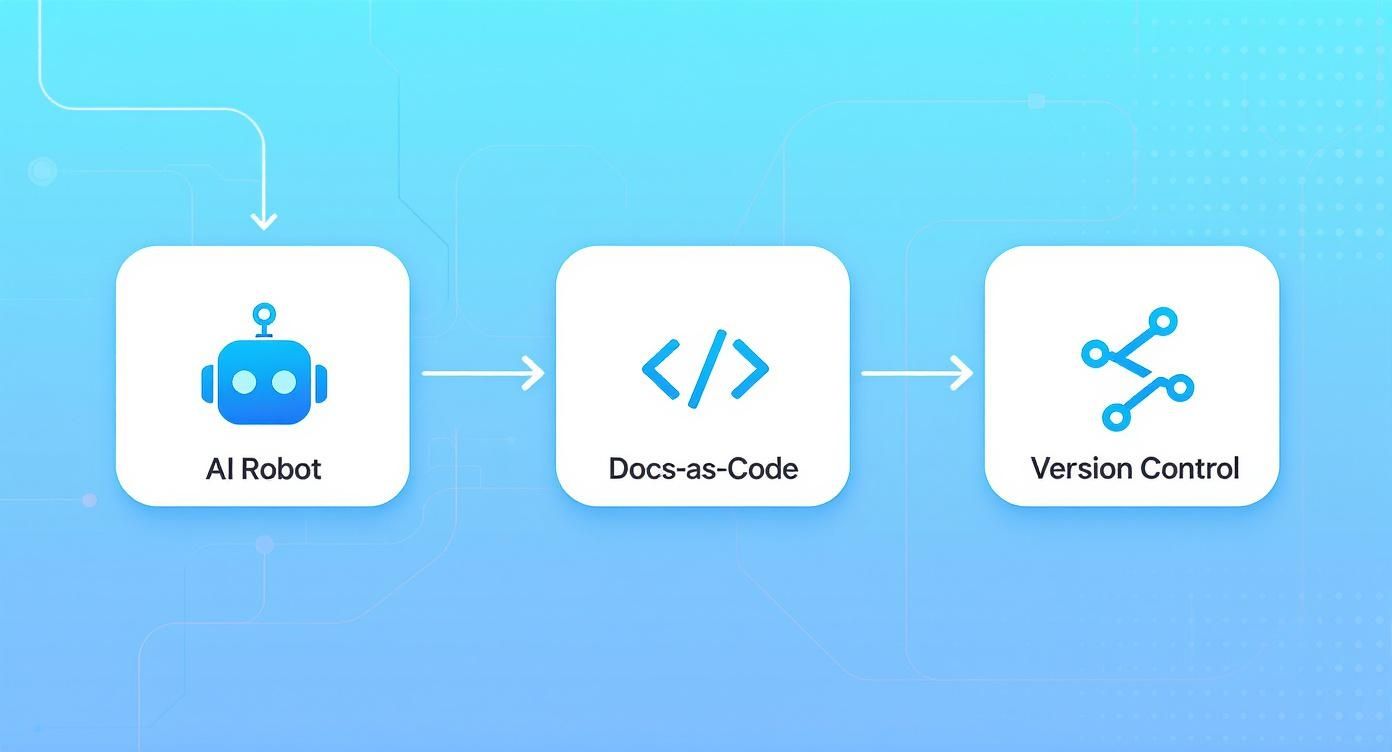
As you can see, tools that use AI, docs-as-code, and version control are at the heart of any modern GDP strategy, automating tasks that used to be a huge manual headache.
On top of that, platforms use secure electronic signatures and compliant cloud storage to maintain a perfect, unbroken chain of custody. Every single action—from someone viewing a document to applying a signature—is time-stamped and logged in an immutable audit trail. This digital journal provides a level of detail and security that a paper process just can’t compete with. To truly dial this in, it’s smart to actively seek out user input; checking out best practices for documentation feedback can help you refine your approach.
Modern platforms are purpose-built to handle this complex environment. They are engineered to make sure every transaction meets strict regulatory standards, creating a clear and defensible record of every step. This turns abstract compliance rules into a seamless, integrated part of the workflow, proving that technology doesn’t just support good documentation—it enforces it.
Your Action Plan for Better Documentation
Knowing what good documentation looks like is one thing. Actually making it a daily habit? That takes a plan.
The good news is, shifting to better good documentation practices doesn’t have to be some massive, intimidating overhaul. It’s all about taking small, deliberate steps that build on each other and foster a real culture of clarity. This checklist is your roadmap to turn those lofty goals into concrete actions your team can start taking today.
Think of it like building a house. You wouldn’t just start nailing boards together without a blueprint. The same logic applies here—a solid plan ensures every piece of your documentation strategy is strong, consistent, and built to last.
Establish Your Foundation
First things first: you need to set the rules of the road. When everyone follows the same playbook, you eliminate the guesswork and inconsistency that sinks most documentation efforts before they even get off the ground.
Don’t skip this part. Studies show that simply standardizing your documentation formats can make finding information up to 35% faster. Even better, companies that use templates see a 40% drop in inconsistencies, which means fewer mistakes and clearer communication all around. You can find more great insights on IT documentation best practices at NinjaOne.
Here’s where to start:
- Develop Standard Templates: Create uniform templates for your most common documents—think reports, meeting minutes, and how-to guides. This gives every record a familiar structure, making them a breeze to read and compare.
- Create a Simple Style Guide: Nail down the basics for language, tone, and formatting. Are we writing “e-sign” or “eSign”? A simple guide keeps everyone’s voice consistent.
- Choose the Right Tools: Pick a single, centralized platform to create, store, and manage everything. Make sure it has rock-solid security and can track different versions of a document.
Define Roles and Responsibilities
One of the quickest ways for documentation to fail is a lack of ownership. If nobody is responsible for keeping things up-to-date, your records will become stale and untrustworthy in no time. Assigning clear roles creates accountability and keeps the whole system humming.
A document without an owner is an orphan. It quickly becomes neglected, outdated, and ultimately, untrustworthy. Assigning clear ownership is the single most effective way to guarantee the long-term health and accuracy of your records.
Get specific about who handles each stage of a document’s life:
- Creation: Who is in charge of drafting the initial document?
- Review: Who acts as the second set of eyes to check for accuracy and clarity?
- Approval: Who gives the final sign-off to make a document official?
- Maintenance: Who is tasked with periodically reviewing and updating the document so it stays relevant?
Implement a Review and Audit Cadence
Finally, remember that good documentation is never “done.” It’s a living, breathing system that has to evolve. Regular reviews and audits are non-negotiable if you want to maintain accuracy.
Putting these checks on the calendar ensures your documentation doesn’t turn into a digital graveyard of outdated info. This simple habit keeps your records sharp and reliable, ready for whatever comes your way—be it an internal request or a formal audit.
Your Top GDP Questions, Answered
Even with the best game plan, questions always pop up when it’s time to put good documentation practices (GDP) into action. It’s only natural to wonder how these big-picture principles shake out in your specific industry or with your team’s unique setup. This section is all about giving you direct, no-fluff answers to the most common questions we hear.
Think of this as your quick-reference guide. We’re going to tackle everything from getting started on a shoestring budget to whether these rules even matter if you’re not in a heavily regulated field. The goal is to give you the confidence to build out your own documentation strategy, no matter the scale.
How Do We Start GDP on a Small Team with Limited Resources?
You don’t need a huge budget or a dedicated compliance department to get this off the ground. It all comes down to starting small and focusing on what matters most.
- Focus on High-Impact Areas: First, figure out which documents carry the most legal or operational risk if they go wrong. A loan agreement? A client contract? Start there.
- Use Simple Tools: You can get going with shared documents and a few standardized templates. The tool itself is far less important than having a consistent process.
- Make It a Team Habit: Just build a quick peer review into your existing workflow. A five-minute once-over from a teammate can catch the vast majority of glaring errors before they become real problems.
The name of the game is progress, not perfection. Kicking things off with small, consistent habits is way more effective than trying to boil the ocean and ending up completely overwhelmed.
Do Good Documentation Practices Apply to Non-Regulated Industries?
Absolutely. While GDP is a must-have in fields like finance and healthcare, the core principles are a game-changer for any business. Following these practices helps you improve consistency across the board, slash the number of preventable errors, and give yourself a solid defense against potential legal headaches.
At the end of the day, clear and accurate records are a massive asset for any organization.
For anyone in the financial world, using a detailed mortgage documentation checklist is a perfect example of this in action—it ensures every piece of paper is exactly where it should be. That same level of organization pays dividends in any industry dealing with complex workflows.
Good documentation is really just about creating a single source of truth. That isn’t a regulatory checkbox—it’s just smart business. It builds trust with clients, empowers your team, and lays the groundwork for you to grow without things falling apart.
What’s the Difference Between GDP and Data Integrity?
This is a great question, and it’s easy to get them mixed up. Here’s a simple way to think about it:
- Data Integrity is the quality of your information—is it accurate, complete, and consistent? It’s the “what.”
- Good Documentation Practices (GDP) are the actions and processes you put in place to make sure you maintain that data integrity. It’s the “how.”
You follow GDP to achieve data integrity. One is the method, and the other is the result. By weaving GDP into your daily operations, you’re making sure the information you rely on is trustworthy from the moment it’s created.
Ready to embed foolproof good documentation practices into your workflows? BlueNotary offers a secure, compliant platform with tamper-evident audit trails and automated record-keeping, ensuring every transaction meets the highest standards. Discover how our online notarization and eClosing solutions can protect your business at https://bluenotary.us.