






So, you're ready to take your notary career into the digital age? I get it. The flexibility is a game-changer. The short version is this: you'll need your traditional notary commission first, then you'll tackle your state's specific Remote Online Notary (RON) requirements, pick a compliant tech platform, and get your final application approved.
This guide will walk you through exactly how to become a notary online, from square one to your first virtual session.
Your Path to Becoming an Online Notary
Making the jump from a traditional notary to an online one opens up a world of possibilities. Forget driving to meet clients. Instead, you'll be using secure audio-visual technology to verify identities and witness signatures right from your home or office. This lets you serve clients from just about anywhere, smashing through geographical barriers and seriously expanding your business potential.
The demand for Remote Online Notarization (RON) has absolutely exploded. As of late 2023, a massive 47 states and the District of Columbia have passed laws giving RON the green light, cementing its role in our modern economy.
While every state has its own playbook, the foundational rule is nearly universal: you must be a commissioned traditional notary public before you can even apply to notarize online.

Mapping Out Your Journey
Knowing the road ahead makes the process feel much less intimidating. While the fine print varies by state, the journey generally follows a clear set of milestones. Each step builds on the last, making sure you’re fully compliant, both legally and technically, before you handle your first remote session.
Following a structured path helps you sidestep common pitfalls, like buying into a technology platform before confirming it's on your state's approved list or trying to apply without the required training. For a deeper dive into how it all works, check out our complete guide to remote online notary services.
Here's the key thing to remember: Becoming an online notary isn't a totally separate career. It's an upgrade to your existing commission, an added authorization that allows you to perform notarial acts using communication technology.
To give you a bird's-eye view, I've broken down the typical stages you'll go through. Think of this as your roadmap to getting started.
Online Notary Journey at a Glance
This table sums up the core stages and what you'll need to accomplish at each step as you transition into a remote online notary role.
| Stage | Key Requirement | Primary Goal |
|---|---|---|
| Foundation | Obtain or renew a traditional notary public commission. | Establish the legal authority to perform notarial acts within your state. |
| Education | Complete state-mandated RON training and pass any required exams. | Understand the unique laws, ethics, and procedures for online notarization. |
| Technology | Select a state-approved RON technology platform and secure digital tools. | Acquire the necessary software, digital certificate, and eSeal for compliant sessions. |
| Application | Submit the official RON authorization application to your state's commissioning office. | Receive formal state approval to perform remote online notarizations legally. |
| Launch | Set up your business profile, define your services, and begin marketing. | Transition from being authorized to actively attracting and serving online clients. |
Each of these steps is a critical building block. By tackling them one by one, you'll set yourself up for a smooth and successful launch into the world of online notarization.
Figuring Out Your State's RON Rules
Alright, let's get down to brass tacks. The absolute most important thing you need to do on your journey to becoming an online notary is to master your state's specific laws. I can't stress this enough. Every single rule, from what kind of training you need to the tech you're allowed to use, is decided at the state level.
This means your first move isn’t buying a new webcam or picking a platform. It's becoming an expert on what your state demands.
Think of it this way: your traditional notary commission is like your driver's license. It gives you the authority to operate. But your state's RON laws are the specific traffic rules for the digital highway. If you ignore them, you're looking at a rejected application at best, or serious legal trouble down the road at worst.
Where to Find the Official Rules
Your ground zero for all this information is your Secretary of State's website. This is the official source, the single point of truth.
Start by searching for something like, "[Your State] Secretary of State Notary Division." Once you're on the site, look for sections labeled "Remote Online Notarization," "RON," or maybe "Electronic Notarization." These pages will have the actual laws and administrative codes you must live by.
Pay close attention to these details:
- Eligibility: Does your current traditional commission qualify you? Are there any other hoops to jump through?
- Training and Exams: Does your state require you to take a specific RON training course or pass another exam?
- Approved Tech: This is a big one. Many states keep a list of approved RON software vendors. Using a platform that isn't on that list is an absolute non-starter.
- The Application Itself: Take note of the exact forms, fees, and any other documents they'll ask for.
And just so you know, this isn't only an American thing. The shift to digital document security is happening all over the globe. Online notarization is picking up steam worldwide, with new regulations popping up constantly. In the Asia-Pacific region alone, the market is expected to grow at a compound annual growth rate of over 15% from 2025 to 2033. You can read up on these global notarization trends on Data Insights Market to see just how big this is getting.
Not All States Are Created Equal
The rules for RON are anything but uniform. Some states have really detailed, mature frameworks, while others are newer to the game and might have simpler rules. Knowing the difference helps you understand the landscape.
Take Florida, for example. They have a very specific set of requirements. Notaries there have to take a two-hour training course from an approved provider, use a state-compliant RON platform, and keep a detailed electronic journal and video recordings of every single session for at least 10 years.
On the other hand, a state that just got on board with RON might have a much simpler application process, but they'll still be incredibly strict about how you verify someone's identity and keep things secure. The core principles—making sure the signer is who they say they are and that the document is protected—are universal. It's the "how" that changes from state to state.
If there's one mistake I see aspiring online notaries make over and over, it's assuming the rules are the same everywhere. Don't do it. Your state’s official commissioning authority is the final word on everything. Period.
Your Personal Compliance Checklist
As you dig through your state's website, make a checklist. This is going to be your personal roadmap for getting authorized. Here are the absolute must-haves for that list.
Critical Checklist Items for State RON Compliance:
| Requirement | What to Look For | Why It Matters |
|---|---|---|
| Surety Bond / E&O Insurance | Does your state require a separate or bigger bond for RON? Is Errors & Omissions (E&O) insurance mandatory? | This protects the public from financial harm if you make a mistake. It's often a non-negotiable part of your application. |
| Digital Certificate & eSeal | Are there specific tech standards for your digital certificate and electronic seal? | Your state dictates the security needed to make sure your electronic notarizations are tamper-evident and legally sound. |
| Record Keeping | How long do you have to store your electronic journal and the audio-visual recordings of notarizations? | States have strict retention periods, often 5-10 years. This creates a clear audit trail. Messing this up can lead to fines or losing your commission. |
| Application Fees | What's the exact filing fee for the RON authorization application? | Knowing all the costs upfront prevents surprises and keeps your application process from getting held up. |
By taking the time to carefully decode these regulations, you're building a solid, compliant foundation for your business. This prep work is what separates the pros who succeed from those who trip over simple administrative mistakes. Get this part right, and you're ready for the next step in launching your digital notary career.
Building Your Digital Notary Toolkit
Once your state gives you the green light, your success as an online notary hinges entirely on your technology. Think of your digital toolkit as your new office. Investing in the right components from the start will save you countless headaches down the road. This isn't just about gadgets; it's the very foundation of your RON business.
I like to break it down into three core pillars: a compliant software platform, robust identity verification tools, and reliable hardware. Each piece is absolutely essential for creating a professional and legally sound experience for your clients.
Choosing Your RON Software Platform
Your Remote Online Notarization (RON) platform is the command center for your entire operation. It’s the secure virtual room where you meet signers, check their ID, and apply your digital seal.
States are extremely particular about the software you use. Many even maintain a list of approved vendors you must choose from. Picking a non-compliant platform is a fast track to having your notarizations invalidated and putting your commission at risk.
When you're looking at platforms like BlueNotary, Notarize, or DocVerify, you have to look beyond the price tag. Focus on the features that guarantee compliance and a smooth experience for both you and the signer.
Here are the absolute non-negotiables:
- Live Audio-Visual Recording: Every state requires a complete, unedited recording of each RON session. The platform must be able to securely store these recordings for a legally mandated period, which is often 5 to 10 years.
- Robust Identity Verification: This is the cornerstone of any legal online notarization. The platform has to offer multi-layered identity proofing, which we'll get into next.
- Digital Certificate and eSeal Integration: Your software must seamlessly integrate your personal digital certificate, allowing you to apply a tamper-evident seal to documents.
- Electronic Journal: A digital version of your traditional notary journal is mandatory. The platform needs to provide a secure, compliant electronic journal that automatically logs key details of every session without you having to lift a finger.
To help you get started, here's a look at how some of the top platforms stack up.
Comparing Popular Remote Online Notarization Platforms
Choosing the right RON software is a big decision. This table breaks down the key features of some leading platforms to help you see what might be the best fit for your business needs.
| Platform Feature | BlueNotary | Notarize | DocVerify |
|---|---|---|---|
| Primary Audience | Independent notaries, small businesses, law firms | Enterprise clients, real estate, financial services | Independent notaries, enterprise clients |
| Pricing Model | Pay-per-notarization and subscription options | Primarily subscription-based, enterprise pricing | Subscription-based tiers, pay-as-you-go available |
| In-House Notaries | No, platform is for independent notaries (BYON) | Yes, has a network of on-demand notaries | No, platform is for independent notaries (BYON) |
| eJournal Included | Yes, fully compliant and integrated | Yes, fully compliant and integrated | Yes, fully compliant and integrated |
| API Integration | Yes, for business and enterprise plans | Yes, for enterprise clients | Yes, for business and enterprise plans |
| Customer Support | Email, chat, and phone support | Primarily email and knowledge base | Email and ticket-based support |
Ultimately, the "best" platform depends on your business model. If you're an independent notary building your own client base, a platform like BlueNotary gives you the flexibility and tools you need. If you're part of a large title company, a more enterprise-focused solution might be a better fit.
The Technology Behind Identity Verification
How do you really know the person on the other side of the screen is who they say they are? This is where sophisticated identity verification technology comes in, and it's far more advanced than just glancing at an ID card through a webcam.
State laws mandate a multi-step process that usually includes:
- ID Credential Analysis: The signer uploads a picture of their government-issued ID (like a driver's license or passport). The platform's tech analyzes the ID's security features—holograms, microprint, etc.—to check for signs of forgery.
- Knowledge-Based Authentication (KBA): The signer then has to answer a series of multiple-choice questions based on their personal credit and public records history. These are dynamic questions like, "Which of the following street names have you been associated with?" that are tough for an imposter to answer correctly.
- Biometric Analysis: Many platforms now add another layer of security by using facial recognition to compare the signer's live face on the video feed to the photo on their ID. This is a powerful tool for ensuring the person presenting the ID is the same person in the photo. To get a better handle on this, you can explore the role of biometrics in the online notary world and see just how it works.
A great real-world example: A client in another state needs to sign a power of attorney urgently. They'll join your session, the platform will scan their driver's license, they'll answer a few KBA questions, and only then will they be admitted to the virtual room with you. This entire, automated process is what makes the notarization legally defensible.
Essential Hardware for a Flawless Session
Finally, your personal hardware is what brings it all together. A choppy video feed or a dropped internet connection can invalidate an entire notarization, forcing you to start over. This is not the place to cut corners.
Here’s your essential hardware list:
- A Reliable Computer: You don't need a high-end gaming rig, but you do need a modern computer with enough processing power to handle live video streaming without lagging or freezing.
- A High-Quality Webcam and Microphone: Remember, the audio-visual recording is a legal record. Your state's laws demand the recording be clear and intelligible. An external HD webcam and a dedicated microphone are smart investments that are miles ahead of the built-in options on most laptops.
- A Fast, Stable Internet Connection: A wired Ethernet connection is always better than Wi-Fi for stability. I'd recommend a minimum upload speed of 5-10 Mbps to ensure a smooth, high-quality video stream that won't get pixelated or drop during a critical signing.
Mastering the Remote Notarization Session
Your first few live online notarizations might feel a little intense. I get it. But once you lock in a solid workflow, it quickly becomes second nature. Let's walk through what a typical session looks like from start to finish, so you can handle every interaction like you've been doing this for years.
Think about a common scenario: a client needs a power of attorney notarized, and they need it done now. Your job is to make that happen smoothly, securely, and in full compliance with state laws.
Kicking Off the Session and Setting Expectations
Good communication from the very beginning is everything. Before the video call even starts, send the signer a quick checklist. Let them know they’ll need their government-issued ID handy, a decent internet connection, and a quiet, private space for the call.
When the session begins, start with a friendly but professional introduction. I always find it helps to quickly outline the steps we're about to take: identity verification, a quick review of the document, the electronic signing, and finally, applying my notarial seal. This simple roadmap puts the signer at ease because they know exactly what's coming.
The whole process relies on a few key pieces of technology working together seamlessly.
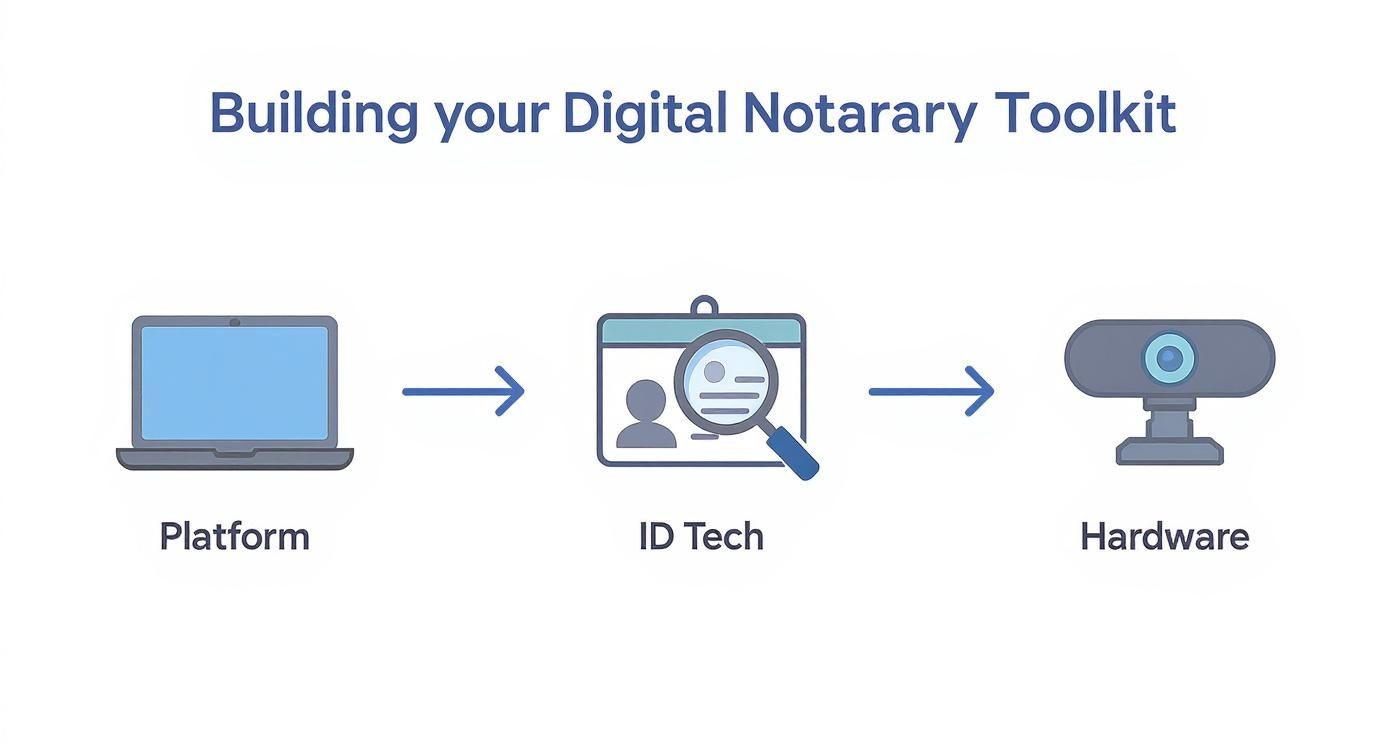
This workflow shows how the RON platform, ID analysis software, and your basic hardware (like a webcam) come together to create a secure, legally sound notarization.
The Heart of the Session: Identity Verification
This is where the magic—and the legal compliance—really happens. It's the most critical part of the whole process, and thankfully, your RON platform handles the heavy lifting. The system will automatically walk the signer through a multi-factor authentication process required by most states.
This usually breaks down into two parts:
- Credential Analysis: The signer uploads photos of their ID. The platform’s software then scans the document's security features to make sure it’s legit.
- Knowledge-Based Authentication (KBA): The signer then has to answer a handful of multiple-choice questions pulled from their personal credit and public records. Think old addresses or previous car loans.
The signer has to pass these checks before they can even join the live video call with you. This layered approach is absolutely fundamental to preventing fraud. If you want to dive deeper into the tech, BlueNotary has a great breakdown of their secure session verification methods.
Guiding the Signing and Sealing
Once the signer is verified and you're both connected on the live audio-visual feed, it's your turn to take the lead. First, you’ll share the document on-screen and give the signer a chance to read through it one last time.
This next part is non-negotiable for compliance. You must verbally confirm the signer's identity again while on the recording. I always ask them to state their full name for the record and confirm that they understand the document and are signing it willingly. This confirmation is a cornerstone of any valid notarial act.
After they give the thumbs-up, you'll watch them apply their electronic signature to the document. The platform makes this super easy, guiding their cursor right where it needs to go. Your job is simply to witness this in real-time.
With that done, you complete the notarial certificate, attach your electronic seal, and apply your digital certificate. That final cryptographic signature is what locks the document down, making it tamper-evident and officially notarized. You can then end the session, and the platform gives the signer immediate access to their completed document.
It's Time to Launch Your Online Notary Business

Getting that state authorization is a huge win, but let's be real—it’s just the starting line. Now the real work begins. It’s time to switch hats from compliance expert to business owner and turn your hard-earned commission into a profitable, client-focused enterprise.
Launching a successful online notary business means you have to start thinking like an entrepreneur. This isn't just about handling documents anymore; it's about crafting a smart pricing strategy, marketing your skills, and building a reputation that keeps people coming back.
The income potential here is no joke. The demand for remote online notarization is booming, and that's reflected in the earnings. While a traditional notary might pull in between $30,000 to $50,000 a year, online specialists often blow past that. Top platforms have seen explosive growth, with some reporting a staggering 300% jump in transactions in just a few years.
For more on this, check out the insights on the potential of an online notary career on Pandadoc Notary.
Defining Your Business Model and Services
First things first, you need to decide how you want to work. As an independent online notary, you've really got two main paths. The one you pick will dictate your marketing efforts and what your day-to-day looks like.
- Work Through a Platform Marketplace: Some of the big RON platforms, like Notarize or BlueNotary, act as a matchmaker. They connect their business clients directly with notaries on their roster. This is a fantastic way to get a steady flow of assignments without having to hunt for them yourself. The platform finds the clients, and you collect a set fee for each job.
- Build Your Own Client Base (BYOC): This is the true entrepreneur's route. You're in complete control. You use a RON platform for the tech but are 100% responsible for sourcing your own clients. The upside? Way higher earning potential per session, since you set your rates and keep the lion's share of the fee.
A lot of savvy notaries actually do both. They take platform jobs to keep the lights on and fill in the slow times, all while marketing their own services to build up a private client list.
Setting Your Pricing Structure
Getting your pricing right is make-or-break. It's a balancing act between being profitable and attracting the right kind of clients.
Your state probably sets a maximum fee you can charge for the actual notarial act. For example, Florida caps it at $25 per online notarization. But that’s just for the stamp. You can, and should, charge for more than that.
Here are a few models to consider:
- Per-Notarization Fee: The classic. You charge the maximum rate your state allows for each notarial seal.
- Session or Technology Fee: This is very common. Many RONs add a small "tech fee" or "convenience fee" to each session. This covers your platform costs and the sheer value of being able to do it all remotely.
- Package Deals: For those dream clients who need notarizations all the time (think law firms, real estate offices, or HR departments), offer a bundle. You could sell a pre-paid package of 10 notarizations at a small discount to lock in their repeat business.
- Specialized Service Fees: If you're an expert in complex stuff like loan signings or thick estate planning packages, don't be afraid to charge a premium flat rate. Your fee should reflect the time, skill, and liability involved.
The most important thing is to be transparent. Post your fees clearly on your website and social media. Clients hate surprises, and being upfront about costs builds trust from the get-go.
Proven Marketing Tactics for Online Notaries
You don't need a huge marketing budget to get the word out. The best strategies are all about building relationships and proving you're the reliable expert they need.
Target High-Value Niches
Instead of trying to be the notary for everyone, focus your energy on professionals who need your services on a regular basis.
- Real Estate Professionals: Get in touch with title agents, mortgage lenders, and real estate attorneys. One smooth closing can turn into a flood of referrals.
- Law Firms: Lawyers who specialize in estate planning, family law, and business law are a goldmine for repeat business.
- Financial Advisors and CPAs: These pros are always dealing with documents like income affidavits or retirement forms that need a notary's seal.
Build Your Online Presence
Your digital footprint is your new storefront. Make it look good.
- Create a Professional Website: You don’t need anything fancy. A simple one-page site is perfect to start. Just make sure it includes your services, your pricing, how to contact you, and a link to your scheduling tool.
- Optimize Your LinkedIn Profile: Your headline should scream "Remote Online Notary Specialist." Connect with people in your target niches and share useful posts about the benefits of RON.
- Get Listed in Directories: Sign up for every notary directory you can find, and make sure your Google Business Profile is filled out completely and kept up-to-date.
Building a business is a marathon, not a sprint, but consistent effort will absolutely pay off. As you grow, knowing how to scale your business effectively will be a game-changer. At the end of the day, your reputation for being professional, reliable, and tech-savvy is your single most powerful marketing tool.
Keeping Your Commission Compliant and Secure for the Long Haul
Once the video call ends, your job as an online notary isn't over. In fact, what comes next is just as critical as the notarization itself. To run a trustworthy and legally sound online notary business, you have to be rock-solid on your ongoing compliance and security practices.
A massive piece of this is record-keeping. Most states require you to securely store the audio-visual recording of every single notarization, plus your electronic journal entry, for a set amount of time. We're often talking five to ten years. This isn't a friendly suggestion—it's a legal mandate that creates a clear audit trail, protecting both you and the public.

Guard Your Digital Identity Like a Hawk
Think of your electronic seal and digital certificate as the 21st-century versions of your physical stamp and signature. Protecting them is everything. If you lose control of your digital certificate, it’s like handing a criminal a signed blank check—they could start fraudulently notarizing documents in your name, and you’d be on the hook.
Here are a few non-negotiable best practices:
- Never share your credentials. The password or key that unlocks your digital certificate is for your eyes only. Period.
- Use strong, unique passwords. Ditch the simple stuff and turn on two-factor authentication wherever it’s offered.
- Lock down your devices. The computer you use for notarizations needs up-to-date antivirus software and a firewall, no exceptions.
As an online notary, you're a custodian of sensitive client information. This means you need to be proactive about cybersecurity. For a deeper dive, check out these excellent tips on preventing data breaches that can help you strengthen your practice against the most common threats out there.
Don't Let Your Commission Lapse
Finally, never forget that your online notary authorization is directly tethered to your traditional notary commission. You have to keep both active and in good standing. My advice? Set calendar reminders a good six months before your commission expires to kick off the renewal process. Don't wait until the last minute.
Some states also mandate continuing education to keep you sharp on new laws and tech affecting RON. Staying compliant isn't a one-and-done deal. It's an ongoing commitment that builds your professional reputation and gives you the confidence to serve your clients well for years to come.
Common Questions About Becoming an Online Notary
Jumping into the world of online notarization is exciting, but it definitely brings up some questions. It’s completely normal. Getting clear, straightforward answers is the best way to move forward with confidence.
Let's break down some of the most common queries I hear from notaries looking to make the digital leap.
How Much Does It Really Cost to Start?
You'll want to budget somewhere between $200 and $500 to get everything up and running. The exact amount depends heavily on your state, but that’s a solid ballpark. This isn't one single fee, but rather a handful of different expenses you'll need to cover.
This initial outlay typically pays for:
- Your traditional notary commission fee (if you're brand new).
- The specific Remote Online Notary (RON) application fee your state charges.
- Any state-mandated training courses and required exams.
- Your digital toolkit—specifically, your electronic seal and digital certificate.
- A background check and any necessary insurance, like an E&O policy.
Just remember, your subscription to a RON platform like BlueNotary is a separate, ongoing operational cost, much like any other software you'd use for your business.
Can I Notarize for People in Other States or Countries?
Yes, you absolutely can! This is one of the biggest perks of being an online notary. But there's a golden rule you can never, ever break: You, the notary, must be physically located within your commissioning state's borders at the time of the notarization.
This part is non-negotiable. Your authority is tied to your physical location.
The signer, on the other hand, can be almost anywhere in the world. Whether they're on a business trip in another state or living overseas, you can help them out as long as the notarial act itself is compliant with your state's laws. It's always a good idea to give your state's statutes a quick double-check on signer location, just to be safe.
The core principle of RON is that your notarial authority is tied to your physical location, while the signer's location is flexible. This is what unlocks the global reach of an online notary business.
What's the Difference Between a Digital Certificate and an Electronic Seal?
It's super easy to get these two mixed up, but they play distinct—and equally vital—roles in every online notarization.
Here's the simplest way to think about it:
Your electronic seal is the digital version of your physical ink stamp. It's the image you visually place on the document to show, "I am an official notary, and I notarized this."
Your digital certificate, however, is the high-tech security engine working behind the scenes. It’s a unique cryptographic key that you apply after your seal. This action securely locks the document, making it tamper-evident and cryptographically linking your verified identity to the document itself. It’s what guarantees the document's integrity long after the session is over.
Ready to put these answers into action? BlueNotary provides the secure, state-compliant platform you need to launch and grow your online notary business, complete with integrated tools and access to a steady stream of clients. Start your journey as an online notary today.