






So, you're thinking about becoming a notary public. It’s a great way to serve your community, add a valuable skill to your resume, or even build a flexible side hustle. The path from applicant to commissioned official is pretty straightforward, but it's a structured process with a few key milestones you'll need to hit.
This guide will be your high-level map, clearing up the fog around the entire procedure so you can get started with confidence.
Your Notary Commission Roadmap
While the specific rules can vary quite a bit from state to state, the core building blocks of the process are surprisingly consistent. Getting a handle on these universal steps is your first real move toward earning that official seal and stamp.
First, you'll confirm you meet the basic qualifications. Then, you'll dive into the official application and vetting stages. From there, it's all about getting your supplies and making it official.
Key Milestones on Your Path
In just about every U.S. state, you'll need to be at least 18 years old, a legal resident of the state where you're applying, and able to pass a background check. No surprises there.
Some states also require you to pass a state exam or secure a surety bond, which is basically an insurance policy for the public. These bonds can range from $5,000 to $15,000, depending on where you live. For a deeper dive into the numbers, you can explore more data about notary market standards.
This infographic gives you a quick visual breakdown of the typical journey.
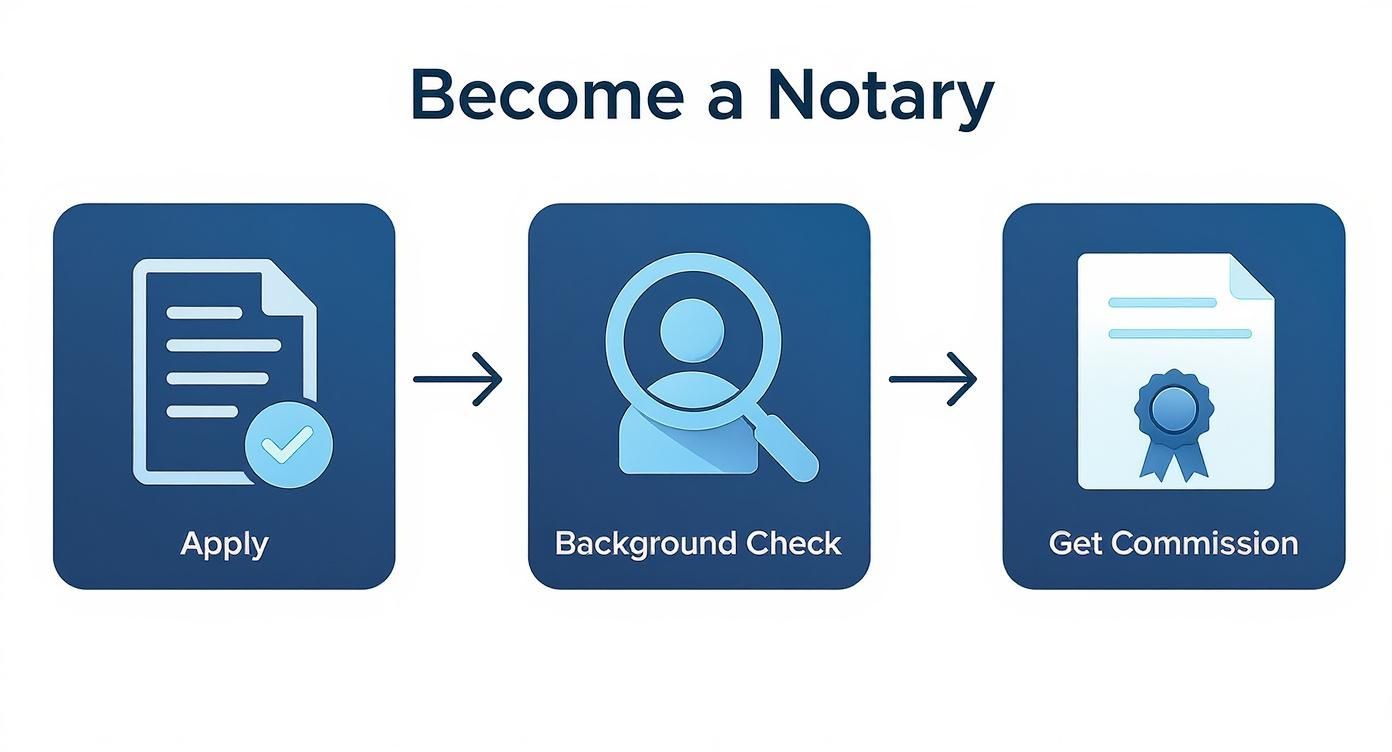
As you can see, it’s a sequential process. You can't get your commission without clearing the background check, and you can't get to the background check without submitting a proper application.
To give you a clearer picture, let's break down the typical stages you'll encounter on your way to becoming a commissioned notary.
Key Milestones in the Notary Commission Process
| Milestone | Typical Requirements | Estimated Timeframe |
|---|---|---|
| Eligibility & Application | Proving age (18+), residency, and submitting the state application form with the required fee. | 1-2 Weeks |
| Training & Exam | Completing any state-mandated training courses and passing the official notary exam (if required). | 1-4 Weeks |
| Background Check | Submitting to a criminal background check, usually involving fingerprinting. | 2-6 Weeks |
| Bond & Insurance | Securing a surety bond and Errors & Omissions (E&O) insurance. | 1 Week |
| Receiving Commission | The state issues your official notary commission certificate. | 1-3 Weeks |
| Final Steps | Filing your commission with the county clerk and purchasing your official seal and journal. | 1 Week |
Keep in mind that these timelines are estimates and can shift based on your state's processing speeds and specific requirements.
Understanding the Overall Commitment
Navigating these steps is all about attention to detail. Don't think of it as a series of bureaucratic hoops to jump through. Instead, see it as a system of checks and balances designed to uphold the integrity of the office. Each piece is there to make sure that the people appointed as notaries are trustworthy and can do the job right.
A notary's primary role is to act as an impartial witness, verifying identities and ensuring that important documents are signed willingly and without coercion. This responsibility is the foundation of the entire commissioning process.
So, how long does it all take? The timeline can really vary. Some states can get you commissioned in just a few weeks. Others might take a couple of months, especially if there's a training course and an exam involved. My best advice is to plan ahead and get all your documents gathered early on—it will make the whole experience much smoother.
Decoding Your State's Notary Requirements

Here’s the first thing you need to know: becoming a notary isn't a one-size-fits-all deal. There’s no single, national path to follow. Instead, it’s more like 50 different roads, each one paved by a specific state's laws.
That means your very first move—and the most critical one—is to figure out the exact rules for the state where you want to get your commission.
Sure, you'll see some common themes, but the details can swing wildly from one state line to the next. One state might demand a full-blown training course and a proctored exam, while its neighbor just asks for a basic application and a background check. Trying to follow generic advice is just a recipe for frustration. You've got to think local from day one.
The Universal Starting Points
No matter where you are, almost every state has a few baseline requirements you have to clear. Think of these as the non-negotiables for getting your foot in the door.
- Age Requirement: You’ll need to be at least 18 years old. This is pretty standard, as it confirms you've reached the legal age of majority and can handle the responsibilities that come with the commission.
- Residency: You generally have to be a legal resident of the state where you're applying. A few states will commission residents of neighboring states who work within their borders, but that's the exception, not the rule.
- Literacy: You must be able to read and write English. It sounds obvious, but it's essential for understanding legal documents and keeping an accurate record in your notary journal.
These criteria might seem simple, but they are strictly enforced. They're in place to make sure every notary has the basic capacity to do the job responsibly.
Navigating the Criminal Record Hurdle
This is a big one. Holding a notary commission is a position of public trust, so states are understandably picky about who they approve. The goal is simple: keep people with a history of fraud or dishonesty away from a role where they could abuse their authority.
So what does a "clean" record actually mean? A felony conviction is almost always an automatic "no" in every state. The rules around misdemeanors, however, are a bit more gray.
A misdemeanor for something like fraud, theft, or forgery will almost certainly sink your application. On the other hand, a minor traffic ticket from a decade ago probably won't be an issue. The golden rule here is to be 100% honest on your application. Trying to hide a past conviction is often seen as a much bigger red flag than the conviction itself.
Finding Your State's Official Rulebook
Okay, so where do you find the absolute, up-to-the-minute requirements for your state? Your single source of truth is your state's commissioning official, which is almost always the Secretary of State.
Their website is your new best friend. It’s where you'll find the official applications, detailed eligibility checklists, fee schedules, and any state-specific training or exam info. Don't rely on random third-party sites for these core rules—they can get outdated fast.
Don't guess. Don't assume. Go directly to the source. The Secretary of State’s website is the only place you'll find the official, legally binding rules for becoming a notary in your jurisdiction.
To get you started, here's a handy list of Secretary of State websites. This is where your journey truly begins.
Unique State-Specific Prerequisites
Beyond the basics of age and residency, many states throw their own unique requirements into the mix. These are the little details that really separate the process from one state to another.
Here are a few common variations you might run into:
- Mandatory Training: States like California and Florida require you to complete a state-approved education course before you can even apply.
- State Exam: In places like New York and North Carolina, you’ll have to pass a written exam to prove you know your stuff when it comes to notary law.
- U.S. Citizenship: While most states just require legal residency, a handful specify that you must be a U.S. citizen.
Getting a handle on these specific demands upfront will save you a world of headaches. It helps you map out your timeline, budget accordingly, and make sure you don't hit any unexpected roadblocks on your way to getting commissioned.
Passing Your Notary Training and Exam
Think of your notary commission as more than just a stamp—it's a grant of public trust. While it's true that not every state requires you to go through formal training, skipping this step is a huge gamble. Proper education is your first and best defense against the legal and ethical messes that can spring from a single mistake. It protects the public, and it protects you.
This isn't about memorizing obscure statutes you'll never use. It’s about building the muscle memory for the core tasks you'll perform every single day. A solid training program gives you the confidence to handle any situation, whether it's properly identifying a signer or maintaining an impeccable journal that could hold up in court.
What a Quality Notary Course Covers
Once you start looking, you'll see a ton of training options out there. A good, state-approved course will go way beyond just teaching you how to stamp a piece of paper. You need a deep dive into your specific duties and limitations under your state's laws.
Make sure any curriculum you consider covers these essentials:
- Proper Signer Identification: This is the absolute bedrock of every notarization. The course must explain acceptable forms of ID, like driver's licenses and passports, and walk you through the process for when a signer shows up without traditional identification.
- Understanding Notarial Acts: You have to know the difference between an acknowledgment, where you verify a signature was willingly made, and a jurat, where you require the signer to swear or affirm that a document's contents are true. Using the wrong one can completely invalidate a document.
- Journaling Best Practices: Your notary journal is your most important tool, period. Your training should teach you how to meticulously record every entry, what specific information your state requires, and why that detailed journal is your best friend if a notarization is ever questioned.
- Avoiding Unauthorized Legal Advice: This is a bright, uncrossable line: you are a notary, not a lawyer. A critical part of any course is teaching you how to avoid the unauthorized practice of law (UPL), which comes with serious penalties.
Simply put, your commission grants you the authority, but the training gives you the skill. One is pretty useless—and dangerous—without the other.
Choosing the Right Training Provider
Not all training programs are built the same. Some are quick, bare-bones overviews, while others are truly comprehensive courses that set you up for success. To make sure you're investing wisely in your new career, ask a few key questions before you sign up.
Is the provider approved by your state's commissioning authority (this is usually the Secretary of State)? In states where training is mandatory, this is a deal-breaker. Does the material look like it’s been updated recently? Notary laws change, and your education needs to reflect what's current.
A great training course doesn't just drill you for an exam; it prepares you for the real-world situations you’re going to face. It's all about building genuine confidence, not just checking a box.
If you’re thinking about specializing—say, as a Loan Signing Agent—you'll need more specific training that goes beyond your basic notary commission course. To get a better sense of that, check out our guide on what a loan signing agent course should include.
Proven Strategies for Passing the Notary Exam
If your state has an exam, don't sweat it. These tests are designed to confirm you understand the rules and your duties, not to trick you. With the right approach, you can walk in ready to go.
First things first: zero in on the official handbook or training materials provided by your state. This is the source material for the exam questions. Pay extra attention to things like official fee schedules, the specific steps for each notarial act, and the rules for your journal.
Here are a few study tips that actually work:
- Use Flashcards: Make simple flashcards for key terms like "oath," "affirmation," "venue," and "principal." Running through them a few times a day is a great way to make the definitions stick.
- Take Practice Tests: Many training providers offer practice exams. These are gold. They help you get comfortable with the question format and quickly show you which topics you need to review again.
- Study in Short Bursts: Instead of a marathon cramming session, try studying for 30-45 minutes at a time over several days. You’ll remember a lot more in the long run.
- Read Every Question Carefully: On test day, slow down and read each question twice. Exam questions can be tricky, and a single word can change the correct answer. Don’t rush and give away easy points.
Managing test-day nerves is also part of the battle. Get a good night's sleep, have something to eat, and show up to the testing center a little early. When you've prepared properly, the exam isn't a scary obstacle—it's just the final step before you earn that commission.
Getting Your Notary Bond and Essential Supplies
Okay, you've sailed through the application and passed your exams. You're in the home stretch now! But hold on—before you perform your first official notarization, you need to get the right protections and tools in place. This is where you'll secure your notary bond, look into insurance, and buy your official gear.
Think of this part as laying down the professional foundation for your notary business. These aren't just "nice-to-haves." They're the required pieces that show you're serious about your role and, more importantly, they protect both you and the public you're about to serve. Nailing these final steps is what makes your commission officially active.
First Things First: Your Notary Bond
A notary bond is a type of surety bond, and it's mandatory in almost every state. It’s a common point of confusion, so let's clear it up right now: the bond does not protect you. It’s there to protect the public from any financial harm if you make a mistake or engage in misconduct.
Here’s a real-world example: say you mess up and notarize a signature for the wrong person, leading to a financial loss for your client. That person can file a claim against your bond. The surety company pays the claim (up to the bond limit), but then they'll turn around and require you to pay them back.
The bond amount is set by your state and usually falls somewhere between $500 and $25,000. The good news is that your cost is just a small fraction of that total amount. It's a non-negotiable expense for becoming a notary in most places.
Why You Should Seriously Consider E&O Insurance
While the bond shields the public, Errors & Omissions (E&O) insurance is what protects you. This policy is your financial backstop, covering legal defense costs and potential damages if you ever get sued for an error you made during a notarization.
Imagine you notarize documents for a big real estate deal. Later, someone claims you didn't properly ID one of the signers, which led to a fraudulent sale. A lawsuit could be just around the corner, and the legal fees alone can be absolutely crushing, even if you’re eventually cleared of any wrongdoing. E&O insurance is the safety net that keeps a single mistake from derailing your finances.
Your notary bond is a requirement that protects your clients. Your E&O insurance is a smart choice that protects your personal assets and your business. Most seasoned notaries will tell you it's an indispensable cost of doing business.
Gearing Up: Your Essential Notary Tools
With your financial protections sorted, it's time for the fun part: getting the physical tools of the trade. These aren't just cool accessories; they're the legally required instruments you'll be using daily.
- Your Official Notary Seal or Stamp: This is your unique mark of authority. Every state has super-specific rules about its design—the shape, the size, and the exact information it needs to show (like your name, commission number, and state). Don't just buy from anywhere; order your stamp from a reputable vendor who guarantees it meets your state's latest requirements.
- The Notary Journal: Think of this journal as your professional diary and your most important record-keeping tool. It’s a detailed log of every single notarial act you perform. A clean, well-kept journal is your number one piece of evidence if a notarization is ever questioned in court. For every entry, you'll need the date, type of act, document name, and all the signer's details.
The Golden Rule of Record-Keeping
A messy or incomplete journal is a notary's worst nightmare. From day one, treat your record-keeping with the seriousness it deserves. Don't just scribble the bare minimum. Be meticulous. Note the type of ID the signer showed you, get their signature in the journal, and even add a thumbprint if your state requires or suggests it.
This detailed log is your best defense, period. If someone challenges a notarization you did years ago, you won't have to rack your brain trying to remember the details. You’ll just flip open your journal to the right entry, and voilà—a clear, timestamped record proving you followed every single procedure correctly.
Adding Remote Online Notarization to Your Services

Your traditional notary commission is a fantastic start, but it's really just the beginning. The world of notarization is rapidly shifting online, and the single biggest step you can take to grow your business is adding Remote Online Notarization (RON) to your skillset.
So, what is it? RON lets you notarize documents for signers located anywhere in the world using a secure audio-video connection. No more meeting in person. This is a game-changer for client convenience and massively expands your potential market beyond your local zip code.
The demand isn't just a trickle; it's a flood. The RON market is on a trajectory to hit nearly USD 1.8 billion by 2033, with an explosive annual growth rate of about 18.2%. This isn't a fad; it's the future of the profession.
Understanding the RON Authorization Process
Let's clear one thing up right away: you can't just decide to start doing online notarizations with your standard commission. Becoming a RON-authorized notary is a completely separate process handled by your state's commissioning authority. Think of it as a special endorsement or an add-on to your existing notary license.
The path to getting authorized looks different from state to state. Some will require you to complete an additional training course focused specifically on RON technology and procedures. Others might have a simpler process involving a new application, a fee, and naming the RON technology provider you intend to use. Your first and most important stop should be your Secretary of State's website to get the exact roadmap for your jurisdiction.
Getting the Right Technology and Tools
Going digital means swapping your physical stamp and journal for a suite of dedicated online tools. These aren't just nice-to-haves; they are legally required to ensure every remote notarial act is secure and legally sound.
- A Digital Certificate: This is your unique, secure digital key. You'll use it to apply your electronic seal to documents, which creates a tamper-evident signature and proves the document's integrity.
- An Electronic Seal: This is simply the digital twin of your physical stamp. It contains all the same required info—your name, commission number, etc.—but is applied to the document electronically.
- A Compliant RON Platform: You are required to use state-approved software specifically built for remote notarization. These platforms provide the whole package: the secure audio-video link, legally required identity verification tools, and a digital journal for your records.
As you step into this role, it's critical to grasp the importance of data security in a remote work environment. You're handling sensitive information, and protecting it is paramount to maintaining client trust.
It's easy to think RON is just a glorified video call, but it's so much more. The best platforms are built with sophisticated security layers, like knowledge-based authentication (KBA) and credential analysis, that often provide a more robust identity check than a quick glance at an ID in person.
Joining a RON Service Provider Platform
For most notaries diving into RON, the smartest move is to join an established platform. Companies like BlueNotary not only provide the compliant tech stack but also—and this is huge—connect you with a built-in stream of clients looking for on-demand online notarizations. It solves the "how do I find customers?" problem right out of the gate.
Getting started on a platform usually follows a few clear steps:
- Submit Your Credentials: You'll need to provide proof of your standard notary commission along with your new, separate RON authorization from the state.
- Verify Your Identity: The platform will run its own checks to confirm you are who you say you are, adding another layer of security.
- Get Set Up Technically: This is the onboarding phase where you'll upload your digital certificate and e-seal and get a feel for how the software works.
- Build Your Profile: You'll create a professional profile that clients see when they connect with you for a notarization session.
Platforms like this take the technical headaches off your plate so you can focus on what you do best: performing your notarial duties. You can learn more about the specifics of becoming a remote online notary to see how these systems turn your commission into an active, income-generating service available to a worldwide audience.
Launching and Marketing Your Notary Business
Getting your notary commission isn't the finish line; it's the starting gun. Now the real work begins: finding clients and turning your official seal into a reliable stream of income. You've got the license to operate, so it’s time to start thinking like a business owner.
You have a few paths you can take right out of the gate. Maybe you want to be a part-time mobile notary, traveling to clients for a few hours a week to supplement your income. Or perhaps you're ready to go all-in, building a full-time practice as a Notary Signing Agent (NSA) guiding people through complex real estate loan documents. Each model requires a totally different playbook for finding and serving customers.
Building Your Client Base
Your best, most valuable clients will be the professionals who need notarizations on a regular basis. These are the connections that provide a steady flow of work, moving you beyond random, one-off signings. Think about who handles high-stakes paperwork in your community every single day.
- Real Estate Agents and Lenders: They are constantly closing deals and need reliable notaries for massive loan packages. This is your bread and butter if you become an NSA.
- Attorneys and Paralegals: Law offices frequently need notarized affidavits, wills, and power of attorney documents. They value speed and accuracy.
- Title and Escrow Companies: These are the hubs of property transactions. Getting in good with a few of these can mean a full schedule.
- Hospitals and Assisted Living Facilities: They often need mobile notaries for patients and residents who can't travel. This is a great niche for mobile notaries.
Networking is your most powerful tool here. Seriously. Show up at local business meetups, introduce yourself at real estate offices, and drop off business cards with law firms. A professional, confident introduction can easily lead to a long-lasting business relationship. You might even find it helpful to explore effective internet marketing strategies for legal firms to better understand how to promote your services to this key demographic.
Don't just hand someone a card and walk away. Explain your value. Mention your flexible hours, your meticulous attention to detail, and the fact that you carry robust E&O insurance. Professionalism and reliability are your best selling points.
Mastering Your Online Presence
In today's market, pounding the pavement is only half the battle. If you don't have a solid online strategy, you're invisible to local clients who find everything through a search bar.
Your first and most critical step is to set up a Google Business Profile. It’s free, and it’s non-negotiable. This is what puts your business on Google Maps, allowing people in your area searching for "notary near me" to find you instantly.
Fill out your profile completely—add your hours, define your service area, and triple-check your contact information. Most importantly, encourage every satisfied client to leave you a review. Those five-star ratings are gold; they build credibility and push you higher in local search results. A strong online presence is your 24/7 marketing machine.
Finally, you need to nail down your pricing. Your state sets the maximum fee you can charge for basic notarial acts, often somewhere between $5 to $15 per signature. But that's just the baseline. As a mobile notary, you can—and should—charge for travel and convenience. As a signing agent, you’ll negotiate a flat fee for handling an entire loan package, which is where the real income potential is. Research what other notaries in your area charge to set competitive rates that reflect your expertise while staying well within your state's legal guidelines.
Got Questions About Becoming a Notary? We Have Answers

As you start looking into the notary profession, you're bound to have a few questions pop up. It's only natural. From how much you can actually make to what your responsibilities are, getting clear answers is the best way to move forward with confidence. Let's dig into some of the most common questions we hear from people just starting out.
Probably the biggest question on everyone's mind is about money. While it's true that states cap the fees for basic notarial acts—often just $5 to $15 per signature—that's definitely not the whole story.
The real income potential is in the services you build around that commission. Mobile notaries, for example, charge travel fees on top of the standard signature fee. And if you specialize in real estate closings as a Notary Signing Agent (NSA), you could earn anywhere from $75 to $200 per appointment.
Notary Signing Agent vs. Traditional Notary
This brings up another key point: understanding the difference between a general notary and an NSA. A Notary Public is a state-commissioned official whose core job is to witness signatures and act as an impartial deterrent to fraud. This is the foundation of the entire profession.
A Notary Signing Agent (NSA), however, is a notary who has gone through specialized training to expertly handle the complex stack of documents involved in loan and real estate transactions. All NSAs are notaries, but not all notaries are NSAs. This extra certification and the required background screening open the door to much higher earning potential because the stakes are higher.
Think of it this way: a traditional notary might handle a single power of attorney, while a signing agent is responsible for guiding a client through an entire mortgage closing package. The level of responsibility is greater, and the compensation reflects that.
Another common concern we see involves past legal troubles. Can you become a notary if you have a criminal record? The short answer is: it depends. Every state has its own rules, and the nature of the offense matters a great deal.
Most states will automatically disqualify anyone with a felony conviction. Certain misdemeanors, particularly anything related to fraud or dishonesty, can also be a major roadblock. The absolute golden rule here is to be completely honest and transparent on your application.
Ready to join the future of notarization? With BlueNotary, you can connect with on-demand clients, access top-tier training, and manage your business from a single, secure platform. Start your journey as a remote online notary today at https://bluenotary.us.