



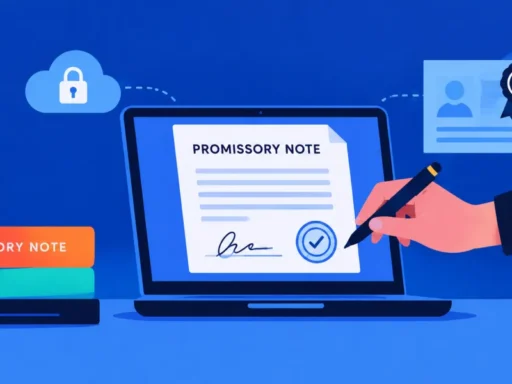


Yes, you can notarize a promissory note online, even though in almost every state a promissory note doesn’t need to be notarized to be legally binding – the borrower’s signature alone makes it enforceable. Notarization is still worth doing, especially for secured or real estate-backed notes, since it makes the signature much harder to dispute later. Where you choose to notarize one, online notary service handles it the same way as any other document, in about 10 minutes for $25, with no travel or scheduling hassle.
Does a Promissory Note Need to Be Notarized?
In almost every state, no. A promissory note becomes legally enforceable once the borrower signs it – notarization isn’t part of what makes the document binding. The note itself just needs to clearly identify the lender, the borrower, the amount, and the repayment terms, along with a signature, to hold up as a valid contract.
That said, a small number of state-specific statutes do require notarization for certain types of promissory notes, particularly those above a certain dollar amount or secured by specific kinds of collateral. Confirming your own state’s rule is worth the five minutes it takes, even though the general answer for most people is no.
The safest approach if you’re unsure is to treat notarization as a low-cost insurance policy rather than a legal hoop to jump through: at $25 and about 10 minutes, the cost of notarizing a note you didn’t strictly need to is far lower than the cost of an unnotarized note being challenged years later when memories of the original agreement have faded.
This surprises people used to thinking of notarization as the default requirement for anything involving money. A promissory note is closer in legal status to an ordinary signed contract than to a deed or a sworn affidavit, which is exactly why the signature alone, without a notary involved, is enough in nearly every jurisdiction to create a fully enforceable debt obligation.
When Is Notarizing a Promissory Note Actually Required?
A handful of specific circumstances push notarization from optional to effectively necessary, even in states that don’t require it by default for every note. Knowing which category your situation falls into ahead of time saves you from an unpleasant surprise later, particularly if the note ends up disputed.
• Secured by real estate: a promissory note secured by real property is typically accompanied by a separate mortgage or deed of trust, and that companion document almost always requires notarization, even if the note itself doesn’t.
• State-specific statutes: some states mandate notarization for notes above a certain dollar threshold or for specific types of secured lending – check your state’s requirement directly rather than assuming your situation matches the general rule.
• Lender policy: some lenders, particularly for larger private or business loans, require notarization as their own internal policy, independent of whether state law technically requires it, simply as an added layer of protection.
Why Notarize a Promissory Note Even When It’s Optional?
Even where notarization isn’t legally required, it provides real practical value if the loan is ever disputed – which is exactly the situation where an unnotarized signature becomes a liability rather than a formality that seemed unnecessary at the time.
• Harder to dispute: a notarized signature is significantly more difficult for a borrower to later claim was forged or coerced, since the notary’s identity verification stands as independent, third-party evidence.
• Shifts the burden of proof: in a collection lawsuit, a properly signed and notarized note generally shifts the burden onto the borrower to prove a valid defense, rather than the lender having to prove the note is genuine in the first place.
• Stronger for large or private loans: family and friend loans, in particular, benefit from notarization precisely because there’s often no other paper trail establishing the agreement existed at all.
Witnesses are generally not required for a promissory note either, following the same optional-but-recommended pattern as notarization – some lenders add a witness line as extra protection for high-value or secured notes, even when neither a witness nor a notary is strictly mandatory under state law.
How Do You Notarize a Promissory Note Online?
To notarize a promissory note through electronic notarization, both the lender and borrower (or just the borrower, depending on the note’s structure) complete the process during a single live video session with a commissioned notary. The steps are the same regardless of the loan amount or whether the note is secured.
1. Finalize the promissory note’s terms – amount, interest rate, repayment schedule, and any collateral – before your session, since a notary can’t help draft or edit the terms themselves, only witness the signing.
2. Upload the unsigned note to your online notarization platform.
3. Verify identity for each signer required to appear, through a government ID scan and additional checks.
4. Join a live video session with a commissioned notary.
5. Sign the note on camera, with all required parties signing during the same session rather than at separate times.
6. Receive your notarized promissory note, with the notary’s certificate and seal attached, ready for both parties to keep on file.
BlueNotary charges a flat $25 for this notarization, with sessions typically completed in about 10 minutes, regardless of the loan amount or number of pages in the note.
BlueNotary’s promissory note template provides a starting point if you don’t already have a properly drafted note ready to sign.
See the full notarization process walkthrough, or start remote online notarization directly.
What’s the Difference Between a Promissory Note and a Mortgage or Deed of Trust?
A promissory note is the borrower’s personal promise to repay a debt – it creates the financial obligation itself. A mortgage or deed of trust is a separate document that secures that promise against a specific piece of real property, giving the lender a legal claim to the property if the borrower defaults. Understanding this distinction clears up most of the confusion around why one document needs a notary and the other often doesn’t, since they’re easy to mentally lump together as “the loan paperwork.”
• Promissory note: the “I owe you,” creating personal liability for repayment, generally not requiring notarization on its own regardless of the loan amount involved.
• Mortgage or deed of trust: the security instrument tying the debt to real property, which does require notarization since it affects a real estate title and typically gets recorded with the county.
This is why a real estate loan typically involves notarizing the mortgage or deed of trust even when the accompanying promissory note itself doesn’t legally require it – the two documents serve different legal functions, with different notarization rules attached to each, even though they’re part of the same overall transaction.
Not sure whether your specific note or loan situation requires notarization? Email BlueNotary directly at [email protected] and the team will help you out.
Ready to notarize your promissory note? Notarize This Document Online Now at sessions run about 10 minutes for $25, with more than 20,000 certified notaries available to connect live.
FAQ Section
Does a promissory note need to be notarized?
In almost every state, no. The borrower’s signature alone makes the note legally enforceable, though notarization is often recommended.
When is notarizing a promissory note actually required?
Most commonly when the note is secured by real estate, when a state-specific statute requires it, or when a lender’s own policy mandates it.
Why notarize a promissory note if it’s not required?
Notarization makes the signature harder to dispute and can shift the burden of proof onto the borrower in a collection lawsuit.
Does a promissory note need witnesses?
Generally no, following the same optional-but-recommended pattern as notarization, though some lenders add a witness line for extra protection.
What’s the difference between a promissory note and a mortgage?
The note creates the personal promise to repay; the mortgage or deed of trust secures that promise against real property and requires notarization.
How much does it cost to notarize a promissory note online?
BlueNotary charges a flat $25 per document, with sessions typically taking about 10 minutes.