


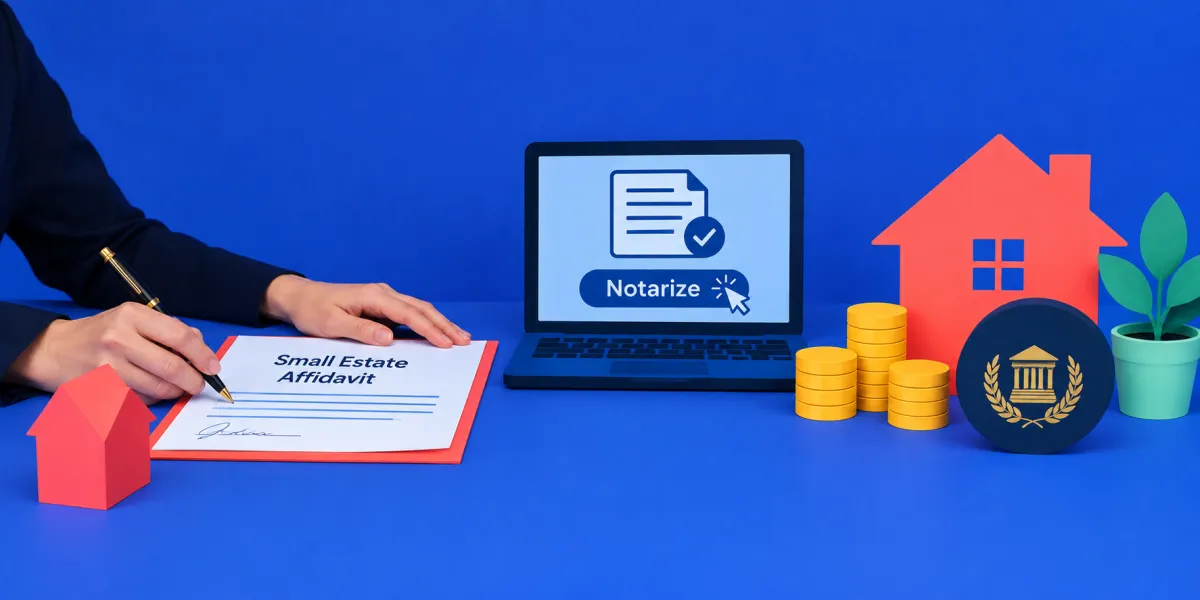

Yes, a small estate affidavit almost always needs to be notarized – it’s a sworn statement made under penalty of perjury, and some states, like Texas, also require two disinterested witnesses on top of notarization. It lets heirs transfer a deceased person’s smaller assets without going through full probate, provided the estate falls under your state’s specific dollar threshold. Notarize documents online handle the signing step in about 10 minutes for $25, without needing to schedule a court appearance.
Does a Small Estate Affidavit Need to Be Notarized?
Yes, in nearly every state. A small estate affidavit is a sworn statement – the heir or beneficiary signs it under penalty of perjury, affirming their right to the decedent’s assets and that the estate qualifies under the state’s threshold and waiting period. That oath has to be administered by a notary, the same way any other true affidavit works.
Some states go further and require additional signatures beyond notarization. Texas, for example, requires the affidavit to be signed by two disinterested witnesses in addition to the heirs, with everyone appearing before the notary together, following Texas Estates Code Section 205.002 and its specific procedural requirements.
What Is a Small Estate Affidavit Used For?
A small estate affidavit exists to let heirs skip the formal probate process entirely for estates that fall under a state-specific value threshold, available in some form in all 50 states and D.C., though the name, threshold, waiting period, and process all vary considerably from one state to the next. The Uniform Probate Code’s Section 3-1201 provides the model framework many states have adopted or adapted for their own version of this process.
• Bypassing probate: rather than opening a formal court case, the heir presents the notarized affidavit directly to banks, the DMV, or whoever holds the decedent’s assets, skipping months of court proceedings and attorney involvement.
• Transferring personal property: commonly used for bank accounts, vehicles, and household belongings rather than real estate, which many states handle separately through their own dedicated process.
• Working with or without a will: a small estate affidavit can generally be used whether or not the decedent left a will, as long as the estate qualifies under the threshold and no probate case has already been formally opened.
Different states call this same basic tool by different names – “summary administration,” “voluntary administration,” or “small succession” among them – but the underlying function is consistent: a faster, court-free path to transferring a modest estate to the people entitled to receive it.
How Much Can Your Estate Be Worth to Qualify?
State thresholds vary enormously, from roughly $10,000 in some states to well over $200,000 in others, so there’s no single number that applies nationally, and relying on a figure you saw for a different state could lead you to the wrong process entirely.
• Some states set thresholds in the tens of thousands, such as Maine’s $40,000 limit and New York’s $50,000 limit for this simplified process to apply, figures that get revisited periodically by state legislatures.
• Other states allow considerably higher values, with several setting thresholds well above $100,000 for estates to qualify for the simplified process rather than full probate administration.
• Most states also require a waiting period, commonly 30 to 45 days after the date of death, before the affidavit can be used to claim any assets, giving other potential claimants time to come forward.
• Real estate is often excluded from the threshold calculation entirely, even when the rest of the estate clearly qualifies, requiring a separate process for any real property involved in the estate, since real property transfers carry their own distinct legal requirements.
How Do You Notarize a Small Estate Affidavit Online?
To notarize a small estate affidavit through electronic notarization, the heir (and any required witnesses) complete the process during a live video session with a commissioned notary, following the same core structure as any other jurat-based affidavit.
1. Confirm your estate qualifies under your state’s threshold and waiting period before starting, since using this process for an ineligible estate can create real complications later, including having the transfer challenged by other potential heirs.
2. Complete the affidavit with the decedent’s information, a list of assets, and the heirs entitled to them, but don’t sign yet, since the signature must happen under oath in front of the notary.
3. Upload the unsigned affidavit to your online notarization platform.
4. Verify identity for the heir and any required witnesses through a government ID scan and additional checks, the same standard verification used for any other document type.
5. Join a live video session with a commissioned notary.
6. Take the oath and sign on camera, with any required witnesses signing during the same continuous session.
7. Receive your notarized affidavit, ready to present to the banks or institutions holding the decedent’s assets, along with a copy of the death certificate most institutions will also request.
BlueNotary charges a flat $25 for this notarization, with sessions typically completed in about 10 minutes, the same rate and turnaround as any other document on the platform, regardless of the estate’s overall value.
BlueNotary’s affidavit form templates include a small estate affidavit option with state-specific language. See the full notarization process walkthrough, or start remote online notarization directly.
Small Estate Affidavit vs. Affidavit of Heirship: What’s the Difference?
These two documents are easy to confuse since both deal with a deceased person’s property, but they solve different problems, and using the wrong one can leave part of the estate untransferred well after the rest has already been handled.
• Small estate affidavit: transfers personal property, like bank accounts and vehicles, directly to heirs, skipping probate entirely for qualifying estates under the state’s dollar threshold and waiting period.
• Affidavit of heirship: specifically identifies the heirs to real property, filed with county deed records, and generally doesn’t itself transfer title the way a small estate affidavit transfers personal property directly to the rightful heirs.
Some situations call for both documents – a small estate affidavit for the bank accounts and vehicles, and a separate affidavit of heirship for any real estate involved, since most states don’t let one document handle both types of property at once, even when the same heirs are involved throughout.
Not sure whether your specific estate qualifies, or which document you actually need? Email BlueNotary directly at [email protected] and the team will help you out.
Ready to notarize your small estate affidavit? Notarize This Document Online Now at sessions run about 10 minutes for $25, with more than 20,000 certified notaries available to connect live.
FAQ
1. Does a small estate affidavit need to be notarized?
Yes, in nearly every state, since it’s a sworn statement made under penalty of perjury. Some states also require additional witnesses.
2. How much can an estate be worth to qualify as a small estate?
It varies enormously by state, from around $10,000 to well over $100,000. Confirm your specific state’s current threshold before proceeding.
3. Is a small estate affidavit the same as an affidavit of heirship?
No. A small estate affidavit transfers personal property directly to heirs, while an affidavit of heirship identifies heirs to real property specifically.
4. How long after death can you use a small estate affidavit?
Most states require a waiting period, commonly 30 to 45 days after the date of death, before the affidavit can be used.
5. Can a small estate affidavit be used to transfer real estate?
Often not. Many states exclude real estate from the threshold calculation and require a separate process for real property.
6. How much does it cost to notarize a small estate affidavit online?
BlueNotary charges a flat $25 per document, with sessions typically taking about 10 minutes.