




Getting a Power of Attorney notarized is what gives the document its legal teeth. The process itself is pretty straightforward: you’ll need the completed—but still unsigned—POA document, a valid government-issued photo ID, and maybe a witness or two, depending on your state’s rules.
You’ll sign the document right there in front of a commissioned notary public. Their job is to verify who you are, make sure you’re signing of your own free will, and then add their official stamp and signature.
Why Notarization Is A Critical Step
Before we get into the how, it’s essential to understand why this step is such a big deal. Think of notarization as a powerful anti-fraud measure. A notary’s main purpose is to act as an impartial third party who confirms the identity of the person signing (known as the “principal”) and witnesses that they’re doing so willingly. This identity verification is what gives a POA its legal muscle.
Without a proper notarization, you’ll find that banks, hospitals, and government agencies will likely reject the document. That could leave your chosen agent totally powerless right when you need them most. For example, a bank isn’t going to grant your agent access to your accounts based on your signature alone; they’ll demand to see that notary seal.
A Power of Attorney is one of the most significant legal instruments you can create, granting someone immense authority over your affairs. Notarization is the official act that breathes legal life into the paper, transforming it from a simple agreement into an enforceable directive.
It’s a good idea to fully grasp the essential role of a Power of Attorney before you start the process. Knowing what the document does makes it crystal clear why the formal verification step is non-negotiable. While the POA is a common one, many other legal papers need this same level of validation. You can get a broader sense of this by looking into the most commonly notarized documents and seeing how this process fits into different legal situations.
Breaking Down The Key Roles
To make sure everything goes smoothly, it helps to know who’s who in the notarization process. There are a few key players involved, and each has a specific job to do to maintain the document’s integrity.

Let’s break down what everyone is responsible for during the notarization. This simple table demystifies what can feel like a complex legal ceremony, helping everyone show up prepared to do their part.
Key Roles in the Power of Attorney Notarization Process
| Participant | Primary Role and Responsibilities |
|---|---|
| The Principal | This is you—the person granting the authority. Your main jobs are to show up in front of the notary, provide a valid ID, and sign the POA document willingly, without any pressure. |
| The Agent (Attorney-in-Fact) | This is the person you’re giving authority to. In most cases, they don’t actually need to be there for the notarization, as their signature isn’t required at this stage. |
| The Notary Public | The notary is a state-commissioned official who serves as an impartial witness. Their duties are to verify your identity, confirm you’re aware and willing, and correctly fill out the notarial certificate. |
| Witness(es) | Some states require witnesses to watch you sign the document. They must also sign the POA themselves to officially state that they saw you execute it. |
Knowing these roles ahead of time makes the whole process feel less intimidating and ensures you have the right people and documents ready to go.
Preparing for a Flawless Notarization
Solid preparation is the key to a notarization that goes off without a hitch. Think of it like gathering all your ingredients before you start cooking; having everything ready prevents that last-minute scramble and keeps mistakes at bay. When you know how to get a Power of Attorney notarized the right way, the whole thing becomes surprisingly simple.
First things first: your Power of Attorney document must be completely filled out but left unsigned. This is the golden rule, the one thing you absolutely can’t forget. Signing the document before you are in the physical or virtual presence of the notary will automatically void the act, and you’ll have to start all over again.
Your Document Checklist
Before your appointment, pull together these essential items. A few minutes of organization now will save you a massive headache later.
- The Completed POA Document: Make sure every field for the principal (that’s you), the agent, and the specific powers is filled in accurately. Give it a once-over for any typos, but keep the signature and date lines completely blank.
- Valid Government-Issued Photo ID: This is non-negotiable. A notary’s primary job is verifying who you are, and they can only accept very specific, current forms of identification.
- Any Required Witnesses: Check your state’s laws to see if witnesses are needed for a POA. If they are, make sure they’ll be present with their own valid IDs at the ready.
Speaking of your ID, double-check that expiration date. A notary is legally required to turn away an expired ID, which is a surprisingly common reason appointments get derailed.
Pro Tip: I always tell my clients to read the entire POA document one last time before the appointment. Fully understanding the powers you are granting is just as critical as the notarization itself. This final review ensures everything is exactly as you intend it to be.
Verifying Identification Requirements
Not all IDs are created equal in the eyes of the law. To sidestep any issues, you’ll want to have a primary form of identification that’s universally accepted.
Accepted Forms of ID Typically Include:
- State-issued driver’s license
- State-issued identification card
- U.S. Passport or Passport Card
- U.S. Military ID
- Permanent Resident Card (also known as a Green Card)
It’s also a smart move to confirm the notary’s fee and what payment methods they accept beforehand. While many states regulate the maximum fee per signature, it’s common for there to be additional charges for things like travel or the use of an online platform. Asking about the total cost upfront eliminates any awkward surprises.
The Role of the Attorney-in-Fact
A question that pops up all the time is whether the agent—also called the attorney-in-fact—needs to be there for the notarization. In almost every situation, the answer is a simple no.
The notarization process is all about the principal’s signature—the person granting the power. Since the agent isn’t signing the document at this stage, their presence isn’t required. This makes scheduling a whole lot easier, especially if your chosen agent lives in another city or even another state.
Now, some POA documents do have a section where the agent must sign to formally accept their role. This is usually a separate step that can be notarized at a later time; it doesn’t need to happen simultaneously with the principal’s signing. Always check the specific language in your document to be sure. Getting these key elements lined up ahead of time sets the stage for a smooth, efficient, and legally sound notarization.
Navigating State-Specific Notary Laws
When you’re figuring out how to notarize a Power of Attorney, it’s critical to understand this isn’t a one-size-fits-all deal. The rules can change dramatically the moment you cross a state line, creating a legal patchwork you have to navigate carefully to make sure your POA is ironclad.
A perfect example of this is the witness requirement. Head down to Florida, and the law is crystal clear: you need two witnesses watching when the principal signs the POA. Skip this, and the document might not hold up. But in many other places, like California, witnesses aren’t necessary at all as long as a notary is present.
Remote Online Notarization Acceptance
Another huge variable is where your state stands on Remote Online Notarization (RON). Let’s be honest, notarizing a document from your living room is a game-changer. The good news is that most states have passed permanent RON laws, which is why platforms like BlueNotary can offer secure, legally binding online notarizations to people just about anywhere.
However, a few states are still operating under temporary rules or haven’t fully jumped on the permanent RON train. What does this mean for you? While an online notarization performed by a notary in a state like Virginia or Florida is legally recognized nationwide, you need to know your own state’s specific rules, especially for things like real estate deals. Getting this wrong can invalidate the entire document right when you need it most.
Key Takeaway: Always, always check your state’s current notary laws before you start. A quick visit to your Secretary of State’s website or a chat with a legal pro can save you from a major headache later.
This decision tree visualizes the key steps to confirm you’re ready for your POA notarization.
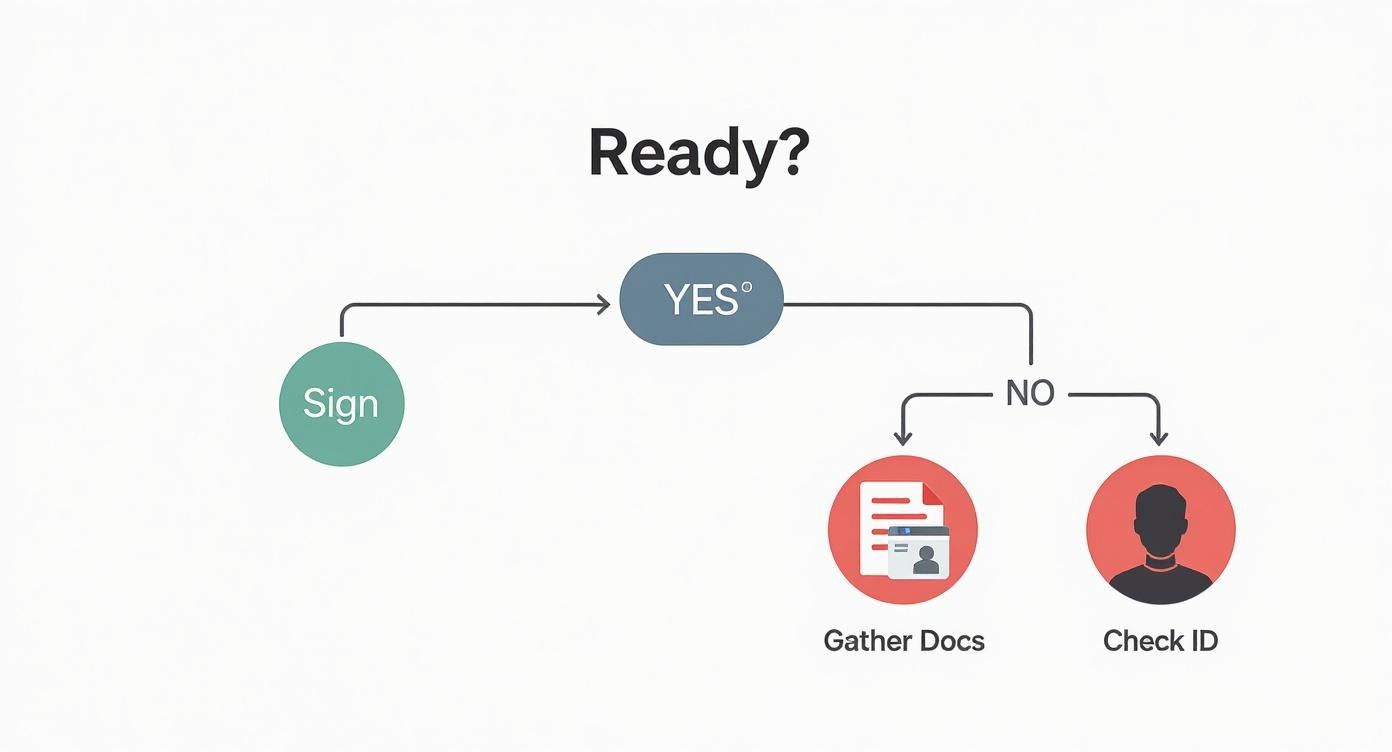
As you can see, before anyone signs, the first job is getting all your documents and a valid ID in order.
Cross-State and International Considerations
Things get even more complicated if the POA needs to be used across state lines or in another country. Generally, a properly notarized POA is accepted nationwide, thanks to the Full Faith and Credit Clause in the U.S. Constitution. But—and this is a big but—some institutions might have their own internal policies. For a deeper dive into these complexities, our guide on cross-state notarization breaks it all down.
Using a POA internationally adds a whole new layer of rules. In the U.S., the notary’s job is often just to confirm the signer’s identity. But other countries might expect more. For example, authorities in Mexico often require the notary to guarantee that the company mentioned in the POA actually exists and that the signer has the authority to act for it. A U.S. notary in California or New York can’t do that, which has led to American POAs being rejected south of the border.
State-Specific Variations at a Glance:
- Witnesses: Some states demand them (like Florida and Georgia), while others don’t (like California and Texas).
- RON Laws: Permanently legal in over 40 states, but the specific regulations and acceptance levels can differ.
- Specific Wording: Certain states require precise language or official forms for POAs, especially for healthcare directives.
Because these rules are so detailed and can change, it pays to use resources built for your specific location. To stay compliant and avoid any legal traps, it’s a smart move to consult some state-specific Power of Attorney resources. The bottom line is simple: a few minutes of research into your local laws is an essential first step to getting your Power of Attorney notarized correctly.
What to Expect During the Notary Appointment
Showing up for a notarization, whether you’re sitting across a desk or connecting on a video call, can feel a little intimidating. But once you know the playbook, you’ll see it’s less about legal jargon and more about a simple, structured verification process. Honestly, if you’ve already figured out how to notarize a Power of Attorney, the appointment itself is the easy part.
The first order of business is always the same: the notary needs to see your ID. Think of them as a neutral, third-party witness whose primary job is to confirm you are who you say you are. They’ll give your government-issued ID a thorough look, matching the photo, name, and expiration date to you.
The Verification Dialogue
With your identity confirmed, the notary will start a brief but crucial conversation. They have to make sure you’re clear on what you’re signing and what it means. This isn’t a pop quiz on contract law; it’s just a gut check for awareness and consent.
The notary is looking to confirm a few key things with simple questions:
- Are you signing willingly? They’ll verify that you’re signing of your own free will, without any pressure or coercion from someone else.
- Do you get the gist? They need to see you have a basic understanding of what a Power of Attorney does and the authority you’re granting.
They can’t give you legal advice, but they must feel confident that you’re a willing and informed participant. If a notary even suspects you’re being forced into signing or don’t grasp the document’s purpose, they are legally required to stop the notarization right there.
Here’s a real-world example: Let’s say an elderly parent is at an appointment with their adult child to notarize a POA. A sharp notary will politely ask to speak with the parent alone for a minute. This isn’t to be rude; it’s to protect the parent from potential pressure and ensure the decision is 100% their own.
The Signing and Sealing
Once the ID check and conversation are out of the way, it’s time to sign. This is the moment of truth, and it must happen in the notary’s presence. Signing the document ahead of time is one of the most common slip-ups, and it will invalidate the whole thing, forcing you to start from scratch.
The notary might also administer an oath or affirmation, depending on what your document requires. For an acknowledgment, you’re just confirming you signed the document voluntarily. For a jurat, you’re swearing or affirming that everything in the document is true.
The final moves are all on the notary:
- Completing the Certificate: They will carefully fill out the notarial certificate, either on the POA itself or on an attached page. This section includes your name, the date, their location, and the type of notarization performed.
- Signing and Sealing: The notary signs their name exactly as it appears on their official commission and then applies their seal or stamp.
This whole sequence—verify, confirm, witness, seal—is what gives your document its legal teeth. Every step is there for a reason: to maintain the integrity of the document and protect everyone involved. The second that notary seal hits the paper, your Power of Attorney is officially and legally notarized.
Choosing Between In-Person and Online Notarization
Not too long ago, if you needed a Power of Attorney notarized, you had one choice: find a local notary and meet them in person. That was it. Today, you have more options, pitting the classic, face-to-face method against a much more flexible, modern approach. Figuring out which path is best for you really comes down to your specific situation.
The traditional in-person notarization is exactly what it sounds like. You track down a notary at a bank, law office, or even a local shipping store, book a time, and show up with your documents and ID. For some, there’s a certain comfort in that direct, personal interaction, especially for a legal document as important as a POA.
But let’s be honest—this route can be a real logistical headache. Trying to coordinate schedules is often a nightmare, particularly if the person signing has mobility issues or a calendar that’s already bursting at the seams. Plus, you’re stuck with finding a notary in your immediate area, which isn’t always easy.

The Rise of Remote Online Notarization
This is where Remote Online Notarization (RON) completely changes the game. Using a secure digital platform, you connect with a state-commissioned notary public over a live video call. This means you can get your Power of Attorney legally notarized right from your living room, your office, or even while traveling overseas. All you need is a reliable internet connection.
The flexibility here is a massive advantage. Think about an elderly parent who can’t easily leave their house, a service member deployed abroad, or a busy executive trying to squeeze it in between meetings. For them, RON isn’t just a matter of convenience—it’s what makes the notarization process possible in the first place. You can see just how a secure remote online notary session works and why it’s become such a trusted option.
Key Takeaway: RON platforms are built from the ground up with security in mind. They use sophisticated identity verification tools like knowledge-based authentication questions and biometric analysis, which often provide a higher level of security than a quick glance at an ID in person. Every single session is recorded and securely stored, creating a tamper-evident digital audit trail that offers powerful protection against fraud.
The demand for this technology is exploding. The global mobile and e-notary market was valued at $348.2 million in 2023 and is projected to skyrocket to $1.88 billion by 2031. This isn’t just a fleeting trend; it’s a clear signal that people are actively seeking more accessible and secure ways to get their documents notarized.
Making the Right Choice for Your Situation
So, what’s the right call for you? It really boils down to three things: convenience, urgency, and your own personal comfort level. There’s no one-size-fits-all answer, just the one that makes the most sense for your unique needs.
To help you decide, here’s a straightforward comparison:
| Feature | In-Person Notarization | Remote Online Notarization (RON) |
|---|---|---|
| Convenience | Requires travel and finding an appointment during standard business hours. | Can be done from literally anywhere with an internet connection, often 24/7. |
| Speed | Can take days to schedule an appointment and get the document signed. | The whole process can often be wrapped up in under 15 minutes. |
| Security | Depends on the notary’s ability to visually inspect a physical ID. | Uses multi-factor identity verification and creates a secure, recorded digital trail. |
| Accessibility | Can be a major hurdle for individuals with mobility issues or those in remote areas. | A perfect solution for homebound individuals, overseas citizens, and anyone with a packed schedule. |
In the end, whether you opt for the familiar handshake of an in-person meeting or the sheer efficiency of an online session, the goal remains the same: executing a legally sound Power of Attorney. By weighing these factors, you can confidently pick the method that gets your document notarized correctly, securely, and with the least amount of stress.
Common POA Notarization Mistakes to Avoid
A single, seemingly small error can render a Power of Attorney completely useless. This can lead to some serious legal and financial headaches, often popping up just when you need the document the most. Knowing the common pitfalls is the best way to make sure your POA is legally sound and ready for action when the time comes.
The most frequent—and fatal—mistake I see is people signing the document before they are in the presence of the notary. I’ve had clients walk in with a perfectly prepared document, proudly signed, only for me to tell them we have to start over from scratch. A notary’s primary job is to witness the signature, so signing beforehand will always get the notarization rejected. It’s a hard and fast rule.
This isn’t just some modern formality; it’s a practice rooted in centuries of legal tradition designed to prevent fraud. The act of notarizing legal documents has deep historical significance tied to ensuring authenticity. In fact, this practice can be traced back to global commerce rules, like France’s Marine Ordinance of 1681, which required official legalization to validate documents for international use. This long-standing tradition highlights why following the rules is so critical for a document’s integrity. You can discover more insights about the history of notarization on upenn.edu.
Errors in Preparation and Identification
Another common pitfall is simply showing up unprepared. This can derail the whole appointment, forcing you to reschedule and causing delays you really don’t need.
Top Preparation Mistakes:
- Bringing an Expired ID: Notaries are legally forbidden from accepting expired identification. No exceptions. Always double-check the expiration date on your driver’s license or passport well before your appointment.
- Forgetting Witnesses: If your state, like Florida or Georgia, requires witnesses for a POA, they absolutely must be present with their own valid IDs. Forgetting them means the notarization can’t happen.
- Using an Outdated Form: POA laws get updated from time to time. Using an old template you found online might not comply with current state statutes, making it invalid right from the start.
Pro Tip: Before your appointment, grab a folder and put your POA document, your ID, and the IDs of any witnesses inside. This simple step ensures nothing gets left behind in the rush.
Conflicts of Interest and Misunderstandings
Beyond simple preparation, misunderstandings about who does what and which document you’re signing can also invalidate the process. It’s crucial that every piece of the notarization is handled correctly to maintain its legal standing.
One of the most critical rules involves the notary’s impartiality. A notary cannot have any personal or financial interest in the transaction. For example, if your chosen agent also happens to be a notary, they can’t notarize your signature on the POA. Using a neutral, third-party notary is essential to avoid a conflict of interest that could void the document down the road.
Finally, make sure you know exactly what you’re signing. There are different kinds of POAs, and each serves a very distinct purpose:
- A Durable Power of Attorney stays in effect if you become incapacitated.
- A Medical Power of Attorney is strictly for healthcare decisions.
- A Special Power of Attorney is limited to a specific transaction or timeframe.
Signing the wrong one can have serious consequences. Taking a little extra time to sidestep these preventable errors is the best way to ensure your Power of Attorney will be a reliable and effective tool when you or your loved ones really need it.
Common Questions About Notarizing a POA
When you’re dealing with a Power of Attorney, a few questions always seem to pop up right before you get it notarized. Let’s clear up some of the most common ones that both principals and agents run into.
What if a Notary Refuses to Notarize My POA?
A notary can absolutely refuse service, but they need a good reason. For instance, they must reject the notarization if the signer doesn’t have proper, unexpired ID. The same goes if the signer seems confused, isn’t aware of what they’re signing, or appears to be under duress.
What they can’t do is refuse you based on personal bias or for discriminatory reasons.
How Much Does It Cost to Get a Notary?
Notarization fees can be all over the map. For a traditional, in-person notarization, state laws cap the maximum fee, which usually lands somewhere between $5 and $15 per signature. Online services often have their own pricing but make up for it in sheer convenience and speed.
A quick but critical reminder: a Durable Power of Attorney stays valid even if you become incapacitated. A standard, non-durable POA does not. Make sure you know which one you have before you start this process, as it completely changes when the agent’s power kicks in and when it ends.
Does a Power of Attorney Expire?
It really depends on how the document is written. A durable POA is designed to last until the principal’s death unless it’s formally revoked. Other types of POAs can be set to expire on a specific date, after a certain task is finished (like a real estate sale), or if the principal becomes incapacitated.
Ready to finalize your Power of Attorney in minutes without having to go anywhere? BlueNotary has a secure, 24/7 online platform that connects you with a certified remote notary on demand. Get your documents handled quickly and correctly right from your home.