






Starting a notary business from home isn’t some far-fetched dream. It’s an incredibly accessible path that balances low startup costs with serious income potential. The whole game plan boils down to getting your state notary commission, adding a Remote Online Notarization (RON) certification, and then connecting with high-value clients in fields like real estate and law.
This guide is your complete blueprint for launching and scaling your own operation right from your house.
Why a Home-Based Notary Business Is a Smart Move
Forget the old image of a dusty stamp at the local bank. Launching a notary business from home today is a savvy career move, powered by a massive digital shift and a real demand for secure, convenient services. What used to be a side hustle is now a scalable, full-time profession for many.
The biggest game-changer? Remote Online Notarization (RON). This technology completely untethers you from your local neighborhood. You can now serve clients across the state—and in some cases, the country—right from your home office. Your client base is no longer your zip code; it can be national.
The Market Opportunity Is Expanding
The need for notarizations, especially online, is absolutely booming. Core industries like real estate, finance, and legal services are moving their workflows online for everything from mortgage closings to legal affidavits. This has created a steady, growing pipeline of work for notaries who are comfortable in a digital space.
- Low Startup Costs: Unlike most businesses, you don’t need a mountain of cash to get started. Your main investments are state commissioning fees, training, and the basic tech you probably already have, like a decent computer and a scanner.
- High Flexibility: This is your business, your schedule. You call the shots. Work part-time, full-time, or just during the hours that fit your life.
- Significant Income Potential: When you specialize in high-value work like loan signings or build relationships with corporate clients, your earning potential really takes off.
This roadmap breaks down the journey from getting commissioned to landing those first clients.
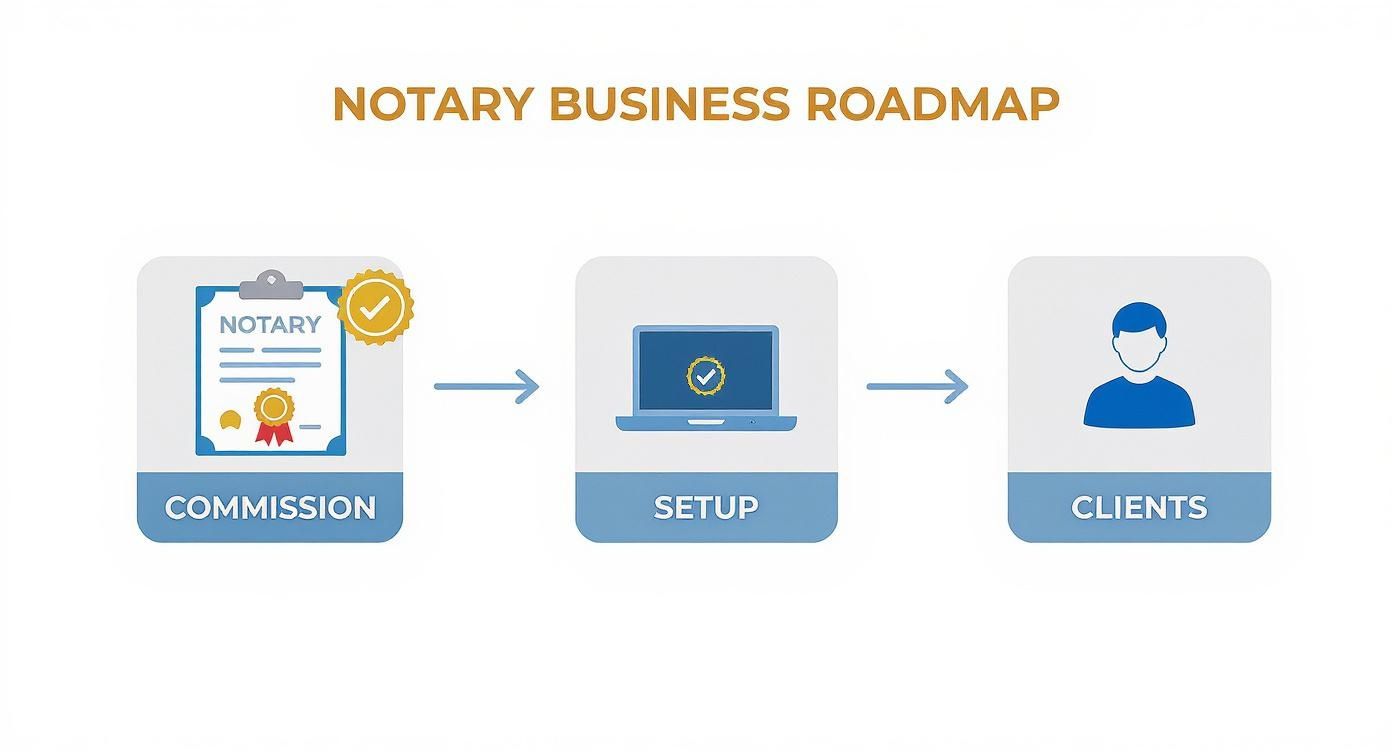
This simple flow—Commission, Setup, Clients—shows just how clear the path forward is.
The Financial Outlook Is Strong
The numbers don’t lie—this is the right time to jump in. The global online notary service market hit around $2 billion in 2025 and is on a steep upward climb, thanks to the digital push in major industries. By 2030, experts predict over 80% of notarial acts in developed markets will happen online. You can see the full online notary service report to get a feel for the market trends.
The modern notary is a tech-savvy entrepreneur. They build their business not just on a stamp, but on efficiency, security, and the convenience they offer to clients who need critical documents handled with care and speed.
Ultimately, starting a notary business from home is about plugging into a permanent change in how business gets done. This guide will walk you through the practical, step-by-step process to build a thriving, compliant, and profitable home-based notary service.
To give you a bird’s-eye view, here’s a simple roadmap that outlines the core phases of your launch.
Home-Based Notary Business Startup Roadmap
| Phase | Key Action Items | Why It’s Important |
|---|---|---|
| Phase 1: Foundation & Licensing | Get state notary commission. Complete RON training & certification. Secure Errors & Omissions (E&O) insurance. | This is non-negotiable. It establishes your legal authority to perform notarizations and protects you from liability. |
| Phase 2: Tech & Office Setup | Choose a RON platform like BlueNotary. Set up computer, webcam, mic, and scanner. Create a professional workspace. | Your tech stack is your office. Reliable tools ensure secure, compliant, and smooth client sessions from day one. |
| Phase 3: Business Operations | Define your services and pricing. Set up a business bank account. Choose bookkeeping software. | This turns your commission into a real business, allowing you to manage finances and track profitability effectively. |
| Phase 4: Client Acquisition | Build a simple website or professional profile. Network with title companies, lenders, and law firms. Market your services locally. | No clients, no business. Proactive marketing and networking are essential for building a steady stream of income. |
This roadmap isn’t just a to-do list; it’s the framework for building a sustainable business that can grow with you.
Laying the Groundwork: Your Notary Commission and RON Certification
Before you even start thinking about clients, marketing, or what to charge, you have to get the legal foundation right. It all begins with securing your official Notary Public commission from your state. After that, you’ll want to get the real game-changer: Remote Online Notarization (RON) certification. This two-step process is the absolute bedrock of your business and gives you the legal authority to operate.
Think of it this way: your traditional notary commission is your standard driver’s license. It’s the minimum you need to get on the road. The RON certification? That’s your commercial license. It opens up a whole new world of high-value work, letting you serve clients well beyond your zip code.
The Traditional Notary Commission: Getting Licensed
Every state has its own specific hoops to jump through to become a Notary Public, and the whole process is usually managed by the Secretary of State’s office. While the details can differ, the core steps are pretty similar no matter where you live. You’ll generally face a mix of eligibility checks, some required training, and an official application.
Your very first move should be to hunt down your state’s official notary public handbook or website. This is your single source of truth.
The National Notary Association’s website, for instance, has a state selection tool that shows how different the requirements can be. It’s often the best starting point.
This highlights just how much things vary from one state to the next. Clicking on your state will lay out the exact steps, fees, and forms you need. It’s the essential first step in your journey.
Here’s a general idea of what to expect:
- Age and Residency: You’ll almost always need to be at least 18 years old and a legal resident of the state where you’re applying.
- Background Check: Most states mandate a criminal background check. They want to make sure you have a clean record and can be trusted with sensitive documents.
- Application and Fees: There’s always paperwork. You’ll have to fill out an official application and pay the state’s filing fees.
- Training and Exam: Some states require you to complete a training course and pass an exam to prove you understand the laws and ethics of being a notary.
Supercharge Your Business with RON Certification
Once you have your traditional commission in hand, the real magic happens when you get authorized for Remote Online Notarization. This is what transforms your side hustle into a scalable, home-based business, allowing you to notarize documents for people anywhere using a secure audio-video connection. This is a separate authorization, and it comes with its own list of requirements.
RON isn’t just a fancy new tool; it’s a complete shift in how notary services work. It shatters geographical limits, boosts security with digital ID verification, and meets the massive demand for convenient, on-demand services.
Getting certified for RON usually involves these steps:
- Take RON-Specific Training: Many states make you take another course that focuses specifically on the tech, laws, and procedures for online notarization.
- Pick a State-Approved RON Platform: You can’t just use any video chat software. You have to use a technology provider that meets your state’s strict security and functionality rules. Platforms like BlueNotary are built from the ground up to be compliant.
- Submit a Separate Application: You’ll need to file another application or an amendment with your state to add RON capabilities to your commission.
- Update Your E&O Insurance: Your Errors & Omissions insurance policy will likely need an update to specifically cover remote online notarial acts. Don’t skip this.
If you want to get into the nitty-gritty of the technology and see how the rules vary by state, you can learn more about the specifics of Remote Online Notary platforms and how they ensure compliance.
Know Your State’s RON Rules Inside and Out
This is critical: RON laws are not the same everywhere. Some states are way ahead of the curve, while others are still catching up. This directly affects your business model and who you can work with.
For example, a notary commissioned in a forward-thinking state like Texas or Florida can perform a RON for a signer located anywhere on the planet, as long as the notary themselves is physically in their home state during the session. That opens up a massive global market. On the other hand, states like California have historically had much tighter restrictions.
Before you invest a dime, get on the phone or email your commissioning authority (again, usually the Secretary of State’s office) and ask these pointed questions:
- Can I perform RON for signers who are located outside of my state? What about outside the country?
- Are there any types of documents I’m not allowed to notarize online?
- Which technology platforms are approved for use in this state?
- What are the exact identity verification methods I must use for online sessions?
Getting crystal-clear answers to these questions is non-negotiable. It’s how you build a compliant and successful business from day one. Take the time to get these foundational legal steps right, and you’ll be setting up your home-based notary business on solid ground, ready to grow.
Building Your Digital Notary Office
Once your commission is in hand and you’re RON-certified, it’s time to build the engine of your business: your digital office. This isn’t about buying a ton of expensive gadgets. It’s about setting up a secure, professional, and efficient workspace that lets you serve clients from anywhere.
https://www.youtube.com/embed/ryuOlRRm_rc
Think of your technology stack as your storefront, your meeting room, and your secure vault all rolled into one. Getting this right from the start is the key to preventing those awkward technical glitches during a signing and ensuring you meet the strict legal standards for every notarization.
Core Hardware Essentials
You don’t need a supercomputer, but you absolutely need reliable tools that project professionalism. Your hardware is the physical foundation of every remote session, and quality really matters here. Shaky video or crackly audio can make a client lose trust in a heartbeat.
Here’s the essential gear you’ll need in your setup:
- A Reliable Computer: This is your command center. Whether it’s a desktop or a laptop, it needs a modern processor and enough RAM to handle live video streaming without lagging.
- High-Quality Webcam: The camera built into your laptop might get the job done, but an external 1080p HD webcam provides a much clearer, more professional image. This is a big deal when it comes to identity verification.
- Clear Microphone: Clients have to hear you clearly. A dedicated USB microphone or a good headset is a smart investment to cut down on background noise and make sure your instructions come through perfectly.
- A Document Scanner: While most of your work will be digital, you’ll still need to scan a client’s ID or other physical papers from time to time. A fast, high-resolution scanner is a must for creating crisp, readable digital files.
This initial hardware spend is a core part of your startup costs. But don’t let that intimidate you. The startup costs for an online notary business are pretty low, usually running between $500 and $1,500 for all your tech, certifications, and initial marketing. Analysts are even predicting that by 2025, most new notaries will be home-based, drawn in by the low overhead and incredible flexibility.
Choosing Your RON Software Platform
Your choice of a Remote Online Notarization (RON) platform is the single most important tech decision you’ll make. This software is so much more than a video chat tool; it’s a complete, state-compliant system that manages every single piece of the notarial act. It’s where you’ll verify identities, apply your digital seal, and maintain your secure journal.
Your RON platform is your partner in compliance. It should automate security, simplify your workflow, and provide an unchallengeable record of every session. Choosing a cheap, non-compliant platform is a shortcut to losing your commission.
Platforms like BlueNotary are built from the ground up for exactly this, bundling all the necessary features into one secure, easy-to-use environment.
Here are the non-negotiable features to look for:
- Identity Proofing Technology: The platform absolutely must offer state-approved methods for verifying a signer’s identity. This usually means Knowledge-Based Authentication (KBA)—where signers answer questions pulled from their personal history—and credential analysis to vet their government ID.
- Secure Digital Journal: Your state requires you to keep a detailed log of every single notarization. A top-tier platform gives you an electronic journal that automatically records every critical detail, creating a secure and tamper-evident audit trail.
- Integrated Scheduling and Payments: A professional platform should make the business side of things easier. Look for built-in tools that let clients book appointments and pay for your services right through the system.
- Ease of Use for Signers: Remember, your clients have to use this too. A confusing or clunky interface leads to frustrated signers and canceled sessions, which is just bad for business.
On top of the software, you’ll also need a professional business address for your state registration and any mail you receive. To keep your home address private and maintain that professional image, you might want to look into getting a virtual address for your business. And as you put all these pieces together, finding reliable web hosting solutions for small businesses is a smart move for building out your online presence.
Winning Your First High-Value Clients

Alright, your digital office is officially open for business. Now comes the real work: shifting gears from setup to sales. Just having a notary commission isn’t enough to pay the bills. You need a rock-solid plan to attract the right clients.
My advice? Forget casting a wide net and hoping for the best. The secret to a profitable home-based notary business is targeting high-value, recurring work from a few key professional sectors. These are the clients who don’t just need a one-off signature; they have a steady stream of documents that keep your calendar full and your income predictable.
We’re talking about the lifeblood of the notary world: real estate pros, lenders, title companies, and law firms.
Pinpoint Your Ideal Clientele
Before you even think about outreach, you have to get crystal clear on who you’re talking to. The most lucrative and consistent work comes from professionals managing complex, high-stakes transactions. Their world revolves around reliability, speed, and security—three things a well-prepared remote notary is perfectly positioned to deliver.
Your ideal client profile looks something like this:
- Real Estate Agents: They’re constantly juggling purchase agreements, deeds, and closing docs, often under insane deadlines.
- Mortgage Lenders & Loan Officers: These folks are swimming in loan applications, disclosures, and closing packages that demand flawless execution.
- Title and Escrow Companies: Think of them as the quarterbacks of real estate deals. They are a goldmine for consistent loan signing gigs because they coordinate all the final paperwork.
- Law Firms: Attorneys always need affidavits, powers of attorney, and other legal documents notarized for their cases.
When you focus on these groups, you stop being a random service provider and start becoming an indispensable part of their daily operations.
Nail Your Pitch and Value Proposition
When you reach out, remember you’re not just selling a notarization—you’re selling a solution. Your pitch needs to immediately hit on their biggest headaches: saving time, cutting down on errors, and making life easier for their own clients. This is where your Remote Online Notarization (RON) certification becomes your superpower.
Your value proposition isn’t “I can notarize your document.” It’s “I can help you close deals faster, wipe out scheduling nightmares, and give your clients a modern, secure experience from anywhere on the planet.”
Always lead with the benefits. Don’t just say you offer RON; show them what RON can do for them. A line like, “I help real estate agents finalize closings for their out-of-state buyers in under 30 minutes,” is infinitely more powerful. It’s a specific solution to a real problem.
Actionable Outreach Strategies
Generic marketing emails are a waste of time. You need to be direct, professional, and persistent.
- Direct Email: Start by building a targeted list of local title companies, law firms, and top-producing real estate agents. A short, personalized email introducing your specialized services can work wonders.
- Professional Networking: Get active on platforms like LinkedIn. Join local real estate and legal professional groups, contribute to discussions, and establish yourself as a go-to resource before you start selling.
- Smart Cold Calling: Calling can be tough, but a simple script makes it much easier. Your goal isn’t to make a sale on the first call. It’s to start a conversation with a simple question like, “I was just curious, who currently handles your loan signings?”
Here’s a sample email template you can tweak and make your own:
- Subject: Faster, More Secure Loan Signings for [Company Name]
- Body:
Hi [Contact Name],My name is [Your Name], and I’m a certified RON notary in [Your State] specializing in real estate transactions. I help title companies like yours finalize closings for remote clients quickly and securely.Using a state-approved online platform, I can help you close a loan package in less than an hour, which completely eliminates travel and scheduling hassles for your signers.Are you open to a quick 10-minute call next week to explore how I can help streamline your closing process?
Best,
[Your Name]
[Your Business Name/Website]
This approach is direct, respectful, and laser-focused on the value you provide. It shows you’ve done your homework and have a real solution to offer.
Once you’ve made initial contact and started building relationships, consider using email marketing tools to stay top-of-mind with your professional network. A simple monthly newsletter highlighting your availability, sharing industry updates, or offering tips on document preparation keeps you visible without being pushy. This automated approach helps you nurture relationships with dozens of contacts simultaneously, turning one-time clients into repeat business.
Ride the Wave of Market Demand
Your timing couldn’t be better. The demand for mobile and remote notary services is absolutely exploding. The global mobile notary market, valued at $0.5 billion in 2025, is projected to skyrocket to $2.6 billion by 2035.
And get this: in the U.S., real estate transactions are the engine driving over 60% of this growth. If you want to discover more insights about the mobile notary market, the data is all there. It confirms that zeroing in on the real estate sector is the smartest play you can make when building a notary business from home.
Operating a Secure and Compliant Business

Once your home-based notary business starts picking up steam, your focus needs to shift pretty quickly to security and compliance. These aren’t just corporate buzzwords; they’re the bedrock of a professional, trustworthy, and legally sound operation. Building a solid risk management framework from day one protects you, your clients, and the integrity of every document you touch.
This is the point where you stop thinking like just a notary and start thinking like a business owner. It means managing your legal structure, getting the right insurance, and truly mastering the fraud prevention tools you have at your disposal.
The Notarial Journal: Your Most Critical Record
Every single state requires notaries to keep a detailed journal of all their notarial acts. For a remote online notary, a secure electronic journal is absolutely non-negotiable. This isn’t just a simple logbook—it’s your number one piece of evidence if a dispute or legal challenge ever comes up.
Your electronic journal, which is often built right into platforms like BlueNotary, should automatically capture the critical details of every session. This creates an unchangeable audit trail that’s worlds more secure than a paper log you could lose or damage.
Key details you have to record include:
- The exact date and time of the notarization.
- The type of notarial act you performed (like an acknowledgment or a jurat).
- A clear description of the document being notarized.
- The signer’s name and exactly how you verified their identity.
Think of your journal as the black box for your business. It provides a complete, tamper-evident record that can definitively prove you followed every required procedure, protecting you from liability years down the line.
Fraud Prevention in a Digital World
As a remote notary, you are the first line of defense against fraud. It all comes down to your ability to properly verify a signer’s identity. This is where getting comfortable with the tools inside your RON platform becomes essential.
Knowledge-Based Authentication (KBA) is a standard requirement for a reason. This process fires off a series of personal questions to the signer, all generated from their public records and credit history. A legitimate signer can breeze through them, but an imposter is going to stumble.
You also have to get good at visual credential analysis. This means carefully examining the government-issued ID the signer holds up to the camera. You’re looking for any signs of tampering, mismatched photos, and the specific security features on that type of ID. A high-quality webcam is your best friend here.
Establishing Your Business Foundation
Operating as an individual is easy, but it leaves your personal assets—your house, your savings—completely exposed if you get sued. Setting up a formal business structure is a huge step in professionalizing your operation and protecting yourself.
The two most common routes are a Sole Proprietorship and a Limited Liability Company (LLC).
- Sole Proprietorship: This is the default for most freelancers. It’s simple to set up, but it offers zero legal separation between your personal life and your business.
- LLC: This structure creates a separate legal entity. It shields your personal assets from business debts and lawsuits, which is a massive advantage for notaries dealing with high-value documents. If you want to dig into the details, you can learn more about what the LLC meaning is and how it protects you.
Getting Errors & Omissions (E&O) insurance is another non-negotiable. This policy is designed specifically to cover you if you make a mistake during a notarization that causes a financial loss for your client. Most states require it, but even if yours doesn’t, working without it is a massive gamble. As you get set up, you’ll also need basic supplies like official rubber stamps to do your job properly.
Finally, set up a dead-simple system to track your business finances from the get-go. Open a separate business bank account to keep your income and expenses away from your personal funds. This makes tax season infinitely less painful and gives you a clear picture of your business’s financial health as it grows.
As you build out your digital infrastructure—from your RON platform to your business bank account to your scheduling software—you’ll accumulate dozens of login credentials. Use a password manager to securely store and organize all your business passwords in one encrypted vault. This isn’t just convenient; it’s a critical security practice that protects your clients’ sensitive information and your business reputation from data breaches.
Got Questions About Starting Your Notary Business?

Diving into any new business venture is bound to stir up a lot of questions. As you’re figuring out how to start a notary business from home, it pays to tackle the common hurdles and details head-on before you’re fully committed.
This is where we get into the nitty-gritty. Let’s walk through some of the most pressing concerns we hear from aspiring notaries, giving you the straightforward answers you need to make the right call.
How Much Does It Actually Cost to Start?
One of the biggest draws of this business is how affordable it is to get off the ground. While the exact numbers will shift depending on your state, you can get fully up and running without breaking the bank.
Your initial investment really boils down to a few key areas:
- State Commissioning Fees: This covers your application, the required background check, and any state-mandated training or exams.
- Essential Supplies: You’ll absolutely need a notary seal (your stamp), a physical or digital journal, and a good Errors & Omissions (E&O) insurance policy.
- RON Platform Subscription: Think of a compliant Remote Online Notarization platform as the engine of your modern notary business. It’s a recurring cost, but it’s essential for remote work.
- Business Formation: Many notaries choose to form an LLC for liability protection, which involves a state filing fee.
For most people just starting out, the total initial investment lands somewhere between $500 and $1,500. That’s pretty much everything you need to legally open your doors and start bringing in clients.
Which Type of Notary Earns the Most Money?
While you can build a steady income with general notary work, the real money is in specialization. The most lucrative path, by far, is becoming a Notary Signing Agent (NSA).
NSAs are specially trained and certified to handle real estate loan documents. These appointments are far more involved than notarizing a single signature on a simple document. Because of that complexity and the higher responsibility involved, they command much higher fees. Lenders and title companies will gladly pay a premium for a knowledgeable, detail-oriented agent who can guide a borrower through a closing package without any mistakes.
By focusing on loan signings, you stop trading your time for small, per-signature fees and start earning flat-rate package fees, often in the $100-$200 range per appointment. It’s the clearest path to a six-figure income in this industry.
Do I Really Need a Website?
No one’s going to shut you down for not having one, but a professional website is a massive asset for building credibility and attracting clients. It’s your digital handshake—your storefront that shows you mean business. A simple, clean site should tell visitors exactly:
- What services you offer (be sure to highlight RON and loan signings).
- Your service areas and operating hours.
- A dead-simple way for them to book time with you.
Put yourself in a client’s shoes. When a busy title company employee is searching for a local notary for an urgent closing, whose information are they going to trust more? A professional website will beat a basic directory listing every single time.
Once your site is live, consider using the QR code Generator to create a scannable code for your business cards that links directly to your booking page—it’s a modern, professional touch that makes it incredibly easy for potential clients to connect with you on the spot.
Beyond having a website, investing time in link building—getting your business listed in local directories, notary association websites, and relevant industry platforms—helps potential clients find you through search engines and establishes your credibility in the professional community. One effective way to integrate content marketing and link building is through guest blogging.”
What Are the Biggest Mistakes to Avoid?
I’ve seen new notaries make the same handful of preventable mistakes time and again. Getting ahead of these common pitfalls will save you a world of headache, time, and money.
- Ignoring State Laws: Notary rules are not suggestions; they’re strict, non-negotiable laws. Getting lazy with your journal, messing up identity verification, or charging improper fees can lead to hefty fines or, even worse, the loss of your commission.
- Underpricing Your Services: So many new notaries are afraid to charge what they’re worth, especially for mobile appointments or after-hours work. Do your homework, see what the going rate is in your market, and price yourself like the professional expert you are.
- Skipping E&O Insurance: Your Errors & Omissions policy is your financial safety net. A simple mistake can happen to anyone, and if it leads to a lawsuit, operating without E&O insurance puts your personal assets at massive risk. It’s a non-negotiable business expense.
Ready to build a secure, efficient, and profitable home-based notary business? BlueNotary provides the state-approved RON platform, client access, and business tools you need to succeed from day one. Start your journey with BlueNotary today!