





Yes, in a nutshell, online notarization is legally recognized and enforceable in the vast majority of U.S. states. While federal laws have paved the way for electronic signatures, the specific rules that make a remote notarization valid are hammered out at the state level. This means its legality really depends on where the notary is commissioned and, in some cases, the type of document involved.
A New Era for Notarization

The question “is online notary legal?” has popped up more and more as people look for smarter ways to handle official documents. The simple act of getting something notarized—which used to mean a special trip to a bank or a lawyer’s office—has completely changed. Now, a commissioned notary can verify someone’s identity and witness their signature using a secure audio-visual connection.
This method, officially known as Remote Online Notarization (RON), is a powerful alternative to the old way of doing things. Instead of everyone being in the same room, the signer and notary connect through a specialized online platform. This digital approach keeps the core principles of notarization intact—verifying identity, confirming willful signing, and preventing fraud—while adding layers of security and convenience that traditional methods just can’t match.
The Rapid Shift to Digital Notarization
The move to online notarization has been incredibly fast. Before 2020, only a handful of states had permanent RON laws on the books. But when the world needed remote solutions, legislative action kicked into high gear.
The real estate industry, in particular, saw a massive benefit, with RON usage jumping by an incredible 547% between 2019 and 2020. This wasn’t just a blip; it was a clear signal of a broader trend. As of today, 39 states now have permanent RON laws, and many others are operating under temporary authorizations, cementing its legal standing across most of the country. You can find more great insights on this industry shift from the American Financial Services Association.
To really get a handle on how this modern process fits in, it helps to see it next to the other methods. Each type of notarization serves a different purpose and operates under its own set of rules.
Remote Online Notarization isn’t just about convenience; it’s about creating a more secure, accessible, and verifiable record of a notarial act. The digital audit trail provides a level of transparency that paper journals often cannot match.
To clear up any confusion, let’s break down the key differences between the three main ways to get a document notarized. This quick comparison shows how each one works, highlighting the specifics of location, document format, and the signing process itself.
A Quick Look at Different Notarization Methods
| Feature | Traditional Notarization | In-Person Electronic Notarization (IPEN) | Remote Online Notarization (RON) |
|---|---|---|---|
| Location | Signer and notary are physically present in the same room. | Signer and notary are physically present in the same room. | Signer and notary are in different physical locations. |
| Document Format | Paper (wet ink signature). | Digital (electronic signature on a tablet or computer). | Digital (electronic signature on a secure platform). |
| Signing Process | Pen and paper. | Signed electronically on a device. | Signed electronically via a secure audio-visual connection. |
| ID Verification | Physical review of government-issued ID. | Physical review of government-issued ID. | Multi-factor authentication, including ID analysis and knowledge-based questions. |
| Record Keeping | Physical notary journal (paper). | Electronic notary journal. | Secure electronic journal with an audio-visual recording of the session. |
Seeing them side-by-side makes it obvious how RON builds on traditional principles while adding modern security and accessibility. It’s the same fundamental act, just performed through a different, more technologically advanced medium.
Understanding How Online Notarization Works

To really get a handle on whether an online notary is legal, you first have to understand that not all “online” notarizations are created equal. The term actually covers a few different methods, and each one has its own specific process and legal footing.
Think about it like paying for something. You can swipe a physical credit card at the store, tap your phone on the same machine, or punch in your card numbers on a website. They’re all valid ways to pay, but the technology and steps involved are totally different.
Notarization has evolved in much the same way. The two big players in the digital space are Remote Online Notarization (RON) and In-Person Electronic Notarization (IPEN). Both deal with electronic documents and e-signatures, but the real difference comes down to where the signer and the notary are physically located. Nailing down this distinction is the first step in making sense of the legal side of things.
Remote Online Notarization (RON) Explained
Remote Online Notarization is what most people are thinking of when they hear “online notary.” It’s a completely digital process where you and a commissioned notary connect over a secure audio-visual platform from literally anywhere. You are not in the same room.
This method uses some pretty impressive tech to not only replicate but often beef up the security of a traditional face-to-face meeting. Instead of handing over your driver’s license, your identity gets checked through a multi-layered process.
Here’s how it typically works:
- Credential Analysis: You’ll upload a photo of your government-issued ID, and the platform’s software scans it to confirm it’s the real deal.
- Knowledge-Based Authentication (KBA): You then have to answer a few personal questions pulled from public and credit records—the same kind of quiz your bank might give you to verify it’s you.
- Live Video Session: The entire signing session is recorded, creating a permanent, verifiable record of everything that happened. The notary also visually confirms you are who you say you are and watches you apply your electronic signature in real time.
Because it’s 100% remote, RON is a game-changer for convenience. It’s perfect for people who are overseas, have trouble getting around, or are just up against a tight deadline. Its legality all comes down to state laws that specifically give notaries the green light to use this kind of communication technology.
RON is so much more than just a video call. It’s a structured, secure, and legally defined process that relies on a specific technology stack to ensure identity verification, document integrity, and the creation of a tamper-evident audit trail.
In-Person Electronic Notarization (IPEN) Explained
In-Person Electronic Notarization, or IPEN, is more of a hybrid approach. It keeps the face-to-face element of a traditional notarization but swaps out the paper and pen for digital efficiency. With IPEN, you and the notary must be in the same physical room.
Instead of signing a paper document, you’ll use an electronic signature on a tablet or computer screen. The notary checks your ID the old-fashioned way—by looking at it right there in front of them. The only thing that’s different is that the document, your signature, and the notary’s seal are all electronic.
IPEN is great for streamlining paperwork and creating an instant digital file without needing all the remote identity-proofing tools. You’ll often see it used in places like law firms or title company offices where everyone is already gathered, but they want to keep the workflow digital. Since everyone is physically present, IPEN is legally accepted in every state that allows electronic signatures.
The Legal Framework Governing Online Notarization
To get to the bottom of “is online notary legal,” you have to understand the tug-of-war between federal laws and state authority. Think of it like the highway system. The federal government might set broad safety standards for interstates, but it’s the individual states that put up the actual speed limit signs.
That’s pretty much how it works here. Big federal laws laid the foundation for digital transactions, but the states are the ones who drew up the blueprints for online notarization.
Federal Laws Paved the Way
Two major federal laws got this whole thing started: the Electronic Signatures in Global and National Commerce Act (E-SIGN) of 2000 and the Uniform Electronic Transactions Act (UETA), which most states quickly adopted.
Together, these laws established a groundbreaking principle: electronic signatures and records are just as legally valid as the traditional pen-and-paper kind. But while these acts were a huge step forward, they didn’t specifically give notaries the green light to perform their duties over a webcam. To really dig into how this all works, it helps to understand the core electronic signature legal requirements.
E-SIGN and UETA essentially unlocked the door for digital documents but didn’t hand over the key for remote notarization. That job was left to the states.
States Hold the Ultimate Authority
The power to commission and regulate notaries has always been a state-level responsibility. It’s a fundamental function of state government, designed to make sure notarial acts performed within their borders meet strict local standards.
This is exactly why we see such a patchwork of laws from state to state. Each state legislature has to pass its own specific laws to define what Remote Online Notarization (RON) even is, spell out the required technology, and set the rulebook for their notaries.
The bottom line is this: a notarial act is always governed by the laws of the state where the notary is commissioned. This holds true whether the signing happens in a physical office or over a video call. It’s the notary’s location, not the signer’s, that dictates which rules apply.
Because this is a state-by-state affair, the legal landscape is always shifting. For a current snapshot of what’s allowed where, check out our detailed state-by-state remote notarization guide.
The Push for National Standards
While the state-by-state approach is legally sound, it definitely creates headaches and confusion. That’s why there’s been a growing movement to establish more consistent national standards for everyone.
The SECURE Notarization Act is a big piece of this puzzle. This federal bill, passed by the U.S. House of Representatives in 2023, aims to create a baseline legal framework for RON across the entire country. It would set minimum security and technology standards that all states would have to meet, effectively allowing any authorized notary to perform a RON for a signer located anywhere.
Even with this push, the goal isn’t to strip states of their authority. States would still be in charge of commissioning and managing their notaries. The act would simply ensure that a remote notarization legally performed in one state is recognized and accepted in all the others.
Interstate Recognition: A Legal Cornerstone
This brings us to a crucial legal concept: interstate recognition. In simple terms, a notarial act that is legally and correctly performed in one state is generally considered valid in all other states.
This idea is grounded in the Full Faith and Credit Clause of the U.S. Constitution. It means that if a notary commissioned in Virginia properly performs a RON for a signer in California, that notarized document is typically accepted nationwide. The key is that the notary followed all of Virginia’s specific RON laws to the letter.
Of course, there can be exceptions. Certain institutions or document types might have their own peculiar rules, so it’s always a smart move to double-check acceptance before you start.
Key Compliance Requirements for a Legal Notarization
So, is online notary legal? The answer isn’t just a “yes” or “no.” It really comes down to a strict set of compliance rules that transform a simple video call into a legally binding act. A legitimate Remote Online Notarization (RON) is built on several foundational pillars, all designed to slam the door on fraud and protect the integrity of the document. Skip any of these, and the whole thing could fall apart in a legal challenge.
These aren’t just best practices; they are state-mandated requirements. A compliant RON platform has to nail these every single time. From proving who the signer is to creating a permanent, tamper-evident record, each step is a crucial link in the chain.
Robust Identity Verification
Before a single signature is placed, the notary must be absolutely certain about the signer’s identity. In a traditional setting, this means physically checking a driver’s license. The digital world, however, needs a much more sophisticated defense against fraud.
A legally sound RON session uses a multi-layered identity verification process, which always includes at least two key components:
- Credential Analysis: The signer starts by uploading a picture of their government-issued ID, like a driver’s license or passport. The platform’s tech then gets to work, analyzing the ID’s security features—think holograms, microprint, and watermarks—to confirm it’s the real deal and hasn’t been doctored.
- Knowledge-Based Authentication (KBA): This is the second line of defense. It’s a dynamic quiz with multiple questions pulled from the signer’s personal credit and public records. The questions are designed to be things only the true individual would know, like old street addresses or past loan amounts.
This one-two punch is the digital equivalent of a notary carefully inspecting an ID in person. It’s a non-negotiable requirement in nearly every state with RON laws on the books.
Secure Audio-Visual Recording
The entire notarization session—from the moment the signer and notary connect until they say their goodbyes—has to be recorded. This isn’t just a simple video file; it’s a critical piece of evidence that acts as a permanent, unbiased witness to the whole event. Professional notaries often use meeting recording software to ensure high-quality audio and video capture, with platforms offering AI-powered transcription to create searchable text records of each session for enhanced compliance and documentation.
This audio-visual recording creates an indisputable record of the transaction. It captures the signer’s clear consent and awareness, shows the notary performing their duties correctly, and is a powerful deterrent against anyone being forced to sign against their will.
State law dictates how long this recording must be securely stored by the notary or the platform, which is often for 5 to 10 years. This long-term storage ensures the transaction can be audited or reviewed years down the road, giving everyone involved lasting legal protection.
To make this process as smooth as possible, businesses and individuals need a RON platform that handles these compliance requirements automatically. Here’s a quick checklist of what to look for.
RON Platform Compliance Checklist
This table breaks down the essential features a platform must have to ensure every notarization is legally sound.
| Compliance Requirement | What It Means | Why It’s Critical |
|---|---|---|
| Identity Verification | The platform must use multi-factor authentication, including credential analysis and Knowledge-Based Authentication (KBA). | Prevents identity theft and fraud by confirming the signer is who they claim to be. |
| Audio/Video Recording | The entire notarial session is recorded and securely stored for a state-mandated period (usually 5-10 years). | Creates a permanent, auditable record of the transaction, protecting all parties from future disputes. |
| Digital Certificate & Seal | The notarized document is sealed with a unique, tamper-evident digital certificate tied to the notary. | Guarantees the document’s integrity. Any unauthorized change after sealing will invalidate the certificate. |
| Detailed Audit Trail | Every action—from login to final signature—is logged with a timestamp, creating a comprehensive digital paper trail. | Provides a step-by-step forensic record that can be used as evidence in legal proceedings. |
| Secure Electronic Journal | The notary maintains a secure electronic journal logging all notarial acts, just like a traditional paper journal. | Fulfills state requirements for notarial record-keeping and ensures a complete history of the notary’s acts. |
Choosing a platform that ticks all these boxes isn’t just about convenience; it’s about ensuring your notarized documents are legally defensible and will be accepted without question.
Tamper-Evident Digital Sealing and Audit Trails
Once the document is signed and notarized, it’s sealed using advanced cryptographic technology. This digital seal, which includes the notary’s electronic stamp and signature, makes the document tamper-evident. If someone tries to change even a single character after the fact, the seal will show as invalid, instantly flagging the document as compromised.
The infographic below shows how state laws are the primary authority for online notarization, with federal acts providing foundational support.
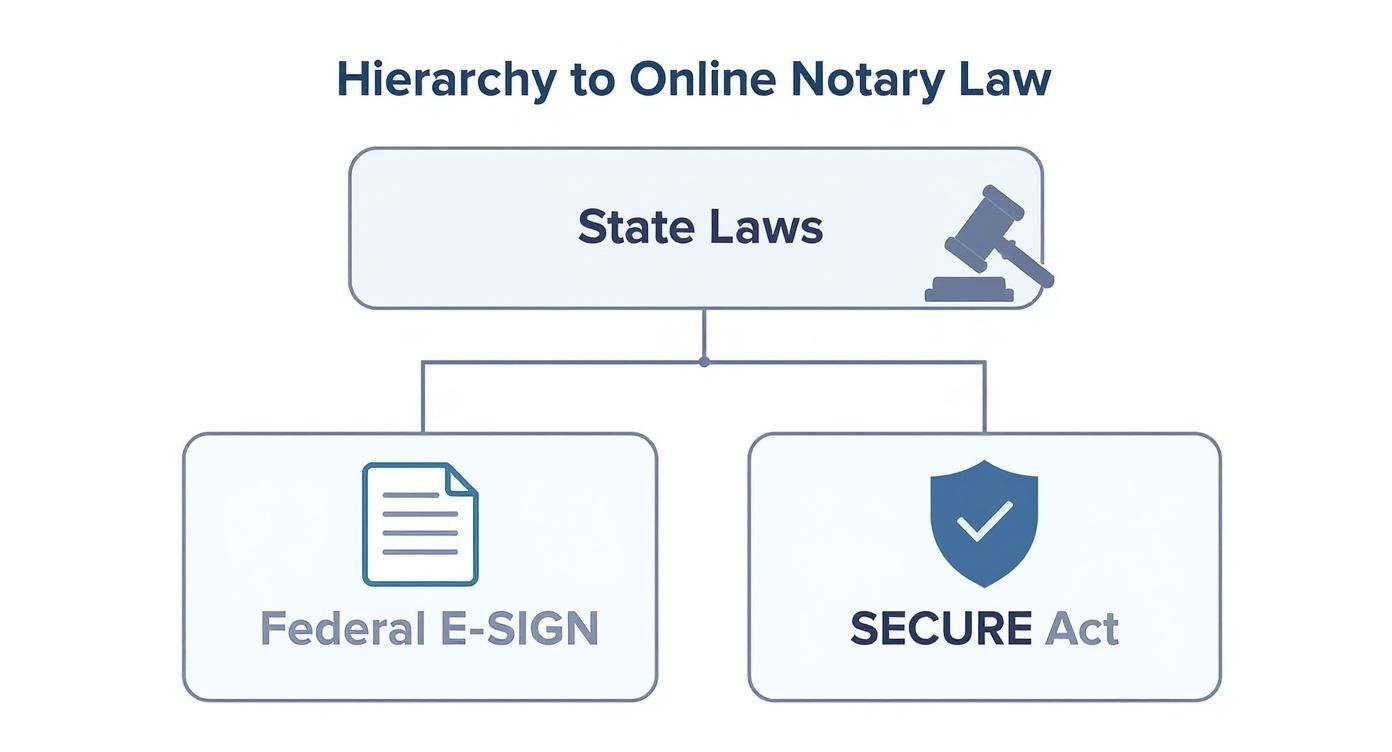
This helps clarify that while federal laws like E-SIGN and the SECURE Act create a supportive framework, it’s the state-level regulations that give a notary their ultimate authority.
On top of that, every single action taken on the platform is logged in a detailed audit trail. This log captures who did what and when, from the initial identity check to the final click to sign. This comprehensive record, combined with the video recording and a secure electronic journal, creates a complete, legally bulletproof package that proves the notarization followed the law to the letter. If you’re interested in the new federal standards, you can learn more by understanding the SECURE Notarization Act.
When Should You Use Online Notarization? (And When Should You Not?)

Just because online notarization is legal doesn’t mean it’s the right tool for every single job. Think of Remote Online Notarization (RON) as a powerful new wrench in your toolbox—perfect for some tasks, but not a replacement for the whole set.
Some transactions are practically made for the digital stage, while others still demand the old-school, in-person approach. Knowing the difference between a green light and a red flag is what keeps your documents moving and ensures they’re accepted without a hitch.
The massive shift toward digital convenience is undeniable. The global online notary market was valued at USD 1.2 billion in 2023 and is on track to explode to USD 6.5 billion by 2032. That’s not just a trend; it’s a reflection of widespread adoption across nearly every industry. You can dive deeper into these numbers in this market analysis from Archive Market Research.
Green Lights: Ideal Use Cases for Online Notarization
Online notarization really hits its stride in situations where speed, convenience, and remote access are critical. It has completely changed the game in a few key areas, smashing through the geographic barriers and scheduling nightmares of the past.
Here’s where RON shines the brightest:
- Real Estate Closings: This is the poster child for RON’s success. Title companies, lenders, and law firms now routinely conduct remote closings. This lets a homebuyer in another state or a seller traveling abroad sign mortgage documents from anywhere, dramatically cutting down travel time and getting deals funded faster.
- Financial and Business Agreements: Think contracts, loan agreements, or shareholder resolutions. These documents often need a notary’s seal to be official. RON helps businesses execute these critical papers in minutes, not days, so deals don’t stall waiting for a physical meeting.
- Legal Documents: Affidavits, depositions, and powers of attorney are notarized online all the time. For lawyers, it’s a game-changer. They can get a sworn statement from a client across the country or a witness on another continent without anyone having to get on a plane.
- Estate Planning: Basic estate documents like living wills and healthcare directives can often be handled remotely. It’s a simple, stress-free way for people to get their affairs in order from the comfort of their own homes.
The real magic of RON is how it makes distance irrelevant. A soldier deployed overseas can close on their family’s new home in Texas. An executive traveling through Asia can sign a critical affidavit for a court case in New York. This kind of accessibility was pure science fiction just a few years ago.
Red Flags: When to Stick with Traditional Notarization
For all its benefits, RON isn’t a silver bullet. Certain legal and government requirements are slow to change, meaning some paperwork still has to be done face-to-face with pen and ink. Trying to force a digital solution where it’s not accepted will only lead to rejection, delays, and a lot of headaches.
The key is to spot these situations before you start. The goal is always to choose the method that guarantees acceptance, and sometimes, that means sticking with what’s tried and true.
Specific Scenarios Requiring In-Person Notarization
Here are the most common times you should hit the pause button and double-check if a traditional notary is required:
- Documents Needing an Apostille: If your document is headed for a foreign country, it will likely need an apostille. This is a special certificate from a state or federal authority that authenticates the notary’s seal for international use. Many of the agencies that issue apostilles still insist on a traditional wet-ink signature and physical stamp.
- Certain Wills and Trusts: The laws around creating wills and trusts are notoriously strict and vary wildly from state to state. Some jurisdictions have rigid witness requirements or have explicitly banned RON for these foundational estate documents. Always, always talk to a lawyer in the relevant state first.
- Documents for The Department of Motor Vehicles (DMV): Many DMVs are still playing catch-up with technology. They often aren’t set up to accept electronically notarized documents for things like vehicle title transfers.
- Some Court Filings and Certified Copies: While e-filing is common in courts now, specific local rules may still demand original, wet-ink signatures on certain documents. Likewise, creating a “certified true copy” of a document sometimes requires the notary to physically inspect and handle the original paper copy.
At the end of the day, the answer to “is online notary legal?” really depends on the context. By understanding both its strengths and its limits, you can make the right call and ensure your documents are legally solid and ready for their destination.
How to Choose a Compliant Online Notary Platform
Picking a Remote Online Notarization (RON) platform isn’t like choosing just any old piece of software. The stakes are way higher. If you end up with a platform that cuts corners on compliance, it could invalidate your documents, putting your business and your clients in a serious legal bind.
So, how do you see past the slick marketing to find a provider that actually has your back?
It all comes down to legal defensibility and evidence. A truly compliant platform is built from the ground up to produce a complete, unchangeable package of proof for every single notarization. This means you need to get under the hood and look closely at its security, how it verifies identity, and the quality of the audit trail it creates.
Security and Identity Verification First
The entire foundation of a legal online notarization rests on one simple thing: proving the signer is who they say they are. A compliant platform must offer robust, multi-factor authentication that meets—or even exceeds—state requirements. This isn’t a nice-to-have feature; it’s the absolute core of the process.
Look for platforms that require a two-step identity check:
- Credential Analysis: The software must be able to scan a government-issued ID and analyze its security features to spot fakes.
- Knowledge-Based Authentication (KBA): The signer is asked to correctly answer a series of personal questions pulled from their credit history and public records.
If a platform just lets someone upload a picture of their ID or skips KBA entirely, that’s a massive red flag. Top-tier providers integrate these checks seamlessly into the workflow, ensuring every session starts on secure footing and can reduce fraud risk by up to 80%.
Audit Trails and Secure Recordings
A legally defensible notarization needs an unbreakable chain of evidence. That’s where the audit trail and the session recording come in. Think of these as your digital witnesses, proving that every single step was followed correctly.
A compliant platform should always deliver:
- A Comprehensive Audit Log: This is a detailed, timestamped record of every action taken, from the moment someone logs in to the final click that applies the notary’s digital seal.
- A Tamper-Evident Digital Seal: The platform has to use cryptographic technology to seal the final document. This makes sure that any change made after the fact will be immediately obvious.
- Secure A/V Recording Storage: The video of the entire session must be stored securely for the time required by state law, which is often 5 to 10 years.
A strong audit trail is your ultimate legal shield. It provides a forensic-level record that can stand up in court as evidence, verifying the integrity of the notarial act and settling any disputes years down the road.
Business Needs and User Experience
Beyond the non-negotiable compliance features, the platform has to actually work for you in the real world. A platform can be perfectly legal but a total nightmare for your team or clients to use. The goal is finding a solution that slots right into your existing operations without causing a headache.
You’ll want to consider things like API integrations for connecting with your current software, responsive customer support for when you inevitably need help, and a simple, intuitive interface that doesn’t frustrate signers. For a full breakdown of what to look for, our checklist for remote online notaries is a great place to start.
Ultimately, choosing the right platform is about balancing ironclad legal compliance with real-world usability to protect every single transaction.
Your Questions Answered: How Online Notary Legality Works in Practice
Even after getting the lay of the land, you probably still have some specific questions about how online notarization shakes out in the real world. Let’s tackle the most common ones to clear up any lingering confusion.
Can I Get Any Document Notarized Online?
Not quite. While Remote Online Notarization (RON) is perfectly legal and accepted for a huge list of documents—think real estate contracts, financial agreements, and affidavits—there are still a few exceptions.
Certain documents, especially those needing an apostille for international use or specific types of wills and trusts, might still require old-school, in-person notarization with a wet-ink signature.
The golden rule? Always check with the person or entity receiving your document. A quick confirmation that they accept electronic notarizations can save you a world of headache and potential rejection down the road.
How Does a Notary Actually Verify Who I Am Through a Screen?
This is a great question, and the answer is that legally compliant online platforms use a multi-step process that’s often even more secure than a quick glance at an ID in person. It breaks down into two main parts:
- Credential Analysis: You’ll be prompted to take a picture of your government-issued ID, like a driver’s license or passport. Sophisticated software then analyzes its security features to make sure it’s the real deal and hasn’t been tampered with.
- Knowledge-Based Authentication (KBA): Next, you’ll have to correctly answer a handful of multiple-choice questions pulled from your personal credit and public history. These are tricky questions that only you should know the answers to (like “Which of these streets have you previously lived on?”).
This robust, two-part system is a cornerstone of what makes online notarization services both legal and trustworthy.
Is a Document Notarized Online Actually Legal in All 50 States?
Yes, for the most part. This is thanks to a legal principle called interstate recognition. In simple terms, if a document is properly notarized online by a commissioned notary following the laws of their state, it is considered legally valid and must be accepted in all other states.
The most important piece of the puzzle is that the notary themselves must be located in a state that has authorized RON and must follow their home state’s rules to the letter.
For example, a notary commissioned in Virginia can legally perform a RON for a signer who is physically in California. As long as the Virginia notary follows all Virginia laws, that notarized document is typically recognized as valid across the entire country. The signer’s location is far less important than the notary’s compliance.
What’s the Difference Between an Acknowledgment and a Jurat?
You’ll run into these two terms all the time. They’re the most common notarial acts, but they do different things.
An acknowledgment is where you, the signer, declare to the notary that you willingly signed a document. It’s about confirming your intent. In contrast, a jurat is where you swear or affirm under oath that everything in the document is true.
The key difference in practice? For a jurat, you must sign the document in the notary’s presence (even virtually). For an acknowledgment, you could have signed it beforehand.
Ready to get your documents notarized with confidence and speed? BlueNotary provides a secure, compliant, and user-friendly platform that makes online notarization simple. Whether you’re an individual, a law firm, or a title company, our system ensures every transaction is legally sound and accepted nationwide. Notarize your documents online in minutes with BlueNotary.