






A notary licence is the official authorization that lets you witness signatures, administer oaths, and certify documents as a commissioned public official. Without it, none of those acts carry any legal weight.
If you're thinking about becoming a notary — or you just need to understand what one actually is before hiring someone — this article covers exactly how the notary licence works, what it costs, how long it lasts, and how the newer remote online notary (RON) certification fits in.

What Is a Notary Licence?
A notary licence — more formally called a notary commission — is the state-issued authorization that gives a person the legal authority to perform notarial acts. The terms "licence" and "commission" are often used interchangeably, though "commission" is the technically correct term in most U.S. states.
Key Insight: A notary isn't a lawyer, and a notary licence isn't a law degree. It's a limited, state-specific authorization to perform one narrow but important job: verifying identity and witnessing signatures on legal documents.
A notary public serves as an impartial third party. Their job is to confirm that the person signing a document is who they claim to be, that they're signing voluntarily, and that they understand what they're signing. The notary licence is what makes that verification legally recognized.
Every state issues its own notary licence. There's no federal notary licence. This means requirements, fees, and rules vary from state to state — sometimes significantly.
How to Get a Notary Licence
The process for obtaining a notary licence follows a similar pattern across most states, though the specifics differ. Here's how it typically works:
-
Meet the basic eligibility requirements: You must be at least 18 years old, a legal resident of the state where you're applying, and free of felony convictions. Some states have additional requirements.
-
Complete a notary education course: Many states now require a training course before you can apply. These courses cover notarial law, proper procedures, and common mistakes. Some states make this optional but strongly recommended.
-
Pass a notary exam: States like California require a written exam. Others don't test you at all. Check your state's Secretary of State website for current requirements.
-
Submit your application: You'll file an application with your state's commissioning authority — usually the Secretary of State's office — along with the required application fee.
-
Purchase a surety bond: Most states require notaries to carry a surety bond (typically ranging from $500 to $15,000) to protect the public against notarial errors. This is not the same as insurance.
-
Receive your commission certificate: Once approved, you'll receive your official notary commission. You can then purchase your notary seal and journal.
-
File your oath of office: Some states require you to file an oath of office with your county clerk before you can begin notarizing.
The whole process typically takes two to six weeks from application to active commission.
Notary Public License Requirements by State
Requirements for a notary licence vary considerably by state. The table below shows how key requirements differ across a sample of states.
Notary Licence Requirements Compared by State
| State | Exam Required | Education Required | Bond Required | Commission Term |
|---|---|---|---|---|
| California | Yes | Yes (6 hours) | Yes ($15,000) | 4 years |
| Texas | No | No | Yes ($10,000) | 4 years |
| Florida | No | Yes (3 hours) | Yes ($7,500) | 4 years |
| New York | Yes | No | No | 2 years |
| Colorado | No | No | No | 4 years |
This table reflects general requirements and may not capture recent legislative changes. Always verify current notary public license requirements directly with your state's Secretary of State office or the National Notary Association.
The variation is real and it matters. A notary licence issued in Texas doesn't automatically authorize you to notarize documents in New York. You'd need a separate commission there.

How Much Does a Notary Licence Cost?
Getting a notary licence is relatively affordable. Here's a breakdown of typical costs:
- Application fee: Usually between $10 and $60, depending on the state
- Education course: Free to $200, depending on the provider and state requirements
- Exam fee: $20 to $40 in states that require one
- Surety bond: Varies widely — anywhere from a few dollars per year to $50+ annually depending on bond amount and term
- Notary supplies: Seal/stamp and journal typically run $30 to $75 combined
Total startup costs for most new notaries fall somewhere between $50 and $400. Some states are on the lower end with minimal requirements. States with mandatory education, exams, and large bond requirements push costs higher.
The notary licence itself doesn't generate income on its own — but many notaries charge per notarization (state fee caps typically allow $2 to $15 per signature), and loan signing agents can earn considerably more per appointment.
Notary Licence vs Remote Online Notary (RON) Certification
This is where many people get confused. A standard notary licence and a RON certification are related but distinct.
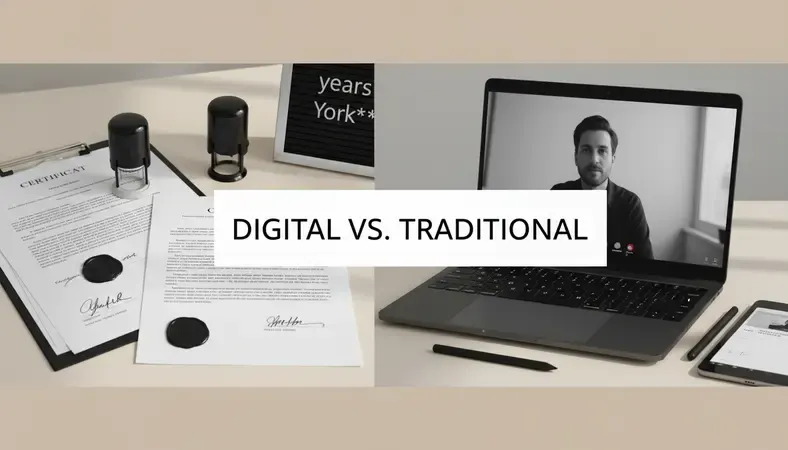
A traditional notary licence authorizes in-person notarizations. The signer must physically appear before the notary. A RON certification — sometimes called a remote online notary authorization — allows a notary to perform notarizations via live audio-video technology, without anyone being in the same room.
Traditional Notary Licence vs RON Certification
| Feature | Traditional Notary Licence | RON Certification |
|---|---|---|
| Signer location | Must be physically present | Anywhere with internet access |
| Technology required | None | Audio-video platform, digital tools |
| Additional authorization | Not needed | Separate RON authorization required |
| Document format | Paper | Electronic |
| States that allow it | All 50 states | 40+ states (and growing) |
| Best for | Local, in-person signings | Remote signings, real estate, legal docs |
You must already hold a valid notary licence before you can apply for RON authorization. The RON certification is an add-on, not a replacement. You'll also need to use an approved RON platform that meets your state's technology standards.
Platforms like BlueNotary make the RON process straightforward — handling the audio-video session, identity verification, and electronic seal in a single compliant workflow.
How Long Does a Notary Licence Last?
Most notary commissions last four years, though some states issue shorter terms. New York, for example, issues two-year commissions. A few states use different intervals entirely.
When your commission expires, you don't automatically lose the ability to become a notary — you simply need to renew. The renewal process is usually similar to the initial application, though some states waive the exam for renewals.
If you let your commission lapse and continue notarizing, any documents you notarize during that gap are legally invalid. That's a serious problem for anyone relying on those documents. Mark your expiration date and start the renewal process at least 60 days before it arrives.
What Can You Do With a Notary Licence?
A notary licence opens up several practical and professional opportunities:
- Notarize legal documents: Deeds, affidavits, powers of attorney, wills, and contracts
- Administer oaths: For affidavits, depositions, and official statements
- Certify copies: In states that permit it, certify that a copy of a document is a true reproduction of the original
- Serve as a loan signing agent: With additional training, handle mortgage and real estate closings — one of the most lucrative uses of a notary licence
- Offer mobile notary services: Travel to clients rather than working from a fixed office
- Become a remote online notary: With RON authorization, notarize documents for signers anywhere in the country
The notary licence is also a common credential for legal support professionals, real estate agents, title company employees, and administrative professionals who regularly handle sensitive documents.
For more context on how notarization works within the broader legal system, the Wikipedia entry on notary publics provides useful background on the role's history and scope.
Common Questions About Notary Licences
Do I need a notary licence to get documents notarized?
No. You only need a notary licence if you want to perform notarizations. If you need a document notarized, you just need to find a commissioned notary — at a bank, UPS store, through a mobile notary, or via a RON platform like BlueNotary.
Can I notarize documents in any state with my licence?
No. A notary licence is state-specific. You can only notarize documents in the state that issued your commission. If you frequently work across state lines, you'd need to obtain a commission in each state — or use RON, which some states allow across jurisdictions.
Is a notary licence the same as a notary certification?
Not exactly. Some organizations (like the National Notary Association) offer voluntary certifications that demonstrate additional training. These aren't the same as the state-issued commission. The commission is the legal requirement; the certification is a professional credential.
Can a notary refuse to notarize a document?
Yes. A notary can — and sometimes must — refuse if they have reason to believe the signer is being coerced, doesn't understand what they're signing, or if the document appears fraudulent. A notary is not required to notarize any document presented to them.
What happens if a notary makes a mistake?
Errors in notarization can render documents invalid. This is why surety bonds exist — they provide a financial remedy if a notary's mistake causes harm. Notaries can also purchase errors and omissions (E&O) insurance for additional protection. For guidance on electronic notarization requirements, the National Conference of State Legislatures tracks current state laws.
Key Takeaways
A notary licence is a state-issued commission — straightforward to obtain, affordable to maintain, and genuinely useful for anyone who regularly handles legal documents or wants to offer notarial services professionally. If you already hold a notary licence and want to notarize documents remotely, complete your first remote online notarization with BlueNotary — no office visit required, legally compliant in minutes. Ready to get started? Visit BlueNotary to learn more.