






Think of a Notice of Commencement (NOC) as the official starting gun for a construction project. It’s a public document that gets filed to formally announce that work is about to begin, clearly identifying the key players and setting the project's official start date. This simple form is the bedrock of financial security and transparency for everyone involved.
What Is a Notice of Commencement in Construction?
A Notice of Commencement is much more than just another piece of administrative paperwork; it's the project's official "birth certificate." This legal document is filed in public records to formally signal the start of construction or property improvements. Its main job is to create a transparent, official record that protects every single party tied to the job, from the property owner all the way down to the smallest supplier.
Imagine trying to build a house without a blueprint. It would be chaos. The NOC serves a similar purpose for a project's financial and legal structure, laying out all the essential information in one place so everyone is working from the same set of facts.

The Core Function of an NOC
At its heart, a Notice of Commencement is a communication tool. It’s a critical legal document used to formally mark the start date of any work. By filing the NOC with the county clerk where the project is located and posting it at the job site, owners put all stakeholders on notice that the project is kicking off. It’s vital for subcontractors and suppliers, as it identifies key contacts and details about the scope of work. You can get more insights on this foundational document at billd.com.
The document establishes a crucial timeline. The date the NOC is recorded becomes the official start date that determines the priority of any future mechanic's liens. This ensures that anyone who provides labor or materials to the project after this date has a clear path to protect their right to get paid.
Key Components of a Notice of Commencement
A quick look at the essential information included in an NOC and why each piece matters.
| Component | Description | Why It's Important |
|---|---|---|
| Property Owner's Information | Full name and address of the legal property owner. | Identifies who is ultimately responsible for the project and payments. |
| Property Description | The legal description of the property, often including the street address and lot number. | Clearly defines the physical location where the work is being performed. |
| General Contractor Details | Name and address of the primary contractor managing the project. | Provides a direct point of contact for subcontractors and suppliers. |
| Lender Information | Name and address of any institution financing the project. | Secures the lender's interest and informs parties where the funding is coming from. |
| Surety/Bonding Company | Information on any payment bond that secures the project. | Offers another layer of payment protection for subcontractors and suppliers. |
| NOC Effective Date | The official date the project commences. | Establishes the priority date for all subsequent mechanic's liens. |
Each of these components works together to create a complete picture of the project's legal and financial framework, preventing confusion down the road.
Who Is Involved
Typically, the responsibility for filing the Notice of Commencement falls to the property owner or their designated agent, like the general contractor. When a project is financed, the lender often requires the NOC to be filed before they release any funds, which really shows you how important it is in the financial chain of command.
The document is there to serve several key parties:
- Property Owners: It protects them from hidden liens and the nightmare scenario of paying twice for the same work.
- General Contractors: It gives them a clear project start date and helps ensure all their subcontractors are compliant.
- Subcontractors & Suppliers: It gives them the info they need to file preliminary notices and secure their lien rights, making sure they have a legal path to get paid.
- Lenders: It secures their interest in the property by creating a clear timeline for all financial claims.
In essence, the Notice of Commencement acts as the central information hub for a construction project. It connects all the spokes—owner, contractor, subs, and suppliers—to the wheel, allowing the project to move forward smoothly and with total legal clarity.
Without a properly filed NOC, the whole payment protection system can fall apart, leaving subcontractors unpaid and owners vulnerable to unexpected financial claims. Getting this document right isn't just a good idea; it's an essential first step in managing risk.
Why the Notice of Commencement Is a Legal Shield
Sure, a Notice of Commencement officially kicks off a project, but its real power is in acting as a legal shield. This isn't just another form to file; it's a savvy risk management move that builds a transparent and secure financial foundation for everyone involved, from the property owner all the way down to the material supplier.
When it's filed correctly, it stops a whole chain reaction of costly disputes that can completely derail a project.
Think of the NOC as the project's payment nerve center. It sends clear signals to every single party, making sure everyone knows who's in charge, who's funding the work, and what the official start date is. That transparency is the secret sauce to its protective power.
A Master Key for Subcontractors and Suppliers
For subs and suppliers, a properly filed Notice of Commencement is the master key to protecting their payment rights. The details inside it—the owner's name, the general contractor's info, and the legal property description—are absolutely critical for them to file their own protective documents, like a Notice to Owner or preliminary notice.
Without a recorded NOC, these downstream teams are basically flying blind. They might not know who to send their notices to, or worse, they could send them to the wrong person and accidentally give up their right to file a mechanic's lien. And let's be honest, a mechanic's lien is often the only real leverage a sub has to get paid for the work they've already done.
Picture this scenario:
- A lumber supplier drops off $50,000 worth of materials at a job site.
- The property owner never bothered to file a Notice of Commencement.
- The general contractor goes belly-up without paying the supplier.
- The supplier, with no public NOC to find the official owner information, misses the deadline to secure their lien rights.
In that situation, the supplier is out a huge chunk of money, all because the project's foundational legal document was missing.
Safeguarding Owners from Hidden Liens and Double Payments
Now, flip the coin. For a property owner, the NOC is a crucial defense against surprise financial claims and the absolute nightmare of double payments. By officially recording the project's start and identifying the key players, the owner draws a clear line in the sand. Any payments made after the NOC is filed are generally considered "proper payments" by law.
This protection is huge. When an owner pays their general contractor, they rightfully expect that cash to trickle down to the subcontractors and suppliers. But if the GC doesn't pay them, those unpaid parties can slap a lien directly on the owner's property.
A properly filed Notice of Commencement protects the owner by limiting their liability to the original contract amount. It effectively blocks "hidden" liens from subcontractors they never even knew existed, forcing all payment claims into a transparent, legally recognized process.
Without a valid NOC, an owner could pay their contractor in full, only to get slammed with multiple liens from unpaid subs. They'd be forced to pay again just to clear the liens and avoid foreclosure on their own property—a devastating and totally preventable outcome.
Creating a Transparent and Fair Project Environment
At the end of the day, the Notice of Commencement creates a fair and predictable environment for everyone. It swaps ambiguity for clarity, establishing a single source of truth that defines the project’s legal and financial boundaries from day one.
This proactive step cuts down on disputes, makes communication smoother, and ensures everyone’s rights are protected. By acting as a legal shield, the NOC doesn't just check a box on a compliance list; it builds the trust and accountability needed for any construction project to succeed. It ensures owners get what they paid for without any nasty surprises, and that every contractor and supplier has a clear path to getting paid for their hard work. Ignoring it isn't just a minor oversight—it's an open invitation to financial chaos.
How NOC Filing Rules Change State by State
A Notice of Commencement isn't a one-size-fits-all document. Its requirements are dictated entirely by state law, which means the process that works perfectly in Florida could be completely invalid in Ohio. This variation is exactly why understanding your local statutes is non-negotiable for anyone in the construction business.
Navigating these differences is critical. Some states mandate filing an NOC for projects over a certain value, while others don’t use the document at all, relying on different systems to manage lien rights. Assuming a single standard exists is a direct path to costly legal headaches and jeopardized payment protections.
Spotlight on Key States
Let’s take a look at how the rules for a Notice of Commencement shift across states where it’s a common requirement. The differences in deadlines, responsibilities, and required information really highlight the importance of local expertise.
Florida: Florida is arguably the most well-known state for NOC usage. An NOC is required for most construction projects valued over $5,000 and must be filed before any work begins. The owner is responsible for signing and recording it with the county clerk and posting a certified copy right there at the job site.
Ohio: In Ohio, the rules are similar but have their own flavor. The NOC must be filed before work starts, but it applies to a wider range of projects. The owner, lessee, or their agent files the document, and failing to do so can extend the deadline for subcontractors to file their mechanic's liens.
Georgia: Georgia also requires an NOC, but it must be filed within 15 days of the project starting. A key difference here is that filing an NOC in Georgia limits the lien rights of parties who don't have a direct contract with the property owner, making it a powerful tool for owners looking to manage project risk.
Michigan: Michigan uses a Notice of Commencement for both residential and commercial projects. It must be recorded before the project starts and posted at the site. Subcontractors and suppliers then have to provide a Notice of Furnishing to the owner and general contractor within 20 days of their first work to protect their lien rights.
Comparison of NOC Requirements in Key States
To make these distinctions clearer, let's compare the core requirements side-by-side. Think of this table as a quick reference guide for contractors, owners, and suppliers working across state lines.
| State | Filing Deadline | Who Files | Key Information Required |
|---|---|---|---|
| Florida | Before work starts | Property Owner | Must be posted at the job site. |
| Ohio | Before work starts | Owner or Agent | Failure to file extends lien deadlines for others. |
| Georgia | Within 15 days of starting | Property Owner | Subcontractors must file a Notice to Contractor. |
| Michigan | Before work starts | Owner or Lessee | Subcontractors must send a Notice of Furnishing. |
As you can see, while the concept is similar, the execution is highly specific. Each state's Secretary of State website is a primary resource for finding official statutes and forms; our list of Secretary of State websites can help you quickly find the correct one for your project's location.
The core takeaway is this: A Notice of Commencement is a creature of state law. Never assume the rules are the same from one state to another. Always verify local requirements with the county recorder's office where the project is located.
While NOC rules vary by jurisdiction, the idea of having formal startup requirements for construction projects is universal. For example, in the UK, securing planning permission is fundamental to any build, which involves understanding crucial documents like site plans and location plans. This just illustrates a core principle in construction: formal, public declarations are essential for a project’s legality and transparency, no matter where you are in the world.
A Step-By-Step Checklist for Filing Your NOC
Filing a Notice of Commencement can feel like a mountain of paperwork, but it doesn't have to be. The best way to tackle it is to think of it as a simple checklist. Getting these steps right, in the right order, is your best defense against the kind of common mistakes that can put your project's financial security at risk.
We've broken down the whole process into five straightforward, actionable steps. Follow this guide from gathering your details to posting the final document, and you'll have an NOC that's accurate, compliant, and ready to protect your project from day one.
1. Gather All Essential Project Information
Before you even think about filling out a form, your first job is to get all your ducks in a row. This is the foundation of your NOC, and accuracy is everything. One slip-up here, like a typo in the legal property description, can render the whole document useless. Get this part right, and the rest is smooth sailing.
Here’s what you need to round up:
- The Full Legal Property Description: This isn't just the street address. You’ll find the official description on the property deed or by checking with the county property appraiser's office.
- Owner and Contractor Details: Make sure you have the full legal names, addresses, and contact info for both the property owner and the general contractor.
- Lender and Surety Information: If there’s a loan or a bond on the project, you'll need the exact names and addresses for the bank or lending institution and the surety company, including any bond numbers.
- Project Scope: Just a clear, brief description of the work. Something like, "Construction of a new single-family home with a two-car attached garage" is perfect.
2. Complete the NOC Form Accurately
With all your information in hand, it's time to fill out the official Notice of Commencement form. Most county recorder offices have a template you can use, but it's crucial to make sure you have the right version for your specific jurisdiction. Every single field needs to be filled out with care.
Pay extra attention to dates and names. Double-check the spelling of everyone involved and confirm the project start date. This isn't a place for estimates or typos—this document is about to become a public record and the legal backbone of your project.
3. Get the Document Properly Notarized
A Notice of Commencement is a sworn statement, which is a formal way of saying it has to be signed by the property owner (or their authorized agent) in front of a notary public. An NOC that isn't notarized is completely invalid and offers zero protection. This step is what officially verifies the signer's identity and the document's authenticity.
This is the exact point where projects often hit a snag. Setting up in-person appointments with a notary can be a hassle and lead to frustrating delays. Thankfully, modern solutions now let you get this done remotely, which can be a huge time-saver.
4. Record the NOC with the Correct County Office
After it's notarized, the NOC needs to be officially recorded. This is done at the clerk of the court or the county recorder's office in the same county where the project is happening. This is what makes the document an official public record. Filing it in the wrong county is the same as not filing it at all.
Timing here is absolutely critical. The NOC has to be recorded before a single worker starts or any materials are delivered to the site. Filing it even one day late can create serious problems for lien rights and owner protections.
5. Post a Certified Copy at the Job Site
The final piece of the puzzle is making sure everyone on the project can see the recorded NOC. State laws require a certified copy to be posted in a prominent spot on the job site where it’s protected from the weather. Usually, this means right next to the building permit.
This step ensures that any subcontractor or supplier who comes on-site can easily find the info they need to protect their own payment rights. For anyone involved in home construction, understanding related documents is just as important. For additional guidance, you can explore this useful home improvement contract template to ensure all your project agreements are sound.
Common Notice of Commencement Mistakes to Avoid
A mistake on a Notice of Commencement isn't just a typo; it can unleash a wave of expensive problems, putting lien rights in jeopardy and leaving property owners open to surprise financial claims. While it looks like just another form, even tiny errors can completely wipe out its legal protections. Knowing where the common landmines are is the first step to protecting your project from legal and financial chaos you can see coming a mile away.
Navigating the rules for a Notice of Commencement is absolutely critical, but even the most careful teams can make small mistakes that spiral into huge issues. These aren't just simple clerical oversights—they are cracks in the very legal foundation of your project.
The process has a few key steps that you have to nail perfectly to stay compliant and keep everyone protected.
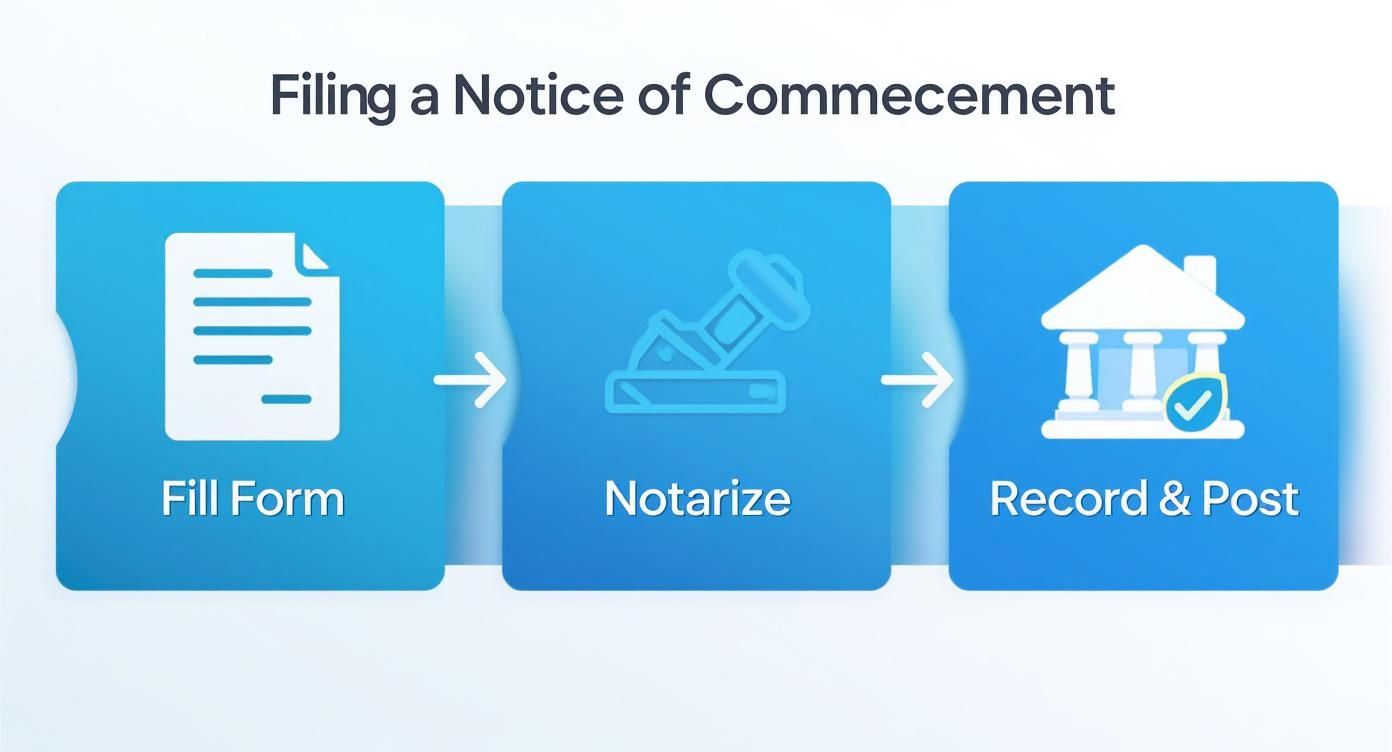
This flow chart breaks down the critical stages—filling out the form, getting it notarized, and recording it publicly. Each of these steps is a potential pitfall if you're not paying close attention.
Inaccurate or Incomplete Information
One of the most common—and damaging—mistakes is filing an NOC with shoddy details. Using a simple street address instead of the complete legal property description is a classic blunder. An incorrect property description can make the whole document worthless because it fails to properly identify the property that's being worked on.
In the same way, a typo in the owner's or general contractor's name can create a world of confusion. If a subcontractor can't clearly identify the key players from the NOC, their ability to file a valid Notice to Owner and lock in their lien rights is suddenly at risk.
Preventative Strategy: Always, always check your information against official records. Pull the legal property description straight from the property deed or county records. Double-check the spelling of every single name and the accuracy of every address before you sign anything.
Missing Critical Filing Deadlines
With a Notice of Commencement, timing is truly everything. Most states that require an NOC insist that it be filed before a single hammer swings or any materials get dropped off. Filing just one day late can have massive consequences, potentially erasing the owner's protection against having to pay twice for the same work.
Forgetting to file it at all? That's even worse. In a state like Florida, if your project is over $5,000, failing to file an NOC means any payments the owner makes to the general contractor might not be seen as "proper payments." This leaves them on the hook for subcontractor liens, even if they've already paid the GC in full.
Failure to Post the Notice On-Site
Getting the NOC recorded with the county is only half the job. The law also demands that a certified copy of that recorded document gets posted in a visible, weather-protected spot right at the job site. This isn't just for show; it's to make sure that every subcontractor, supplier, and worker on the property can easily find the project's official details.
Failing to post the notice can be treated as if you never filed the NOC in the first place. This simple oversight can gut the owner's protections and create a mess for subs who are just trying to follow their own notice rules.
- Common Posting Mistake: Tucking the notice away inside a locked job site trailer where nobody can see it.
- Best Practice: Post the NOC right next to the building permit. Stick it in a clear, weatherproof holder that's easy to spot from the street.
Getting the Notice of Commencement right from the get-go isn't just about checking a box for compliance. It's about setting the project up for transparency, security, and success. By steering clear of these common mistakes, you ensure your project's legal shield is locked firmly in place.
How Digital Tools Are Finally Modernizing the NOC Process
Let's be honest: the traditional Notice of Commencement process is a headache. It often feels like a frustrating paper chase, from juggling schedules for in-person notary appointments to physically trekking documents down to the county recorder's office. This old-school workflow isn't just slow; it's a minefield for costly errors and delays that can stop a project before it even starts.
But thankfully, digital tools are completely flipping the script. What was once a cumbersome requirement is becoming a secure, efficient, and surprisingly simple part of the project kickoff. Modern platforms are ditching outdated methods for faster, more reliable solutions. Instead of relying on snail mail or expensive couriers, construction pros can now manage this vital legal document from anywhere, at any time.
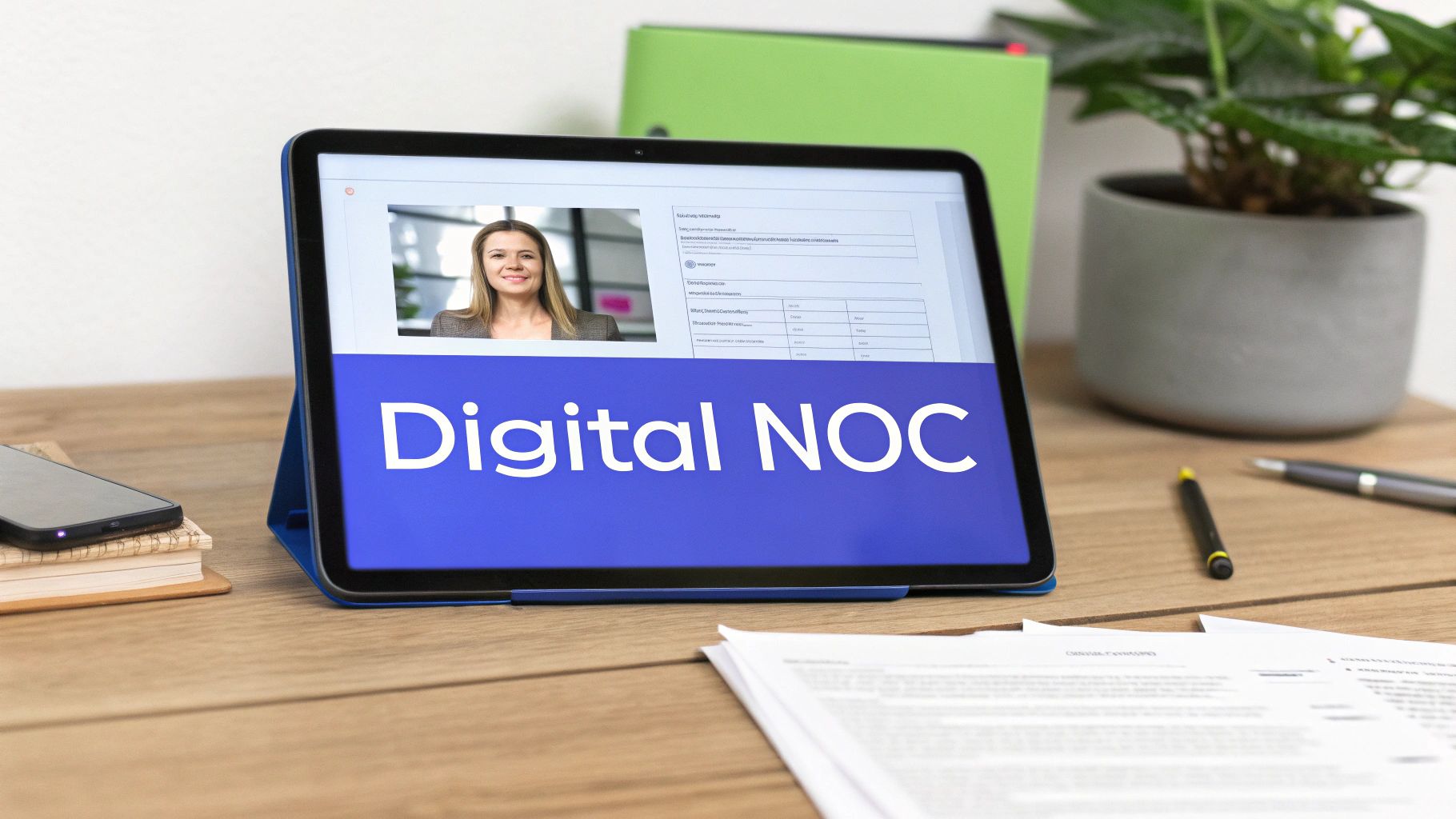
This kind of clean, simple interface shows just how easy it is to connect with a notary online. The days of traveling across town and dealing with scheduling conflicts are over. Being able to upload, sign, and notarize a notice of commencement in minutes is what keeps projects moving forward right from day one.
Remote Online Notarization Is a Game-Changer
Historically, one of the biggest hurdles in filing an NOC has been the notarization itself. This critical step requires the property owner to physically sign the document in front of a commissioned notary public—a logistical nightmare for busy owners, especially those who live out of state.
This is exactly where Remote Online Notarization (RON) comes in. RON platforms connect a property owner with a certified notary through a secure, live video session. The technology offers some massive advantages:
- Unbeatable Speed and Convenience: An owner can get their notice of commencement notarized in as little as 10 minutes from their office, home, or even a job site. No more travel, no more scheduling headaches.
- Serious Security: RON sessions use sophisticated identity verification tools and create a tamper-evident digital seal. In many ways, it offers a higher level of security than traditional, in-person methods.
- Total Accessibility: For property owners who are out-of-state or even out of the country, RON makes it possible to execute crucial documents without booking a flight.
You can see for yourself how a remote online notary can slot right into your workflow.
Cutting Down on Errors and Staying Compliant
Beyond just the notarization, digital platforms are a powerful weapon against human error. Guided digital templates for the NOC make sure all the mandatory information is filled out correctly, preventing common slip-ups like using the wrong legal property description. That built-in compliance check is worth its weight in gold.
Digital solutions create a secure, auditable trail for every single notice of commencement. Once it's notarized and recorded, the document can be stored and shared digitally, giving every stakeholder instant access to the official record.
These platforms also make submitting the documents a breeze. In an industry where efficiency is everything, knowing your options—even for seemingly old-school tasks like learning how to send faxes online—can streamline the entire process. By embracing these tools, construction professionals can dramatically cut down on risk, simplify compliance, and keep their projects moving without getting bogged down by administrative friction.
Your Top Questions About Notices of Commencement, Answered
Jumping into the world of construction law and documents like the Notice of Commencement can feel a little overwhelming. But don't worry, once you get the hang of a few key concepts, it's pretty straightforward. Here are some quick answers to the questions we hear most often, designed to help you handle the process like a pro and sidestep any costly mistakes.
What Happens If I Just… Forget to File an NOC?
Forgetting to file a Notice of Commencement is one of those small oversights that can lead to massive financial headaches. For a property owner, it strips away your primary legal shield against mechanic's liens. This could put you in the nightmarish position of paying for the same job twice—once to your general contractor and then again to a subcontractor who never got paid.
And it’s not just the owners who are at risk. If you’re a subcontractor or supplier, the lack of a filed NOC can completely invalidate your right to file a mechanic's lien. That lien is often your most powerful—and sometimes only—tool for getting paid for the work you’ve already done.
Do I Really Need an NOC for a Small Home Renovation?
This is a classic "it depends" situation, and it all comes down to your state's laws and the total project cost. Many states draw a clear line in the sand. Florida, for example, requires a Notice of Commencement for any project valued at $5,000 or more. So while a quick paint job might fly under the radar, a full kitchen remodel almost certainly won't.
Pro Tip: Never guess or assume your project is "too small." The only way to be sure is to check the specific rules with your local county recorder's office before a single hammer swings. It’s a quick check that can save you a world of trouble.
Can I Change a Notice of Commencement After It's Filed?
Absolutely. In fact, you should amend your NOC if any of the critical details change after you've filed it. Keeping the public record accurate is essential if you want the document's legal protections to hold up.
What kind of changes warrant an amendment?
- Swapping out the general contractor for a new one.
- Securing new financing or switching lenders.
- Any updates to the project's surety or bonding information.
In these situations, you'll either file a formal amendment or a Notice of Termination followed by a brand-new NOC. This makes sure everyone involved is on the same page and working with the correct information.
Filing a Notice of Commencement shouldn’t slow you down. With BlueNotary, you can get your documents notarized online, 24/7, in about 10 minutes. It's a secure and efficient way to ensure your project kicks off on time and in full compliance. Learn more about how BlueNotary simplifies the process.