



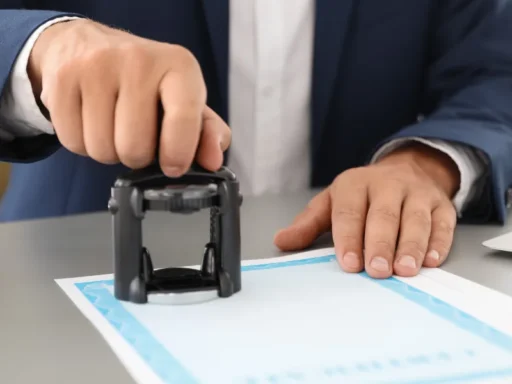


Yes, online notarization is legal in New Jersey. A 2021 law lets New Jersey notaries notarize remotely by live video after notifying the State Treasurer of their technology. You show ID, sign on camera, and the notary applies an electronic seal. Costs vary by provider, while in-person fees are capped by state law.
Is online notarization legal in New Jersey?
Yes. New Jersey permanently authorizes remote online notarization. Governor Phil Murphy signed Assembly Bill 4250 on July 22, 2021, creating the New Jersey Law on Notarial Acts, which lets notaries perform in-person electronic notarizations and remote notarizations through communication technology. The law is modeled on the Revised Uniform Law on Notarial Acts.
Holland & Knight’s summary says the law permanently authorizes notaries to notarize electronic documents signed in their presence and to notarize tangible and electronic documents through communication technology when the signer is in a different location (Holland & Knight). The National Notary Association’s summary adds that the law requires journals, a new official stamp, and education, and provides for notarial acts on electronic records and for remotely located individuals (NNA).
The statute says a notarial officer located in New Jersey may perform a notarial act using communication technology for a remotely located individual if the statute’s requirements are met, and that such an act is deemed performed in New Jersey and governed by New Jersey law (N.J.S.A. 52:7-10.10). Before a notary performs the first remote act, the notary must notify the State Treasurer and identify the technologies the notary intends to use (NNA U.S. Notary Reference).
How does an online notary work in New Jersey?
You upload an unsigned document, verify your identity, meet a notary on live video, sign while the notary watches, and receive the sealed file. A virtual notary is simply a commissioned notary who does this by video. The steps are similar to in-person notarization, except the meeting happens through communication technology.
1. Prepare the document as a PDF, complete and unsigned.
2. Confirm that the person or office receiving it accepts online notarization.
3. Upload the document, choose Notarize Now or schedule, and verify your identity.
4. Join the live video session and show your ID to the notary.
5. Sign while the notary watches; the notary completes the certificate and applies the seal.
6. Download the sealed copy and send it as delivered.
On BlueNotary, the steps follow its signer instructions, last updated July 14, 2026, and its identity guide lists accepted IDs and the KBA or biometric options. For a full walkthrough, see BlueNotary’s guide to how online notarization works. The notary’s identity-proofing and recording duties come from New Jersey’s statute and the Treasurer’s rules, which the notary follows.
Have an unexpired government-issued photo ID ready. BlueNotary’s identity guide lists a driver’s license, REAL ID or state ID, passport card, passport book, and permanent resident card as accepted options, offers KBA or a biometric scan, and says non-U.S. citizens use a passport book with a biometric scan. You also need a device with a camera and microphone and a stable connection, because the notary must be able to see and hear you throughout the session.

How much does an online notary in New Jersey cost?
It depends on the provider. On BlueNotary, one signer and one stamp is $25, each extra stamp is $8, and each extra signer is $5. New Jersey also caps what notaries may charge per act, so in-person fees are very low. Compare both before you choose, since online adds convenience, not a lower price.
| Option | Typical charge | Notes |
| In-person notary, most acts | Up to $2.50 per notarial act | Statutory cap per a secondary summary; many notaries charge little or nothing |
| Real estate transfer | Up to $15 per transaction (grantors) | Cap from the same summary |
| Real estate financing | Up to $25 per transaction (mortgagors) | Cap from the same summary |
| BlueNotary online, one signer, one stamp | $25 | Includes the live session with a notary |
| BlueNotary extras | $8 per extra stamp, $5 per extra signer | Witness free if you bring one, $10 if BlueNotary provides one |
New Jersey’s standard notary fee is $2.50 per act for most services, $15 per transaction for real estate transfers, and $25 per transaction for financing, according to a notary compliance site (NotaryAct), and another summary says the state caps fees at $2.50 per act (Notary Requirements). Those secondary sources are not the statute, so confirm current limits with the Division of Revenue and Enterprise Services. These sources do not address how the cap applies to a platform’s charges, so ask your provider what its price covers.
BlueNotary’s rates are on its fee schedule (checked October 2026). A document with two signers and one stamp would be $25 plus $5, or $30. Business teams that notarize often can ask about plans on BlueNotary’s pricing page.
What can and cannot be notarized online in New Jersey?
Most documents in PDF form can be notarized online, but wills and similar documents are carved out, and the receiving party decides whether to accept the result. Real estate and court documents often need extra care, so check with the lender, title company, court, or attorney before you book.
New Jersey’s rule on electronic notarization excludes wills, codicils, and testamentary trusts (N.J.A.C. 17:50-1.16), and the remote-notarization statute has its own treatment of tangible records governed by wills and codicils law (N.J.S.A. 52:7-10.10). BlueNotary’s help center says it can accept most documents, excluding those submitted to a foreign embassy, codicils and testamentary trusts, and Form I-9, and that acceptance is up to the receiving party.
• Good fits: business contracts, personal agreements, government forms, affidavits, and many powers of attorney.
• Check first: real estate closing documents, court filings, and anything for use abroad.
• Not available online: wills, codicils, and testamentary trusts.
What must a New Jersey notary do to notarize remotely?
A commissioned New Jersey notary must notify the State Treasurer before the first remote act and identify the technology used, keep a journal of every notarial act, and follow identity and recording rules. Non-attorney applicants pass an exam. These duties apply to the notary, not to you as the signer.
The statute requires the notification before a notary’s initial remote act (N.J.S.A. 52:7-10.10), the NNA’s reference lists the exam for non-attorney applicants and the notice requirement (NNA U.S. Notary Reference), and a compliance site says the 2021 law requires a journal of every notarial act, paper or electronic (NotaryAct). A commissioning guide says any commissioned notary can add remote notarization by notifying the Treasurer and choosing a compliant technology, with a $25 state application fee for the commission itself (Notary Requirements).
When is an in-person notary better in New Jersey?
In-person is often better for a single simple signature, because New Jersey’s fee caps are low and many banks and local notaries charge little or nothing. It is also better when a recipient requires wet ink, a court or recorder wants a paper original, or a document type is excluded online.
| Your situation in New Jersey | Better first choice |
| One simple signature and a local notary is nearby and open | In-person notary, given the low statutory cap |
| After hours, on a weekend, or you cannot travel | Online notary by video |
| Signers in different cities or states | Online notary; each signer joins from their own device |
| Will, codicil, or testamentary trust | In-person with an attorney |
| Recipient requires wet ink or a stamped paper original | In-person notary |
Online notarization fits better when you need a notary outside business hours, signers are in different places, or you want a recorded session and an electronic copy. If you only need a signature and no notary, BlueNotary’s eSign may be enough. See the remote online notarization page for how BlueNotary’s service works.
Document ready to sign? Notarize Online in New Jersey with BlueNotary after you confirm the receiving party accepts it.
FAQs
1. Is a virtual notary the same as an online notary?
Yes, in practice. Both terms describe a commissioned notary who notarizes by live video through communication technology instead of meeting you in person.
2. Do I have to be in New Jersey to use a New Jersey online notary?
Not necessarily. The statute covers a remotely located individual, and the act is deemed performed in New Jersey and governed by New Jersey law when a New Jersey notary performs it. Check the receiving party’s rules.
3. Can a New Jersey notary notarize a will online?
No. New Jersey’s rule on electronic notarization excludes wills, codicils, and testamentary trusts. Sign these in person with an attorney.
4. What does online notarization cost compared with in-person?
In-person fees are capped by state law, at $2.50 per act for most services according to secondary sources. BlueNotary charges $25 for one signer and one stamp, plus $8 per extra stamp and $5 per extra signer.
5. How do I know my notary is registered for remote notarization?
A New Jersey notary must notify the State Treasurer before the first remote act. Ask the provider how its notaries are credentialed and how you can verify a notary’s commission.
6. Will the other party accept an online notarization?
Often, but not always. Courts, agencies, lenders, and some recipients set their own rules, so confirm before you book.