





An online notary service is exactly what it sounds like: a way to get your documents legally notarized over the internet using a secure video call. Instead of the old routine—finding a local notary, driving over, and signing a paper logbook—you connect with a state-commissioned notary public from your computer or phone. It’s the modern, much-needed update to a centuries-old practice, often called Remote Online Notarization (RON).
What Is an Online Notary Service?
At its heart, an online notary service takes the entire in-person process and moves it into a secure digital space, but without losing an ounce of legal validity. Picture it like a high-tech, virtual office where you, the notary, and the document all meet. It's a full-service platform that blends live, face-to-face interaction with some seriously smart technology.
This approach shatters the old limits of notarization. No more dealing with scheduling headaches, traffic, or "we close at 5" signs. The notary comes to you, wherever you are, through a secure platform built for speed, accessibility, and trust.
The Core Components of Online Notarization
This isn't just a fancy Zoom call. A true online notary service is a sophisticated system designed from the ground up to be secure and legally binding. These platforms weave together several key technologies to not only match but often exceed the security of a traditional, in-person signing.
Here’s what makes it all work:
- Live Audio-Visual Connection: You meet face-to-face with a real, commissioned notary public in real-time. This is a crucial point—it’s not an automated bot. A certified professional guides you through the process and witnesses your signature live on camera.
- Advanced Identity Verification: Before you even get to the signing, the platform has to confirm you are who you say you are. This is a multi-step process, typically involving a scan of your government-issued ID and answering a few personal questions that only you would know (this is called Knowledge-Based Authentication, or KBA).
- Digital Documents and eSignatures: You simply upload your document to the platform. When it’s time to sign, you apply a legally-binding electronic signature that is cryptographically tied to the document.
- Tamper-Evident Sealing: Once everything is signed, the notary applies their digital seal. This seal is like a digital lockbox for the document. It creates a tamper-evident audit trail that instantly flags any alteration made after the fact.
- Secure Session Recording: The entire video and audio session is recorded and stored securely. This recording becomes irrefutable proof of the notarization, offering a level of verification that a simple paper journal entry could never match.
Before we dive deeper into the workflow, let's quickly compare the old way with the new.
Traditional Notary vs Online Notary Service
The differences between meeting a notary at a bank and meeting one online are pretty stark. One is rooted in paper and physical presence, while the other is built for a digital-first world. This table breaks down the key distinctions.
| Feature | Traditional Notary | Online Notary Service (RON) |
|---|---|---|
| Location | Must be physically present with the notary. | Anywhere with an internet connection. |
| Scheduling | Limited by office hours and travel time. | Available 24/7, on-demand. |
| Identity Proofing | Visual ID check and a signature in a paper journal. | Multi-factor authentication (ID scan, KBA, biometrics). |
| Security | Relies on a physical stamp and ink signature. | Digital, tamper-evident seal and a full audit trail. |
| Record Keeping | A handwritten entry in the notary's journal. | A secure audio-visual recording of the entire session. |
| Speed | Can take hours or days to coordinate and complete. | Often completed in under 15 minutes. |
| Cost | Varies by state, plus potential travel costs. | Competitive pricing, no travel expenses. |
As you can see, Remote Online Notarization doesn't just replicate the traditional process—it adds layers of security and convenience that simply weren't possible before.
The Growing Demand for Remote Solutions
The shift to online notarization isn't just a passing trend; it's a massive wave of adoption fueled by the need for more efficient and secure solutions. The global online notary market was valued at around $2 billion in 2025 and is on track to more than double, hitting a projected $4.3 billion by 2033. You can explore more of the data behind this growth in this online notary market trends report.
This explosive growth makes one thing clear: an online notary service has officially moved from a "nice-to-have" alternative to an essential tool for individuals and entire industries like real estate, law, and finance that can't afford to slow down.
How Does Online Notarization Technology Actually Work?
You might think an online notary service is some kind of digital magic, but it's really just a smart, multi-layered system built for one thing: trust. This isn't just hopping on a video call. It's a carefully orchestrated process that weaves together identity proofing, live video, and cryptographic security to create a final document that’s often even more secure than one notarized in person.
The entire setup is designed to answer three critical questions with rock-solid certainty:
- Are you who you claim to be? (This is all about Identity Proofing.)
- Did you sign freely and understand what you were signing? (That's the job of the Live Video Session.)
- Can we prove the document is exactly the same as when it was signed? (This is where the Digital Seal comes in.)
Let's pull back the curtain and see how the technology makes this happen, step by step. For a quick visual, check out our overview of how it all works.
The First Line of Defense: Identity Proofing
Before you even lay eyes on the notary, the platform has to be sure it's really you. Think of it like a bank teller inspecting your driver's license, but on steroids. Online notary platforms typically use a powerful one-two punch to verify your identity.
First up is Credential Analysis. You'll snap a picture of your government-issued ID, like a driver's license or passport, and upload it. The system's software doesn't just look at the photo; it scans for all the tiny security features—holograms, microprint, watermarks—and checks them against a massive global database to make sure the ID is the real deal and hasn't been faked.
Next, you'll probably face Knowledge-Based Authentication (KBA). This is a short, multiple-choice quiz pulled from your personal credit history and public records. The questions are tricky and personal, things only you would know, like a previous address or the amount of an old car loan. Pass both of these checks, and you're cleared for the live session.
At its core, Remote Online Notarization (RON) technology transforms a manual, paper-based ritual into a secure, auditable, and transparent digital event. Every step, from identity verification to the final digital seal, is recorded and protected against tampering.
This structured workflow provides a clear and secure path for every notarization.
The process is designed to be straightforward for you while maintaining tough security behind the scenes.
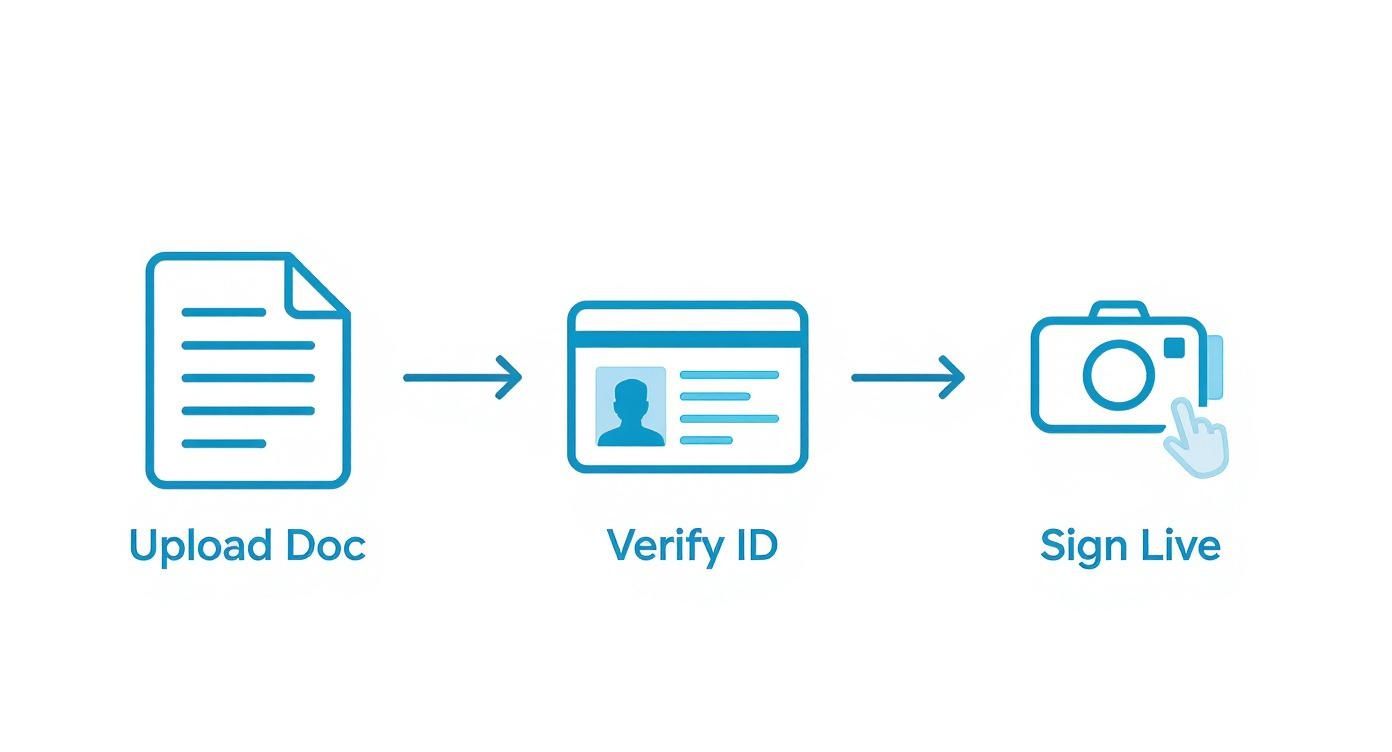
This graphic really simplifies it, showing how uploading your document, proving who you are, and signing live come together for a secure and seamless transaction.
The Live Notarization Session
Once your identity is locked in, you're connected to a live, recorded video session with a state-commissioned notary public. This isn't a chatbot or a pre-recorded message—it's a real person, face-to-face in real time.
During the call, the notary will visually confirm you match your ID, make sure you're aware of what you're signing, and watch as you apply your electronic signature. This live interaction is the key legal piece of the puzzle. It satisfies the "personal appearance" requirement in state laws, just as if you were sitting across a desk from them.
The whole audio-visual session is recorded and stored securely, creating a permanent, tamper-evident record of the entire event. This recording is ironclad proof of the notarization, offering a level of detail a traditional paper journal just can't touch.
Cryptographic Security and the Digital Seal
The last step is where the real tech muscle comes in. After you sign, the notary applies their digital notary seal and signature. This isn't just a picture of a seal—it's a powerful cryptographic tool that binds the notary's identity, your signature, and the document itself into a single, secure package.
This digital seal uses something called Public Key Infrastructure (PKI) to create a unique "digital fingerprint" for the document the moment it's notarized. If anyone tries to change even a single comma or period after the seal is applied, the digital signature will instantly break and show as invalid. This gives your document long-term, verifiable integrity.
It's no surprise that trust in this tech is growing fast. The global e-notary software market, valued at $261.99 million in 2025, is on track to blow past $797 million by 2037. That's a massive vote of confidence in these digital solutions.
Is Online Notarization Actually Legal?
When people first hear about online notary services, a common question pops up: is a document notarized over video actually legally binding? The short answer is a resounding yes. The legitimacy of Remote Online Notarization (RON) isn't some legal gray area or a clever loophole. It's built on a solid legal foundation that gives electronic documents and signatures the exact same weight as their traditional paper-and-ink counterparts.
This legal muscle comes from two landmark federal laws: the ESIGN Act of 2000 (Electronic Signatures in Global and National Commerce Act) and the UETA (Uniform Electronic Transactions Act). These two pieces of legislation fundamentally changed the game, establishing that a signature or record can't be dismissed or denied legal effect just because it's in an electronic format.
Think of it this way: an email can be a legally binding contract, right? In the same way, a document notarized on a secure online platform is a fully enforceable legal instrument. The technology has evolved, but the core legal principles of witnessing, verifying identity, and signing remain firmly in place.
The Power of Interstate Recognition
So, what happens if a notary in one state notarizes a document for a signer in another? This is where a cornerstone of the U.S. legal system called interstate recognition comes into play, backed by the Full Faith and Credit Clause of the Constitution.
This principle is simple but powerful: a notarial act, when performed correctly according to the laws of the notary's home state, must be recognized as valid in every other state.
- Here's a real-world example: A person sitting in their California home can legally connect with a commissioned online notary in Virginia to get a document notarized. Even though California has its own RON laws, it is required to recognize the Virginia notary's act as perfectly valid.
This system guarantees that your digitally notarized document carries its legal authority no matter where in the U.S. you need to present it. If you want to dive deeper, you can learn more about how states recognize notarizations from other states in our detailed guide.
The key takeaway is this: the legal validity of an online notarization depends on the notary's compliance with their state's RON laws, not on the signer's location. A properly executed online notarization is legally solid, nationwide.
This framework gives incredible flexibility to businesses and individuals, especially when people who need to sign the same document are in different cities or even different countries.
How States Handle Online Notarization
While federal law lays the groundwork, each state has the right to pass its own specific laws governing Remote Online Notarization. The good news is that a growing majority of states have fully embraced RON, enacting permanent laws that spell out the exact requirements for their notaries.
These state laws are what add layers of security and trust to the process. They typically dictate the specific technologies and identity verification standards an online notary platform must use, mandating features like:
- Rock-Solid Identity Proofing: Requiring multi-step authentication, which often involves analyzing a government-issued ID and asking a series of personal questions that only the true signer would know (Knowledge-Based Authentication, or KBA).
- Audio-Visual Recording: Mandating that the entire notarization session is recorded and securely stored, often for many years. This creates an indisputable digital audit trail of the entire event.
- Tamper-Evident Technology: Ensuring the platform uses cryptographic "sealing" to lock the final document down, making any subsequent changes or tampering immediately obvious.
This state-level oversight is what makes the process so trustworthy. When you use a reputable online notary service, you're working with a platform that is not just federally compliant but also meets the strict technological and procedural rules set by the states that commission notaries. The end result is a secure, convenient, and fully enforceable legal document.
When to Use an Online Notary Service
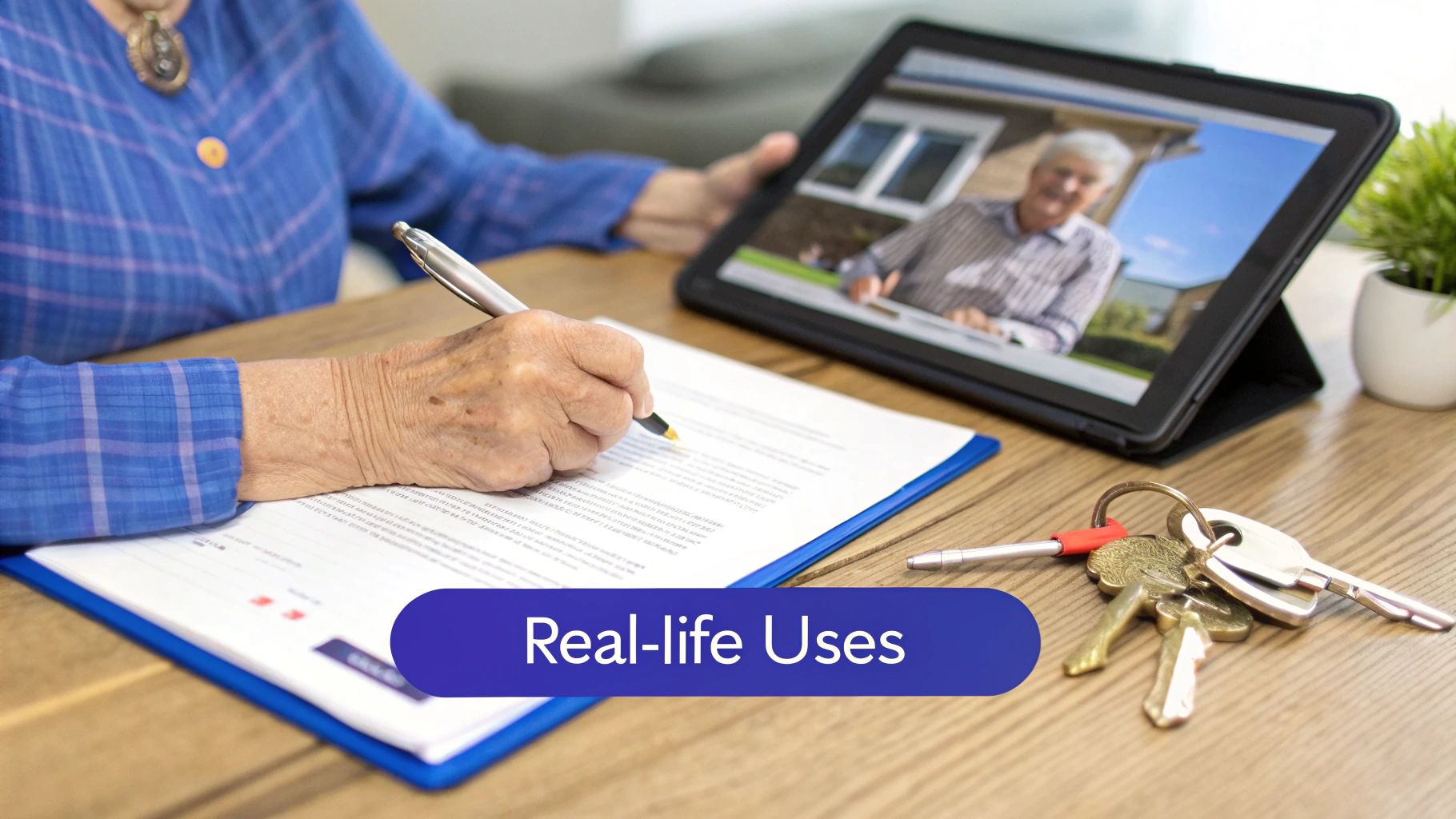
The real magic of an online notary service isn't the tech itself, but the real-world problems it solves. It's about bridging distances, saving precious time, and offering a secure path forward when getting to a notary in person is a headache—or flat-out impossible.
Let's step away from the technical jargon and look at where the rubber meets the road. These are the situations where remote online notarization (RON) goes from a neat idea to an absolute necessity for businesses and individuals every single day.
Real Estate Closings from Anywhere
Real estate is probably the industry that's been most dramatically reshaped by online notarization. Anyone who's bought or sold a house knows the traditional closing is a logistical nightmare. You have to get buyers, sellers, and agents all in the same room at the same time, which is easier said than done.
An online notary service blows those barriers away.
Think about a military family stationed overseas needing to close on their new home back in the States. Instead of dealing with costly international travel or the complexities of granting power of attorney, they can hop on a secure video call and sign all the closing documents in less than an hour. For anyone who can't be physically present, this is a total game-changer.
Or consider a real estate investor who buys properties in multiple states. With RON, they can manage and sign closing packages for different properties on the same day without ever leaving their desk. It speeds up the whole process and makes investing across state lines so much simpler.
Legal Documents and Life Planning
The legal world runs on notarized documents. They're the backbone of ensuring agreements are valid and enforceable. But the simple act of finding a notary can be a huge hurdle, especially for clients with mobility issues or those living in rural areas.
A perfect example is an elderly parent who needs to sign a power of attorney or a healthcare directive. A trip to a law office or bank might be physically difficult or just plain stressful. An online notary lets them handle this critical step from their own home, with family or their lawyer joining the video call for support.
An online notary service removes the friction from sensitive legal processes. It provides a secure, accessible, and dignified way for individuals to execute important documents like affidavits, wills, and trusts without the burden of travel.
This level of accessibility means essential legal protections don't get put on the back burner just because of logistics.
Accelerating Business and Commerce
In business, time is money. Delays are expensive. Waiting for all parties to physically sign a contract can stall projects, hold up funding, and create friction you just don't need. Online notarization is the solution that keeps business moving at the speed of, well, business.
Picture a startup founder trying to lock down an investment. The key stakeholders are scattered from New York to San Francisco. Instead of the old-school method of mailing documents back and forth—and waiting days for each signature—they can all meet in a virtual signing room. The investment agreements get signed, sealed, and notarized in one fell swoop, letting capital flow right away.
This applies to all sorts of business needs:
- Commercial Contracts: Finalizing deals with partners or vendors in different states or even different countries.
- HR Documents: Securely notarizing employment-related forms or consent agreements for a remote workforce.
- Corporate Resolutions: Executing official company decisions with board members who are miles apart.
The scale of this shift is massive. Online notary platforms have become essential infrastructure for companies managing tons of documents. For example, in 2025, one leading platform reported completing over 1.5 million notarizations, proving just how reliable these services have become in critical sectors. You can discover more insights about the leading remote online notarization platforms and their impact. It’s clear that businesses now rely on this technology for core operations, baking security and efficiency right into their workflows.
How to Choose the Right Online Notary Platform
With remote online notarization exploding in popularity, dozens of platforms have popped up, each promising the best service. But let’s be honest—not every online notary service is created equal. Picking the right one is a lot like choosing a bank. You have to look past the slick marketing and zero in on what really matters: security, compliance, and an experience that doesn't make you want to pull your hair out.
Making a bad choice can mean rejected documents, security risks, or a process that confuses you and your clients. To sidestep these headaches, you need a solid framework for evaluating your options. This will help you cut through the noise and find a provider that fits your needs, whether you're notarizing a single document or folding this service into your daily business operations.
Compliance and Legal Adherence
This is the big one—the absolute non-negotiable. A platform’s commitment to state and federal law is the bedrock of its entire service. The provider you choose must be 100% compliant with the specific RON laws in the state where its notaries are commissioned. This is what guarantees your notarization is legally sound and will be recognized nationwide.
Look for providers who are upfront about their compliance. They should be able to clearly explain how they adhere to federal laws like the ESIGN Act and UETA. If you're in a specialized field like real estate or healthcare, you'll also want to confirm they align with industry-specific standards, such as those from MISMO (Mortgage Industry Standards Maintenance Organization) or HIPAA.
Security and Identity Verification
You’re handing over sensitive documents and personal information, so the platform’s security needs to be rock-solid. Don't just take their word for it; dig into the specific technologies they use to protect your data and confirm identities.
A top-tier platform will have multiple layers of security:
- Robust Identity Proofing: The service has to use sophisticated tools to make sure signers are who they say they are. This usually involves credential analysis (scanning a government ID for security features) and knowledge-based authentication (KBA), which asks questions only the real person would know.
- Data Encryption: All your information, whether it's being sent over the internet or stored on their servers, should be locked down with powerful encryption.
- Secure Audit Trails: The platform must create a detailed, tamper-evident record of the entire session. This includes the video recording, digital signatures, and every step taken.
It’s crucial to understand how a platform handles your data, which is usually outlined in their Privacy Policy. You can also get a feel for their technical chops by looking into how they manage session verification, which is key to maintaining the integrity of every transaction.
User Experience and Ease of Use
What good is fancy technology if no one can figure it out? The best online notary services deliver a smooth, intuitive experience for everyone involved—the signer, the notary, and anyone else in the loop. The design should be clean, the instructions should be clear, and the whole process should feel simple from start to finish.
Put yourself in the user's shoes. Is it easy to upload a document? Are the ID verification steps straightforward? Does the video call connect without a hitch? A clunky, confusing platform creates frustration and can lead to mistakes or people giving up halfway through. Also, check if they offer 24/7 customer support, because when you're stuck, you'll be glad it's there.
A great user experience isn't a luxury; it's a core feature. The platform should empower users with confidence, not overwhelm them with complexity, turning a potentially stressful legal task into a simple, 10-minute transaction.
Platform Features and Integration Capabilities
Once you've covered the basics, look at the extra features that can make your life easier. For individuals, this might be access to document templates or the ability to add witnesses to a session for a small fee.
For businesses, the checklist gets longer. Does the platform have a central dashboard for managing multiple users and tracking documents? More importantly, can it be integrated into your existing software using an API (Application Programming Interface)? Plugging notarization directly into your workflow can be a game-changer for efficiency.
Before you make a final decision, take a close look at this comparison table. It breaks down the key features to help you weigh your options systematically.
Online Notary Platform Feature Comparison
| Feature | What to Look For | Why It Matters |
|---|---|---|
| State Compliance | Clear listing of states where notaries are commissioned and adherence to RON laws. | Ensures the notarization is legally valid and will be accepted nationwide. |
| ID Verification | Multi-factor authentication, including credential analysis and KBA. | Prevents identity fraud and protects all parties involved in the transaction. |
| Security | End-to-end data encryption and secure, tamper-evident audit trails. | Protects sensitive personal and financial information from unauthorized access. |
| User Interface (UI/UX) | Clean design, simple navigation, and clear instructions for signers and notaries. | A good experience reduces errors, saves time, and prevents user frustration. |
| API & Integrations | A well-documented API for connecting with other business software (e.g., CRMs, DMS). | Crucial for businesses looking to automate workflows and scale operations. |
| Pricing Model | Transparent pricing—either pay-per-notarization or subscription plans. | Allows you to choose a cost-effective model that matches your usage volume. |
| Customer Support | Availability of 24/7 support via live chat, email, or phone. | Ensures help is available immediately if technical issues arise during a session. |
| eClosing & MISMO | Specific features for real estate transactions, including MISMO compliance. | Essential for title companies and lenders to conduct fully digital closings. |
Finally, think about the cost. Some platforms charge per notarization, which is great for one-off needs. Others offer subscription plans that deliver more value for businesses handling a steady stream of documents. By carefully weighing these factors—compliance, security, usability, and features—you can confidently choose an online notary service that’s a perfect fit.
Got Questions About Online Notarization? We’ve Got Answers.
Switching to a digital process for something as important as notarization naturally brings up a few questions. After all, we’re talking about legal documents and personal identity, so you want to be sure you have all the facts. Let's tackle some of the most common questions we hear so you can feel completely confident moving forward.
We’ll break down everything from security and what you’ll need to get started, to how long it takes and using your documents internationally. The goal here is to clear up any confusion and give you the practical details for a smooth first experience.
Is It Really as Secure as In-Person Notarization?
Yes—and in many ways, it’s far more secure. A traditional notarization often hinges on a quick glance at an ID and a handwritten entry in a paper journal. A quality online notary service builds a much stronger, more verifiable chain of evidence through layers of digital security.
This isn’t just a simple video call. The enhanced security comes from a few key pieces working together:
- Multi-Factor Authentication: Before you even see the notary, the platform confirms your identity with a high degree of certainty. This involves processes like knowledge-based authentication (KBA)—those questions only you should know the answer to—and advanced ID verification that scans your government-issued ID for signs of fraud.
- Tamper-Evident Audit Trails: The entire audio-visual session is recorded and stored securely. This creates a detailed, unchangeable record of the signing event, offering way more proof than a simple signature in a logbook ever could.
- Cryptographic Sealing: Once notarized, the document is locked with a digital seal. This seal acts like a high-tech tripwire; if anyone tries to alter the document after the fact, the seal breaks, instantly revealing the tampering.
Together, these features create a transaction that is not only more convenient but often much more secure than the old-school, in-person alternative.
What Equipment Do I Need for an Online Notary Service?
You probably already have everything you need. The good news is there’s no special hardware or clunky software to install. Most modern platforms are designed to work right in your web browser.
Here’s the short list of what you’ll need to use an online notary service:
- A computer, tablet, or smartphone
- A working camera and microphone
- A reasonably stable internet connection
- A valid, government-issued photo ID (like a driver’s license or passport)
That’s pretty much it. The platform does all the heavy lifting behind the scenes, keeping the process simple and accessible for you.
How Long Does a Remote Notarization Take?
The speed is one of its biggest perks. While the exact time can shift a bit depending on how complex your document is or how many people are signing, the whole process is remarkably quick.
On average, a typical online notarization session—from starting the identity check to downloading your finished, sealed document—is done in just 10 to 15 minutes.
When you think about the time it takes to schedule, drive to, and wait for an in-person notary, the time savings are massive.
Can I Use a Document Notarized Online in Another Country?
This is a really important question, and the short answer is: it depends entirely on the country receiving the document. While a document notarized through a compliant online notary service is legally valid across all 50 U.S. states, its acceptance abroad isn’t automatic.
Different countries have their own rules about digital signatures and electronic notarizations. If you’re sending a document overseas, you might also need an extra layer of certification called an apostille. The most critical step is to check the legal requirements of the destination country or agency before you get the document notarized. This little bit of homework upfront will ensure your document is accepted without any hitches.
Ready to see just how fast and secure online notarization can be? With BlueNotary, you can connect with a certified online notary 24/7 and have your documents handled in minutes. Whether it's for your business or personal needs, our platform makes the entire process simple, compliant, and easy to access from wherever you are. Get your documents notarized online today.