






A title transfer notary is much more than just a person with a stamp. They are an impartial, state-commissioned witness who verifies the identities of everyone involved in a property or vehicle transfer. Their job is to make sure every signature is genuine and that no one is being forced to sign.
This official verification, sealed with a notarial stamp, is a powerful defense against fraud. It’s the final step that transforms a simple title document into a legally binding contract.
Why a Notary Is Essential for Your Title Transfer
Think of a notary public as the official gatekeeper for your ownership transfer. Their role goes far beyond a simple rubber stamp; they are your first line of defense in high-value transactions like real estate or vehicle sales.
This impartial verification process confirms that everyone is who they claim to be. More importantly, it ensures they are signing the documents willingly and with full understanding.
A notary's job is all about preventing fraud and creating legal certainty. They meticulously check government-issued IDs, physically witness the signing, and log the entire event in their official notary journal. This process offers serious protection for both the buyer and the seller.
- For Sellers: A notarized signature is your proof that you've legally given up your ownership rights and responsibilities. This protects you from future liability, like getting a bill for traffic violations on a car you no longer own.
- For Buyers: Notarization gives you confidence that the seller is the legitimate owner and has willingly transferred the title. It’s your best defense against someone trying to dispute your ownership down the road.
The Real-World Impact of Notarization
Trying to skip this step can backfire, badly. An unnotarized or improperly notarized title will likely be rejected by the DMV or county recorder's office. This can cause massive delays and might even void the entire sale.
Worse, it leaves the door wide open for someone to later claim they never signed the document or were forced to sign under duress.
The notary’s seal is more than just ink on paper; it represents a legal declaration that due diligence was performed. It’s what instills trust and enforceability into the document, making the transfer legally sound and recognized by official bodies.
Before we look at the specific responsibilities of a notary, it’s important to understand just how crucial their role is in the modern economy. This demand for trustworthy verification is a big reason why notary services are booming. The mobile notary service market, which is closely tied to title transfer notary work, was valued at around USD 0.42 billion and is projected to hit USD 0.74 billion. That growth is fueled by a nearly 49% demand increase from real estate and financial transactions alone, according to businessresearchinsights.com.
The table below breaks down exactly what a notary does during a title transfer and why each step is so important for a smooth, secure transaction.
Key Notary Responsibilities in a Title Transfer
| Notary Responsibility | Why It Matters for Your Title Transfer |
|---|---|
| Verify Signer Identity | This is the core of fraud prevention. The notary confirms that the person signing is the legal owner by checking a valid, government-issued photo ID. |
| Confirm Willingness and Awareness | The notary ensures that all parties are signing freely, without coercion, and understand the document they are signing. |
| Witness the Signature | The notary must physically or digitally (for RON) watch each person sign the title. This prevents forgeries and signature disputes. |
| Administer Oaths or Affirmations | For certain documents, the notary will place the signer under oath, adding a layer of legal gravity to their statements. |
| Complete the Notarial Certificate | The notary fills out the official certificate on the title, including the date, location, their signature, and their official seal or stamp. |
| Maintain an Official Journal | A detailed record of the notarization is kept in the notary's journal, which can serve as legal evidence if the transaction is ever questioned. |
Ultimately, a notary’s role is to affirm the authenticity of the signatures, which builds the confidence needed for a legal transfer of ownership. It provides the security and peace of mind you need to ensure your change of ownership is final and indisputable.
For a deeper look into the history of property ownership and how titles are tracked, check out this guide on understanding the chain of title.
Preparing Your Documents for a Flawless Notarization
A smooth title transfer notarization actually starts long before you ever meet the notary. Getting your ducks in a row ahead of time is the single best way to prevent hiccups and make sure your document is legally solid. Think of it as putting together a complete, verifiable package for the notary.
You'll need more than just the title itself. Most transactions require a few core pieces of paperwork to move forward. While the exact list can shift a bit depending on your state and situation, you should absolutely plan on having these items ready.
- The Certificate of Title: This is the big one—the official proof of ownership. Make sure you have the original document. Photocopies are a non-starter.
- A Valid Bill of Sale: This is your transaction receipt. It should clearly lay out the sale price, date, and the names and addresses of both the buyer and the seller.
- Lien Release Documentation: If there was ever a loan against the vehicle or property, you need an official document from the lender stating that the debt is paid in full. No exceptions.
- Government-Issued Photo ID: Every single person signing the document needs a current, unexpired photo ID. A driver's license or passport works perfectly. The name on the ID must perfectly match the name printed on the title.
The Most Important Rule: Do Not Sign Anything Yet
If you only remember one thing from this guide, make it this: Do not sign or date the title before you are in the presence of the notary—whether that’s in-person or virtually on a screen.
A notary's main job is to witness the physical act of you signing the document. If you show up with a pre-signed title, they legally cannot notarize it. The whole process will grind to a halt, and you'll have to start over.
The same goes for filling out other critical sections. You can fill in basic info like your name and address, but any spot for a signature or date needs to be left completely blank. Go ahead and enter the correct odometer reading and sale price, but keep your pen away from that signature line.
This infographic breaks down the simple, three-part flow of the notarization itself.
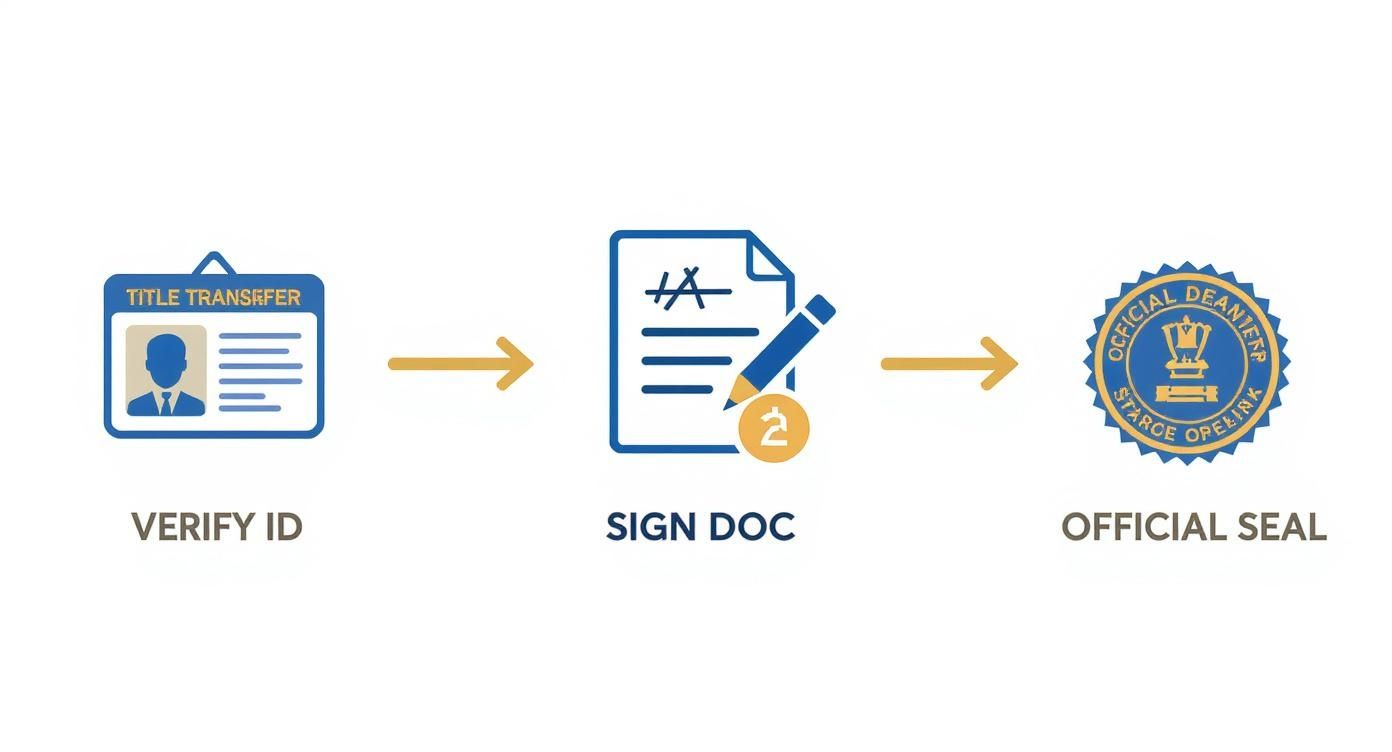
As you can see, it all comes down to the notary verifying who you are and watching you sign. Only after they've checked your ID and you've signed the document will they apply their official stamp and complete the notarization.
Here’s a pro tip from the trenches: before your appointment, double-check every single character on your documents. A simple typo in a name or a Vehicle Identification Number (VIN) can get your title rejected at the DMV, sending you right back to square one. Accuracy is your best friend.
Title transfers are a huge reason people need notaries, but this same careful process applies to tons of other life events. You can learn more about the most commonly notarized documents to see just how widespread this is. For a deeper dive into the kinds of documents you'll need to plan for your future, many of which also require notarization, check out this excellent resource on essential estate planning documents. A little prep work now makes your time with the notary fast, final, and stress-free.
Choosing Between In-person And Online Notarization

Once your documents are prepped and ready to go, you've hit the final step: the notarization itself. Today, you're not stuck with just one option. You can go the traditional route with an in-person meeting or embrace the future with Remote Online Notarization (RON). The best path really boils down to your specific needs for speed, location, and sheer convenience.
The classic, in-person method is exactly what it sounds like. You and any other signers physically meet with a notary public. This could happen at a bank, a title company's office, or you could even hire a mobile notary to meet you at a location that works for everyone.
During the meeting, the notary’s job is to verify everyone's identity by inspecting their government-issued IDs. They'll make sure the photo and name on the ID match the person standing in front of them. After a brief verbal confirmation where they ask if you understand what you're signing and are doing so willingly, you'll sign the title. The notary then completes the act by applying their official ink stamp and signature.
The Rise Of Remote Online Notarization
Remote Online Notarization, or RON, completely flips the script on the traditional process. Instead of getting everyone in the same room, you connect with a commissioned title transfer notary through a secure, live audio-video platform.
But this is far more than just a simple video chat. RON platforms are built with multiple layers of security to lock down the identity verification process. This typically involves a few key steps:
- Knowledge-Based Authentication (KBA): You’ll be asked a series of personal questions pulled from your public records and credit history—things only you would know the answer to.
- Credential Analysis: You’ll take a picture of your driver’s license or passport, and the system’s technology will analyze it for signs of tampering or fraud.
- Live Video Session: The notary visually confirms you are the person on the ID and watches as you apply your electronic signature to the document in real time.
The entire session is recorded and securely stored, creating an ironclad audit trail that’s often more secure than a paper journal. This tech-forward approach offers incredible flexibility. You can dive deeper into how a remote online notary platform uses this technology to ensure a legally binding and secure notarization.
Which Option Is Right For You?
So, how do you decide? Let’s break it down with a simple comparison.
In-Person vs Remote Online Notarization (RON)
Use this side-by-side comparison to decide which notarization method is right for your title transfer needs.
| Feature | In-Person Notarization | Remote Online Notarization (RON) |
|---|---|---|
| Location | Requires all signers to be in the same physical location. | Signers can be anywhere in the world with an internet connection. |
| Convenience | Best for local transactions where parties can meet easily. | Ideal for long-distance deals or signers with mobility issues. |
| Speed | Can be quick for simple transactions, but scheduling can cause delays. | Sessions can often be completed in minutes, 24/7, without travel. |
| Security | Relies on the notary's visual inspection of physical IDs. | Uses multi-factor authentication, including KBA and credential analysis. |
| Audit Trail | A physical journal entry, which can be lost or damaged. | A secure, tamper-evident audio-video recording of the entire session. |
| Best For | Private car sales, simple local property transfers. | Multi-state real estate closings, transactions with remote parties. |
Ultimately, both in-person and remote notarizations lead to the same legally valid outcome. In-person is a fantastic choice for straightforward, local deals where everyone can get together without much fuss. Think of a simple car sale between two people in the same town—a mobile notary can meet them both, and the deal is done.
On the other hand, RON truly shines when things get complicated. Picture a real estate closing with the seller in Florida, the buyer in California, and the title company in Texas. RON cuts out the need for costly plane tickets or the slow, risky process of mailing documents back and forth. Everyone can finalize the transfer from the comfort of their own home or office.
This level of convenience is a major reason for the industry's explosive growth. The global mobile and online notary public market, valued at around USD 0.5 billion, is on track to hit an incredible USD 2.6 billion. This surge is powered by the very digital tools and AI-driven identity checks that make RON so secure and efficient.
Your final choice should hinge on practical factors like geographic distance between signers, your timeline, and your comfort level with technology. By weighing the pros and cons, you can confidently pick the method that makes the most sense for your title transfer.
Navigating State-Specific Notary Requirements
It’s a common mistake to think a notary’s stamp works the same way everywhere, like a universal key. The truth is, notarization laws are a patchwork quilt of state-specific regulations. What makes a title transfer notary act perfectly legal in Texas could get your document flat-out rejected in California.
Ignoring these local rules is one of the fastest ways to derail an entire transaction. State laws dictate everything from the exact wording needed on the notarial certificate to whether witnesses are required in addition to the notary. This isn't just bureaucratic red tape; it's the legal framework that gives the notarization its teeth.
For instance, a notary in California has a strict legal duty to keep a detailed journal and capture the signer's thumbprint for certain real estate deals—a serious anti-fraud measure. Head over to Florida, and you'll find they've been a pioneer in Remote Online Notarization (RON), with some of the most advanced laws governing digital identity proofing and secure online sessions.
Why You Must Check Local Rules
These differences aren't just trivia—they have a direct impact on your title transfer. If your state requires two witnesses for a property deed transfer and you only have the notary, that transfer is legally incomplete. Simple as that. In the same way, if the notary uses a generic acknowledgment form when your state demands specific statutory language, the county recorder’s office will almost certainly refuse to file it.
This gets even more critical with the rise of RON. While many states have embraced online notarization, the rulebook isn't universal. Some states let their notaries perform RON for signers located anywhere in the world, while others have strict rules about where the signer must be.
Think of state notary laws as the operating system for your transaction. Using the wrong one causes a system failure. The only way to ensure a smooth, legally binding transfer is to verify the exact requirements of the state where the property is located or the vehicle is registered.
Finding Your State's Official Guidelines
So, how do you find out the correct procedure? Your single source of truth is always the government body that commissions notaries, which is usually the Secretary of State's office. Their websites are where you'll find the official handbooks, statutes, and any recent updates to notary law.
To make this a little easier, we've compiled a helpful resource. You can find direct links to the official guidelines for each state by checking this list of Secretary of State websites. Taking just a few minutes to check these official sources can save you from the massive headache and potential costs of having a critical document kicked back on a technicality. It’s a small step that ensures your title transfer gets done right the first time.
Common Mistakes in Title Transfer Notarization
I've seen it happen more times than I can count. A simple, preventable error brings a title transfer to a grinding halt, creating massive headaches and frustrating delays. While the notarization process itself is pretty straightforward, a few common slip-ups can easily derail an otherwise smooth transaction.
Knowing what these pitfalls are ahead of time is the best way to get it right on the first try.
The most frequent—and frankly, most costly—mistake is signing the title before you're in front of the notary. A huge part of a title transfer notary's job is to personally witness the signature. If you show up with a document that's already signed, they legally have to refuse the notarization. No exceptions.
Picture a seller trying to be extra prepared. They sign their car title at the kitchen table the night before the meeting. When they arrive, they're told that signature is invalid for notarization purposes. The sale screeches to a halt, and they often have to make a long, expensive trip to the DMV to apply for a duplicate title.
Identity and Document Discrepancies
Another classic hurdle is mismatched identification. The name on your government-issued ID must be an exact match to the name printed on the title. Even a tiny difference can become a huge problem.
For example, let's say a buyer’s driver’s license reads "Jonathan Smith," but the title was drawn up for "Jon Smith." A diligent notary has to reject this. They have no legal way of confirming that "Jon" and "Jonathan" are the same person. This sends everyone back to the drawing board to get the title corrected before the transfer can be completed.
A notary's only tool for verification is your ID. It has to be a current, unexpired, government-issued photo ID. An expired driver's license, even by a day, won't cut it for a notarial act.
Checking the Notary’s Credentials
While most issues come from the signers, it’s also smart to give the notary’s materials a quick look. Any professional notary will keep their tools up to date, but hey, mistakes happen. It’s completely fine to glance at the notary’s stamp.
An expired notary commission stamp will invalidate the entire notarization. If the date on that stamp has passed, any document they put it on will be flat-out rejected by the DMV or county recorder's office.
To steer clear of these all-too-common errors, just remember these three things:
- Wait to Sign: Don't put pen to paper until you are in the physical or virtual presence of the notary and they give you the green light.
- Verify Your Name: Before your appointment, check that your full legal name on your ID is identical to your name on the title document.
- Bring a Valid ID: The morning of, do a quick double-check to make sure your government-issued photo ID is not expired.
By sidestepping these simple mistakes, you can make sure your title transfer is handled quickly and correctly, saving yourself a world of stress.
Where Title Transfer Notary Tech is Headed
The old-school notary stamp and inkpad are quickly giving way to something far more powerful. We're in the middle of a massive shift in how property and vehicle ownership gets secured, driven by sophisticated digital processes.
Secure e-notary platforms are at the forefront, replacing the need for everyone to gather in a single room with encrypted, efficient digital closings. This evolution is making the entire title transfer notary process faster and frankly, a whole lot more convenient for everyone.
A big piece of this puzzle is artificial intelligence. AI-powered tools are getting incredibly good at identity verification, which has always been the notary's most critical job. These systems can analyze signatures and use biometric facial recognition to confirm someone is who they say they are with an impressive degree of accuracy, slamming the door on many common types of fraud.
This isn't just about moving faster. The real win is creating a more secure, transparent, and legally sound record of the entire transfer.
The Dollars and Cents of Going Digital
You don't have to look far to see the proof. The e-notary software market, already valued at over USD 242 million, is on track to explode to nearly USD 797 million.
This explosive growth is happening for a reason. It's riding the wave of the global boom in electronic signature usage, which leaped from 88 million transactions to over 750 million in just five years. That surge built the foundation that digital notarization is now standing on. You can get a deeper look into the market's trajectory and what it signals for the future of document security.
At the end of the day, technology isn't just a shortcut; it's about forging a higher level of trust. For anyone dealing with a title transfer, this means having much greater confidence that the right person signed the right document at precisely the right time.
Common Questions We Get About Notarizing Titles
Even when you think you have everything lined up for a title transfer, last-minute questions always seem to surface. We've been there. Here are some of the most common ones we hear, with straightforward answers to help you handle the final steps like a pro.
Getting the Right Notary and ID
Can I just use any notary for a real estate title transfer?
Legally, any commissioned notary can witness a signature. But for real estate, you really don't want just any notary. Your best bet is always a certified Notary Signing Agent (NSA). These folks have specialized training to navigate the maze of loan and title documents. Using an NSA dramatically lowers the risk of small errors that can cause big delays at closing.
Uh oh, my ID is expired. What now?
This is a complete stop sign. A notary simply cannot accept an expired ID. Their core job is to verify who you are right now, and an expired ID isn't valid proof of your current identity. Before any notarization can happen, you'll need to show a current, unexpired government-issued photo ID. Think driver's license, passport, or state ID card.
An expired ID is an immediate roadblock. A notary's duty is to verify a signer's current identity, making a valid, unexpired government ID a non-negotiable requirement for any title transfer notarization.
Specifics on Your Documents
Does a vehicle 'Bill of Sale' need to be notarized?
This one is all about location, location, location. The answer depends entirely on your state's laws. Some states absolutely require a notarized Bill of Sale, but others only care about the signatures on the Certificate of Title. The only way to know for sure is to check the requirements with your local DMV.
That said, even if it's not legally required, getting a Bill of Sale notarized is a smart move. It adds a solid layer of legal protection for both the buyer and the seller, creating a much stronger official record of the sale.
For a secure, compliant, and ridiculously fast notarization from anywhere, BlueNotary has you covered. Our platform connects you with certified notaries 24/7, turning what used to be a complicated title transfer into a simple, 10-minute online process. Get your documents notarized now.