



A notarized document isn't some special kind of paper printed on fancy letterhead. It’s a regular document that’s been given a legal superpower by a notary public. What you're really looking for are the official marks—the notarial certificate, an official seal or stamp, and the notary's signature—that prove the signer's identity was checked and they signed willingly. These additions are what turn a simple agreement into a legally validated instrument.
Breaking Down What a Notarized Document Looks Like
When you get a notarized document, you’re not looking at a unique type of paper. Instead, you have a standard agreement, affidavit, or power of attorney that now carries specific, legally recognized markers. Think of it like a passport getting a stamp at a border crossing. The passport itself doesn’t change, but that stamp adds a powerful layer of official verification.
These visual cues all serve one crucial purpose: they provide clear evidence that a trained, impartial witness—the notary public—oversaw the signing. It's a common misconception that the notary verifies the document's content, accuracy, or legality. They don't. Their job is strictly to confirm the identity of the person signing and to ensure they aren't being forced to do it.
Core Visual Components
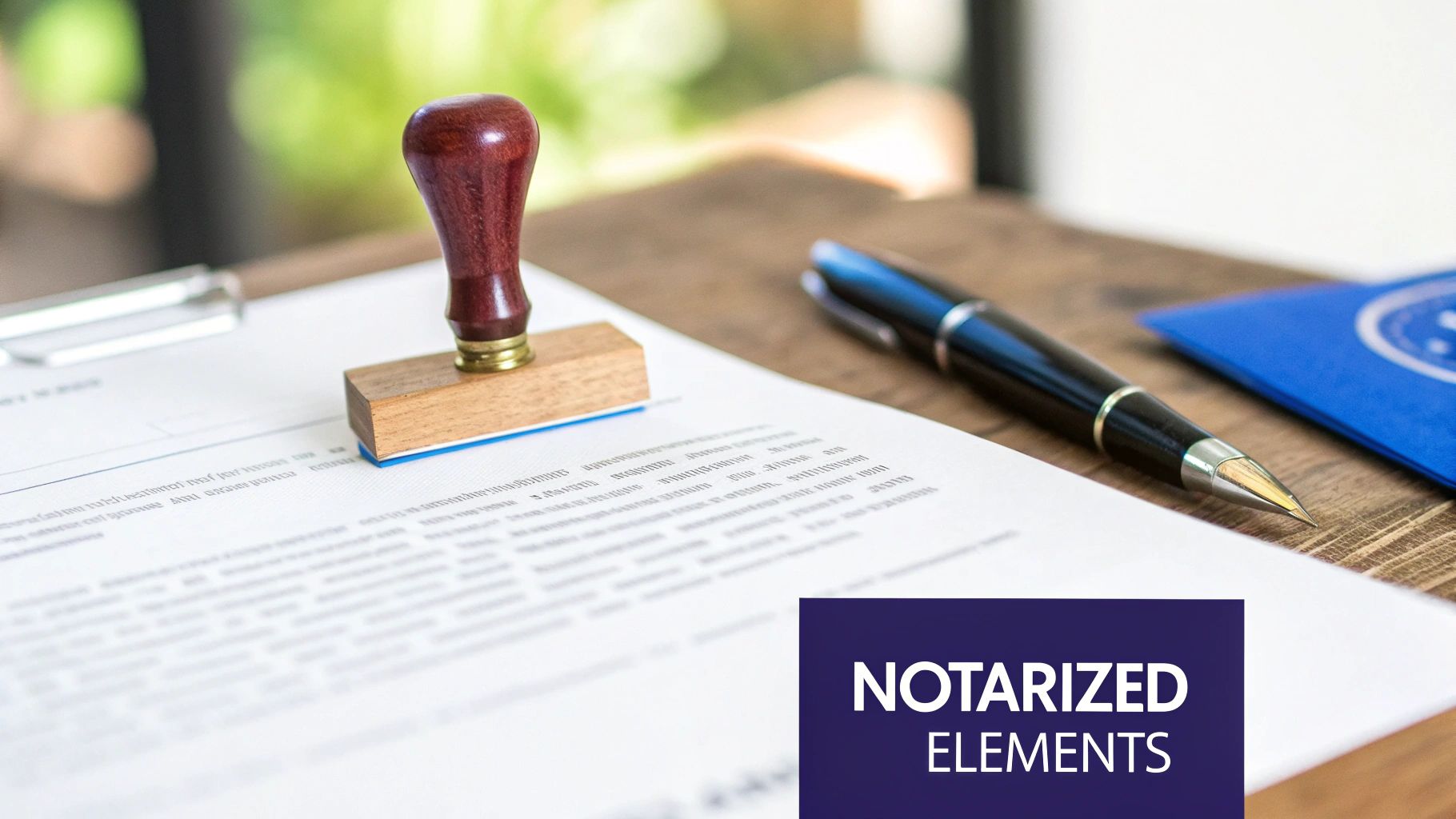
To really get what a notarized document looks like, you have to zoom in on the additions made by the notary. These are almost always grouped together in what’s called the notarial block or certificate.
Here's a quick rundown of the essential components that give a document its notarized status. Think of this as your cheat sheet for spotting a properly notarized paper.
| Component | What It Looks Like | Its Purpose |
|---|---|---|
| Notary Signature | A handwritten or electronic signature from the commissioned notary. | The notary's personal stamp of approval on the notarial act. |
| Official Seal/Stamp | An inked stamp or embossed seal showing the notary's name, state, and commission number. | The official mark of the notary's authority, making the notarization identifiable and official. |
| Notarial Certificate | A pre-printed or attached block of text detailing the who, what, where, and when of the signing. | To formally document the specifics of the notarial act, like whether it was an acknowledgment or a jurat. |
Looking at this table, you can see how these elements work together to create a verifiable record of the signing event, which is the whole point of notarization.
The demand for notaries is definitely on the rise. The mobile notary public sector alone is expected to hit $2.6 billion by 2035, which just goes to show how vital these verification services are in today's world. From simple affidavits to complex real estate deals, you can explore some of the most commonly notarized documents to see these elements in action.
The Anatomy of a Traditional Notarization
When you think of a notarized document, you're probably picturing the classic, pen-on-paper version. This old-school approach depends on physical, tangible elements that act as proof of the notary's official act. Getting to know these components is the first step in recognizing a properly notarized document.

Think of these elements as the three pillars holding up the document's integrity. Each one has a specific job, and together, they create a verifiable record of the signing ceremony. Let's break down exactly what you should be looking for.
The Notarial Certificate Language
The wordiest part of any notarization is the notarial certificate. This is a specific block of text—sometimes pre-printed on the document, other times attached as a separate sheet—that lays out exactly what the notary did. It’s the official story of the notarization.
This isn't just random legal mumbo-jumbo; it contains critical details:
- Venue: This pins down the location of the notarization (for example, "State of Florida, County of Miami-Dade").
- Date: The exact date the signing and notarization happened.
- Signer's Name: The full name of the person whose signature was just notarized.
- Notarial Act: A description of what kind of notarization was performed.
The language actually changes depending on the act itself. For an acknowledgment, the signer is simply confirming they willingly signed the document. But for a jurat, the signer has to swear or affirm that everything in the document is true.
Sample Acknowledgment Wording:
"On this _____ day of ___________, 20__, before me, the undersigned notary public, personally appeared _______________________, known to me to be the person whose name is subscribed to the within instrument, and acknowledged that he/she executed the same for the purposes therein contained."
The Notary Seal or Stamp
Next up is the most recognizable part: the notary's official seal. This is usually a round or rectangular ink stamp that imprints the notary's official details right onto the page. Some states might still allow an embosser, which creates a raised, inkless impression on the paper.
While the designs vary from state to state, the seal almost always includes:
- The notary's full name, exactly as it appears on their commission.
- The words "Notary Public" and the state where they are commissioned.
- The notary's unique commission number.
- The date their commission expires.
This seal is the notary’s badge of authority. It visually links the notarization back to a specific, state-commissioned individual, making the whole thing traceable. It's what gives the document that official, "at-a-glance" look.
The Notary Signature
Last but not least, the notary has to sign the certificate. This is the notary's personal stamp of approval, confirming that everything stated in the notarial certificate actually happened. It attests that they identified the signer, witnessed the signature or acknowledgment, and followed all the required procedures.
The signature must match the name on the notary's commission and their seal. This final, human touch completes the notarization, tying all the official elements together with the notary's direct, personal involvement. To really dig into the foundational rules and legal weight of this process, it helps to understand the practices across the Notary Public industry. These three components—certificate, seal, and signature—are the heart of what a traditionally notarized document looks like.
The Modern Look of Online Notarization
As our world has shifted from paper to pixels, notarization has tagged right along. Remote Online Notarization (RON) gets the same job done as a traditional in-person notarization, but it uses technology to pull it off. While a document notarized online might lack the familiar ink stamp and wet signature, it's often far more secure and easier to verify.
Think of it like the difference between a physical stock certificate tucked away in a safe and shares held in your digital brokerage account. Both represent ownership, but the digital version comes with layers of cryptographic security and an instant audit trail that the paper version just can't match. RON works the same way, swapping out physical elements for beefed-up digital counterparts.
From Physical Stamps to Digital Seals
The most obvious difference you'll spot is the missing physical seal. Instead of a classic ink stamp or a raised embosser, an electronically notarized document has an electronic seal. This is simply a digital image containing all the notary's key information—their name, state, commission number, and expiration date—placed right onto the electronic document.
While it looks like a simple picture, it's cryptographically tied to the notary's unique digital identity. It serves the exact same purpose as a traditional seal: officially marking the document with the notary's authority.
Another critical piece is the notary's digital signature. This isn't just a scanned image of a handwritten signature. It's a cryptographically secure mark created with a special digital certificate that is completely unique to the notary, binding their verified identity to the document at the very moment of signing.
The Power of the Tamper-Evident Seal
The real magic behind a modern notarized document is its built-in security. Every document notarized online is locked with a tamper-evident seal. This digital wrapper is the document’s own personal alarm system.
When you open a properly notarized digital file (like a PDF) in a program like Adobe Acrobat, you'll see a notification bar—often blue or green—at the top confirming the document's validity. If anyone tries to alter even a single character after the notarization is complete, that seal "breaks," and the notification will immediately warn you the document has been compromised.
This provides a level of security that paper documents just can't compete with. You no longer have to squint and guess if a document has been altered; the technology tells you instantly. This evolution is why RON is quickly becoming the go-to method for secure transactions. Historically, notarization has always been about verifying authenticity, and the industry's growth reflects this. By 2025, RON is projected to become the industry standard, offering incredible convenience by allowing notarizations from virtually anywhere. You can dive deeper into this trend with insights on the rise of online notary services on archivemarketresearch.com.
Finally, every single online notarization is backed by a comprehensive audit trail. This is a detailed log that records every action taken during the session, including:
- The exact time the session started and ended.
- The results of the signer's identity verification and credential analysis.
- Every click, signature, and action taken by both the signer and the notary.
- A complete audio-video recording of the entire session.
This detailed record provides an undeniable, step-by-step account of the entire event, offering a level of proof that a simple paper journal entry could never match. To see how all these pieces come together in a live session, you can learn about the complete remote online notary process.
Traditional vs. Online Notarized Documents
While traditional and online notarizations both accomplish the same legal goal, the final documents look quite different. One is all about physical, tangible things—think wet ink signatures and embossed seals. The other is built from secure digital parts.
Getting a handle on this contrast is the key to understanding what a modern notarized document really is.
You can think of a traditional notarization as a moment captured on paper. In contrast, a Remote Online Notarization (RON) document is a secure, verifiable digital file. The core ideas—verifying someone's identity and making sure they signed willingly—are exactly the same. But the evidence left behind on the document is fundamentally different.
This concept map breaks down the key components you'll find in a Remote Online Notarization.

As you can see, things like digital signatures, electronic seals, and a digital certificate are the bedrock of a RON's security and legal standing.
Comparing Key Features
To really see the difference, it helps to map the physical elements of a traditional notarization to their digital equivalents. It's like translating from the language of paper to the language of pixels. Each piece has a direct counterpart that uses technology to do the same job, often better.
The goal isn’t to replace the purpose of notarization but to upgrade the method. A digital signature is cryptographically more secure than a handwritten one, and a digital audit trail is far more detailed than a paper journal entry.
Let's put them side-by-side to see how the look and feel of a notarized document has evolved.
Traditional Notary vs. Remote Online Notary (RON) Features
Here's a straightforward comparison highlighting the evolution from physical to digital components. Each feature serves the same fundamental purpose, just executed in a different medium.
| Feature | Traditional (Wet Ink) Notarization | Remote Online Notarization (RON) |
|---|---|---|
| Signature | A handwritten signature applied with a pen. | A digital signature applied electronically using a unique, secure credential. |
| Seal | An inked stamp or embossed seal with the notary's details. | An electronic seal that is a digital image of the notary's information. |
| Record Keeping | A physical journal entry logged by hand. | A detailed digital audit trail that includes a video recording of the entire session. |
| Verification | Visual inspection of the physical document for signs of tampering. | A tamper-evident digital certificate that instantly validates the document’s integrity. |
This table makes it clear: while the names and forms have changed, the integrity and legal function of each element remain firmly intact. The shift to digital simply adds layers of security and verifiability that were impossible with paper and ink.
Why Notarized Documents Look Different by State
If you place two notarized documents from different states side-by-side, you’ll probably notice they don’t look identical. This isn't a red flag; it’s a perfectly normal result of how notary laws are structured in the United States. There’s no single federal law that governs notarization. Instead, each state sets its own rules.
This state-level control means that everything from the shape of a notary seal to the exact wording required in a certificate can change dramatically as you cross state lines. Think of it like driver's licenses—they all serve the same purpose and are recognized nationwide, but the design and layout are unique to each state. Notarizations follow the same principle.
State-Specific Seal and Stamp Requirements
One of the most obvious differences you'll spot is the notary seal itself. A notary in one state might use a circular ink stamp, while a neighboring state could mandate a rectangular one. These aren't just cosmetic choices; they're legal requirements spelled out in state law.
For example, a Florida notary's seal must include their name, the words "Notary Public – State of Florida," their commission number, and the commission expiration date. Contrast that with California, which requires a serrated or milled border on its circular seal—a small but mandatory detail unique to the state. Even the ink color can be specified, with some states insisting on black ink while others are more flexible.
Mandated Certificate Language
Beyond the seal, the notarial certificate wording is another place you'll see big variations. States often prescribe the exact text that a notary must use for specific acts like acknowledgments or jurats. This language isn't just a suggestion; notaries have to use it word-for-word to make sure the notarization is legally compliant in their state.
A classic example is California's jurat certificate, which includes the specific phrase: "A notary public or other officer completing this certificate verifies only the identity of the individual who signed the document to which this certificate is attached, and not the truthfulness, accuracy, or validity of that document." This disclaimer is a required component for any jurat performed there.
This kind of required language directly changes what a notarized document looks like, since the certificate block can be much longer or shorter depending on where it came from.
These variations often lead to a common question: will a document notarized in one state be accepted in another? The good news is that, thanks to the Full Faith and Credit Clause of the U.S. Constitution, a properly executed notarization from one state is generally recognized as valid across all others. You can learn more about how states handle notarizations from other states to see the legal framework that makes interstate business possible.
Ultimately, these differences are a feature, not a flaw, of the American notarial system. Understanding that a notarized document from Texas will naturally look different from one from New York is the key to handling official paperwork with confidence.
How to Spot a Genuine Notarization
Okay, so you know what a notarization is supposed to have. But how do you know if it's the real deal?
Actively verifying a document's authenticity is a completely different ballgame. Whether you’re holding a crisp paper document or looking at a PDF on your screen, you need to know how to tell a valid notarization from a fake one. This is what protects you from fraud and ensures the document will actually hold up in a legal setting.
Think of yourself as a detective looking over the evidence. For a classic, old-school "wet-ink" notarization, your checklist is pretty straightforward, but every single item is critical. You're looking for completeness and clarity—no part of that notary block should be empty.
Traditional Document Checklist
- Check the Date: Is the notarization date present? Does it make sense in the context of the document's signing?
- Examine the Seal: The notary's seal needs to be sharp and totally legible. If it's smudged, blurry, or faint, that's a red flag. All the text, especially the commission number and expiration date, must be readable.
- Verify the Commission: Look at the commission expiration date on the seal and compare it to the date the notarization happened. If the notary’s commission was expired, the act is invalid. Simple as that.
- Confirm the Signature: The signature in the certificate should clearly match the name printed on the notary's seal.
Verifying a notarization is all about confirming the integrity of the process. Every single element, from the date to the seal's legibility, is a link in a chain of trust that gives the document its legal power. If one piece is missing or off, the whole thing can be worthless.
For digital documents, the process is a bit different but often even more secure. When you open the PDF, look for a blue ribbon or a similar notification bar at the top of your reader. Clicking on that ribbon is the key—it will reveal the details of the digital certificate, confirming the document is authentic and hasn't been touched since the moment it was notarized.
When you're dealing with digital documents, it’s also good to have a sharp eye for visual tricks. Learning how to check if a photo is real can actually build skills that help you spot irregularities in scanned or digital notarizations.
This big shift towards digital security is what's fueling the massive growth in the e-notary software market. In fact, it's projected to become a nearly $1 billion industry by 2036. That number alone shows just how much we're coming to rely on technology to guarantee document integrity for all kinds of important legal and financial business.
Common Questions We Hear All the Time
Even when you know what to look for, notarized documents can still throw a few curveballs. Let's tackle some of the most frequent questions that pop up.
Does a Notary Stamp Have to Be a Specific Color?
This is a classic "it depends" situation, and the answer lies entirely with state law. While you'll see black ink most of the time because it's universally accepted, some states get picky.
One state might require a specific color that shows up clearly on a photocopy, while another gives the notary free rein. This is one of those little details that explains why a notarized document from Texas might look a bit different from one notarized in New York.
Can the Notary Certificate Be on a Separate Page?
Absolutely. This happens all the time and is perfectly legitimate. In the notary world, it's called a “loose certificate.”
Sometimes, there just isn't enough room on the document itself for the notary to squeeze in their signature, seal, and all the required wording. When that happens, they'll use a separate sheet of paper for the notarial block and securely staple it to the original document. A properly attached loose certificate will always make it crystal clear which document it belongs to.
How Can I Tell if an Online Notarized Document Was Altered?
This is where the tech behind online notarization really shines. Every electronically notarized document is locked down with a digital certificate, which acts as a tamper-evident seal.
If anyone messes with the document after it's been notarized—even something as small as deleting a single space—that digital seal will "break." The moment you open the file in a PDF reader like Adobe Acrobat, you'll see a warning bar at the top, immediately alerting you that the document’s integrity is no longer intact.
For a secure and ridiculously simple notarization, BlueNotary offers a 24/7 online platform. You can connect with a certified notary in minutes and get your documents legally notarized from wherever you are, with an instant, tamper-proof download right after. Visit BlueNotary to get started.