



Think about the last time you signed something important—maybe a lease, a loan document, or a new job offer. Chances are, you didn't use an actual pen. Instead, you probably clicked a button, typed your name, or scribbled a signature with your finger on a screen. That’s an electronic signature, or eSignature, in action.
What Is an Electronic Signature?
At its core, an electronic signature is a legal concept, not a specific piece of technology. It’s the digital equivalent of a wet-ink signature, designed to show your intent to agree to the terms of a document, all in a digital format.
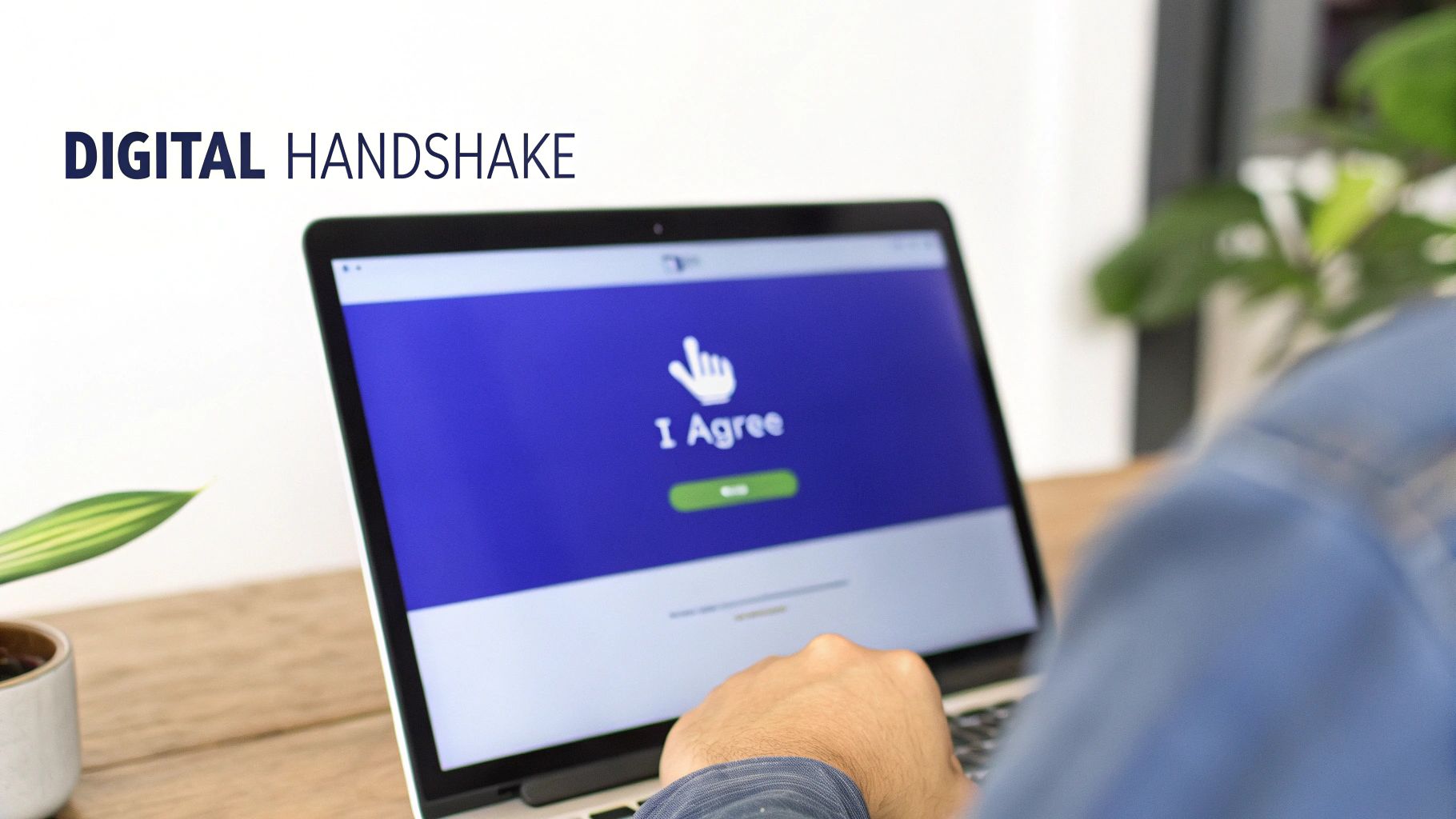
You can think of it as a digital handshake. It’s a legally binding way to show you agree to something without ever touching a piece of paper. You might type your name, draw it with a mouse or stylus, or just click a button that says "I Agree." All of these methods count as a valid electronic signature.
The real magic isn't what the signature looks like; it's the intent it represents. When you eSign a document, the system captures a whole host of data that proves a specific person interacted with it and meant to sign it. This digital paper trail, or audit log, usually includes things like the signer's IP address, the exact date, and the time of signing.
This whole process was made official in the United States way back in 2000 with the passage of the Electronic Signatures in Global and National Commerce Act (ESIGN Act). This was a game-changer. It gave electronic signatures the same legal weight as their handwritten counterparts, which opened the floodgates for companies and individuals to go digital. Today, millions of people rely on eSignatures for everything from multi-million dollar deals to simple permission slips. If you're curious, you can get more details on the history of electronic signatures.
Key Characteristics of an Electronic Signature
To really get a handle on what makes an eSignature tick, it helps to look at its core components. The table below breaks it down into simple terms, giving you a quick reference for the concept.
| Aspect | Description |
|---|---|
| Legal Concept | It's not a single technology but a legal framework for showing your intent to sign something digitally. |
| Indicates Intent | Its main job is to capture a person's consent or agreement to the terms in a document. |
| Various Forms | It can be a typed name, a drawn signature, a checked box, or even a biometric marker like a fingerprint. |
| Data Record | A secure process creates an audit trail, connecting the signature to both the signer and the document. |
Ultimately, an electronic signature is a broad term for any electronic process that shows acceptance of an agreement. It's the simple, fast, and secure way business gets done today.
The Legal Power Behind Your ESignature
Think an electronic signature is just a convenient shortcut? Think again. It carries real legal weight, but that authority didn't just appear out of thin air. It’s built on a solid legal framework that fundamentally changed how we do business. Without it, your digital handshake would be meaningless.
The two landmark laws that give eSignatures their teeth in the United States are the Electronic Signatures in Global and National Commerce Act (ESIGN Act) of 2000 and the Uniform Electronic Transactions Act (UETA), which has been adopted by 49 states.
These laws work in tandem to establish one simple, powerful principle.
The big idea behind both the ESIGN Act and UETA is that a signature, contract, or record can't be denied legal effect or enforceability just because it’s in an electronic format.
In other words, the law cares about the intent behind the signature, not the tool you used to make it. Whether you use a pen or a mouse, what truly matters is that you agreed to be bound by the terms.
The Pillars of a Legally Enforceable ESignature
For an eSignature to actually hold up in court, it has to meet a few key requirements. These aren't tricky legal loopholes; they're commonsense standards that protect everyone involved. Think of them as the digital equivalent of proving a wet-ink signature is the real deal.
A valid eSignature process has to show:
- Clear Intent to Sign: The signer needs to know exactly what they’re doing. This means taking a deliberate action, like clicking a button clearly labeled "I Agree" or "Finalize Signature." No accidental signings allowed.
- Consent to Do Business Electronically: Everyone involved has to be on board with using electronic documents and signatures from the get-go. This is usually handled with a consent clause right at the beginning of the signing process.
- Association of the Signature with the Record: The system must forge a clear, unbreakable link between the signature and the document. The signature can't just be floating in a void; it has to be a concrete part of the record itself.
- Record Retention and Access: A secure, tamper-proof copy of the final, signed document must be stored and made available to all parties. This ensures everyone has access to the same version of the agreement.
On top of all that, a rock-solid audit trail is crucial. Reputable platforms like BlueNotary capture a detailed log of the entire signing event—timestamps, IP addresses, and every single action the signer takes. This digital paper trail provides a far more robust and detailed record than you'd ever get with a traditional paper document, giving you total confidence that your agreements are secure, valid, and legally defensible.
Electronic Signature vs. Digital Signature Explained
It’s one of the biggest points of confusion out there: what’s the real difference between an electronic signature and a digital signature? People toss the terms around like they’re the same thing, but they’re not.
Getting this right is crucial for picking the right level of security for your documents.
Think of it this way: electronic signature is a broad, umbrella term, kind of like the word "vehicle." It's the legal idea that covers any electronic sound, symbol, or process used to show you agree to something. That could be typing your name at the bottom of an email, clicking an "I Agree" box, or scribbling your signature on a tablet.
A digital signature, on the other hand, is a specific type of electronic signature. If an e-signature is a "vehicle," a digital signature is a "bulletproof armored truck." It's a specific technology that offers a much higher guarantee of who signed the document and that the document itself is authentic.
The Technology Behind the Trust
The magic is in the technology. A simple electronic signature is all about capturing someone's intent to sign. A digital signature, however, uses powerful cryptography to lock down the document, creating a tamper-evident seal.
This technology is called Public Key Infrastructure (PKI). It sounds complex, but the concept is straightforward. Imagine you have a special set of keys: a public key you can share with anyone, and a private key that you keep secret.
- When you sign a document, your private key is used to create a unique digital "fingerprint" of that document (this is often called a "hash").
- This encrypted fingerprint, bundled with a digital certificate from a trusted authority, gets embedded directly into the file.
- Anyone who receives the document can then use your freely available public key to unlock and verify the signature. This confirms two things: that the signature truly belongs to you, and that the document hasn't been changed one bit since you signed it.
A digital signature doesn't just show you signed; it cryptographically proves who signed and that the document is exactly as it was at the moment of signing. Any subsequent change, no matter how small, will invalidate the signature.
To really get a handle on the nuts and bolts of how cryptography makes this possible, you can dive deeper into the role of encryption in information security.
Comparing the Key Differences
So, how do you know which one to use? It really comes down to the level of risk and legal weight involved. For most everyday agreements, a standard electronic signature backed by a solid audit trail is perfectly fine. But when the stakes are high—think major financial transactions or critical legal filings—the extra security of a digital signature is a must-have.
Here’s a simple table to break down the core distinctions.
Comparing Electronic Signatures and Digital Signatures
This table highlights the key distinctions between the broad category of electronic signatures and the specific technology of digital signatures.
| Feature | Electronic Signature (SES) | Digital Signature (AES/QES) |
|---|---|---|
| Foundation | A broad legal concept focused on intent. | A specific technology using cryptography (PKI). |
| Security | Security relies on the platform's audit trail and authentication methods. | Secured by encryption, digital certificates, and a tamper-evident seal. |
| Verification | Verified through the audit log (IP address, timestamp). | Verified mathematically using public/private keys. |
| Identity | Identity is typically verified via email or basic authentication. | Identity is rigorously verified by a trusted Certificate Authority (CA). |
| Best For | Routine contracts, internal approvals, and low-risk agreements. | High-value financial transactions, legal filings, and government documents. |
Ultimately, choosing between a standard electronic signature and a digital signature is about matching the security to the situation. Both have their place, but understanding the difference empowers you to protect your agreements appropriately.
How Electronic Signatures Work in the Real World
So, we’ve covered the legal stuff. Now, let’s talk about how electronic signatures actually function in day-to-day life. It turns out, they're the invisible engines powering transactions across countless industries, making things faster, more secure, and possible from just about anywhere.
Think about a real estate agent trying to close a deal with clients who live in another state. Before, this meant mailing a mountain of paperwork and then waiting… and waiting. Now, the agent can shoot over the purchase agreement digitally. The clients can review it, sign it, and send it back in minutes from their own living room, locking down their dream home without missing a beat.
This infographic is a great way to see how the different layers of eSignature technology fit together, from a simple check-box signature to a highly secure digital one.
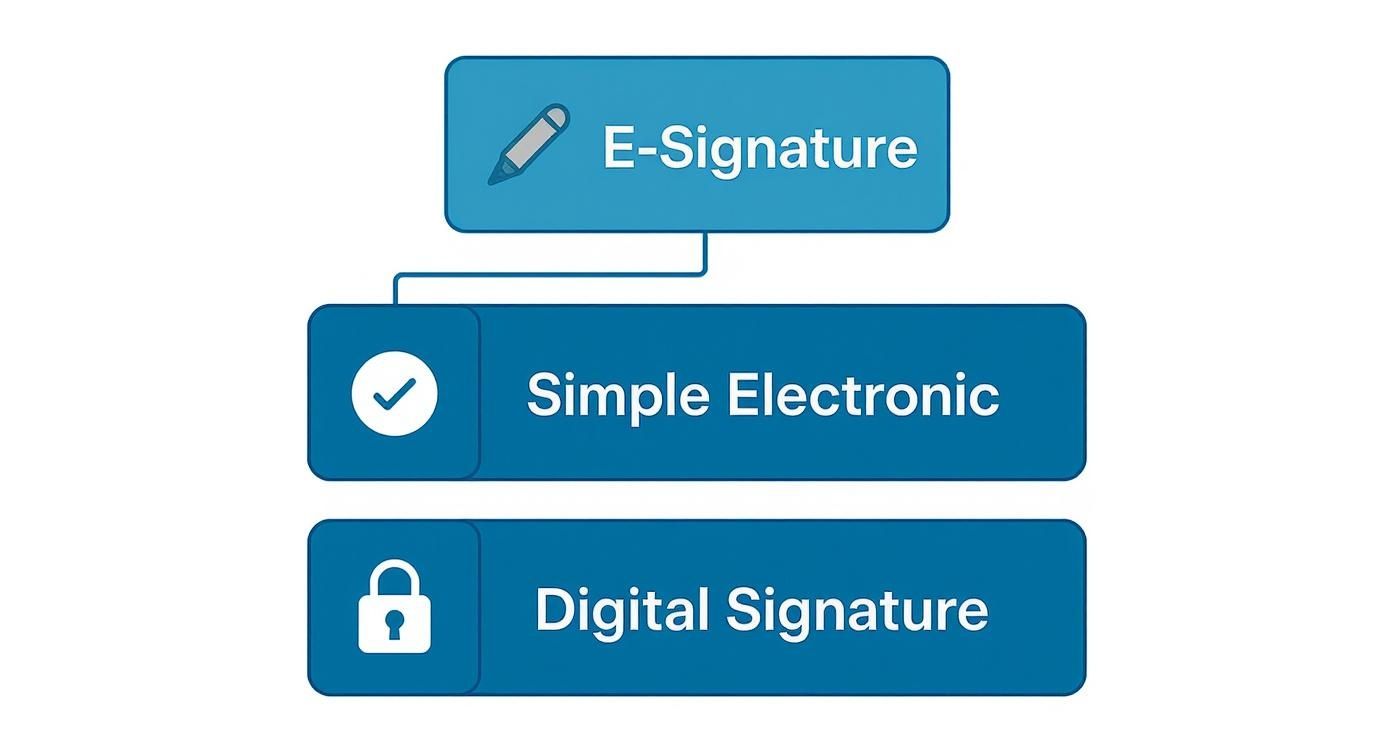
As you can see, "electronic signature" is the big umbrella term. A "digital signature" is a specific, much more secure type used for high-stakes agreements where you can't afford any doubt.
Transforming Industries with Digital Speed
The real impact here goes way beyond just being convenient. It’s about fundamentally changing how business gets done, unlocking efficiencies we could only dream of a couple of decades ago.
Just look at these common scenarios:
- Financial Services: A financial advisor can get a new client set up from halfway across the country, sending over investment agreements for an immediate eSignature. The whole process is faster and feels a lot smoother for the client.
- Legal Departments: Law firms need to finalize sensitive contracts and NDAs with partners all over the globe. The secure, built-in audit trail of an eSignature provides much stronger proof than a simple pen-and-paper signature ever could.
- Human Resources: An HR team makes an offer to a star candidate. That person can accept the job and sign their employment contract on the spot, helping the company secure top talent before a competitor can swoop in.
While the tech feels cutting-edge, the legal groundwork for it is surprisingly old. The idea of accepting a signature that isn’t handwritten dates all the way back to the 19th century. In 1869, the New Hampshire Supreme Court actually recognized a signature sent by telegraph as legally binding, setting an early precedent for electronic validation.
The Rise of Remote Online Notarization
One of the most powerful ways eSignature technology is being used today is in Remote Online Notarization (RON). This process builds on the security of electronic signing by bringing a commissioned notary public into the picture through a live, two-way audio-visual session.
RON combines the legal weight of traditional notarization with the incredible flexibility of digital technology. It allows documents to be notarized securely from anywhere on the planet.
Platforms like BlueNotary are built to integrate secure eSignatures directly into the RON workflow. This is absolutely critical for high-value transactions in real estate, lending, and law—fields where you often need both a signature and a notarial act to make a document official. You can dive deeper and learn more about how remote online notary services work to see how we provide an unmatched level of security and compliance for your most important documents.
Ensuring Your Signatures Are Secure and Compliant
When you're dealing with important documents, trust is everything. It’s not just a nice-to-have; it's the entire foundation of the agreement. So, how can you be absolutely sure an electronic signature is genuine and that the document hasn’t been secretly altered? The answer lies in the layers of robust security modern eSignature platforms build right into the process.
The goal is to create a digital footprint so clear and detailed that it's actually more defensible than a traditional wet ink signature. This security kicks in the moment a document is sent for signing and continues to protect it long after the deal is done.

Two of the most powerful tools in the security arsenal are tamper-evident seals and comprehensive audit trails.
Think of a tamper-evident seal like the digital version of a wax seal on an old-fashioned letter. If anyone tries to change the document after it has been signed—even something as small as adding a single comma—that digital seal is broken. The signature is instantly invalidated, ensuring the document you signed is the exact document everyone else sees, forever.
The Anatomy of a Secure ESignature
Beyond that seal, a detailed audit trail gives you an irrefutable log of every single interaction with the document. This isn't just a simple timestamp; it's a complete, second-by-second chronicle of the entire signing journey.
A strong audit trail will capture everything:
- Signer Verification: How the signer's identity was confirmed, whether through email, SMS codes, or more advanced identity-proofing methods.
- IP Address Logging: The IP address from which the document was accessed and signed, providing a clear geographic data point.
- Event Timestamps: The exact date and time for every action, from when the document was first opened and viewed to the final signature.
- Document History: A complete play-by-play of all interactions, from start to finish.
This level of detail creates an airtight evidence package that can shut down any potential disputes about the signature's validity.
In essence, a secure eSignature platform doesn’t just capture a signature; it captures the entire context and history of the agreement. This makes the process transparent, verifiable, and legally sound.
Meeting Industry Compliance Standards
Of course, security isn't a one-size-fits-all game. Different industries play by different rules. A healthcare provider handling patient records has very different compliance needs than a sales team sending out a standard contract. That's why choosing a platform that meets your specific industry standards is absolutely critical.
For instance, any platform handling medical information must be HIPAA-compliant to protect sensitive patient data. It's non-negotiable. Similarly, a SOC 2 Type II certification signals a provider's serious commitment to maintaining high standards for data security and privacy.
These certifications aren't just fancy acronyms; they are proof that a platform has undergone rigorous, independent audits. You can see exactly how BlueNotary approaches these standards in our dedicated Trust Center.
Ultimately, all these security and compliance measures work together to make your electronic agreements legally defensible. They provide the concrete proof you need of the signer's identity, their intent to sign, and the document's integrity, ensuring your digital handshakes are just as solid as those sealed with ink.
Getting Started with Electronic Signatures
Making the switch to a digital workflow might feel like a huge leap, but bringing electronic signatures into the fold is actually a pretty straightforward process. Think of this as your practical roadmap, guiding you from "I'm curious" to "I'm confident," whether it's just for you or for your whole business.
The first step is simply figuring out what you need. Are you just looking for a quick way to sign a document here and there? Or does your business need a heavy-duty system to handle a high volume of contracts? Your answer really points you toward the right kind of solution.
For those simple, one-off signing needs, a basic tool will do the trick. Plenty of platforms offer an easy way to create a visual of your signature. If you just want to see how it works, BlueNotary actually provides a free and secure online signature generator that gets you up and running in seconds.
Choosing the Right Platform for Your Needs
Once you have a handle on your requirements, the next move is picking a platform that lines up with your legal and day-to-day operational demands. A solo professional is probably going to prioritize ease of use. A real estate firm, on the other hand, must ensure their platform can handle complex transactions, including Remote Online Notarization (RON).
As you weigh your options, keep these key factors in mind:
- Legal Compliance: Does the platform stick to the rules of the ESIGN Act and UETA? For more specialized fields, does it meet standards like HIPAA?
- Security Features: You want to see things like comprehensive audit trails, tamper-evident seals, and solid identity verification methods. This is what makes your documents defensible if they're ever questioned.
- Workflow Integration: How well does the platform fit into the way you already work? A solution like BlueNotary is built to support everything from basic eSignatures to legally binding RON sessions, all under one roof.
A great way to get your feet wet is by testing the process with a low-risk internal document. Think team memos or policy acknowledgments. This builds familiarity and confidence without putting any critical external agreements on the line.
A Smooth Transition to Digital Workflows
After you’ve picked your platform, the focus shifts to making the integration as smooth as possible. Start small. Introduce the tool to a single team or for one specific type of document. This lets you iron out the kinks and get feedback before a big, company-wide rollout.
Platforms like BlueNotary are designed for this kind of scaling. You can begin with simple eSigning and then expand into full-blown digital closings as your team gets more comfortable and your needs grow. By taking a measured, step-by-step approach, you can confidently kick off your digital transformation today.
Got Questions About Electronic Signatures? We’ve Got Answers.
As you start using electronic signatures, a few questions are bound to pop up. It’s a common part of the learning curve. Let's walk through some of the most frequent ones we hear.
Is an Electronic Signature Legal Everywhere?
While electronic signatures are widely accepted, the rules of the road change depending on where you are. In the United States, we operate under the ESIGN Act and UETA. But hop over to Europe, and you’re dealing with eIDAS regulations, which have their own specific standards.
The key is to use a platform that gets this. A good provider knows the legal nuances from one jurisdiction to the next, ensuring your documents are enforceable whether your signer is in Florida or France.
Can I Just Paste an Image of My Signature?
Think of it this way: anyone can copy and paste a picture. That’s why just dropping an image of your signature onto a document doesn't hold up legally. It’s missing the most important part—the proof.
A real electronic signature isn't just the image; it's the secure process behind it. True eSignature platforms create a digital wrapper of data around the signature, providing an audit trail that proves who signed, when they signed, and that the document hasn't been touched since. An image file just can't do that.
The real power of an electronic signature isn’t what it looks like. It’s the mountain of digital proof that comes with it.
What Happens if a Signature Is Disputed?
This is exactly where that digital proof becomes your best friend. If someone challenges a signature, you don't have to rely on guesswork. Reputable platforms generate a comprehensive, tamper-evident audit trail for every single document.
This log is incredibly detailed. It typically captures:
- The signer's IP address
- Timestamps for every action (like when the document was viewed and signed)
- A record of how the signer's identity was verified
Honestly, this level of detail often provides a stronger, more defensible case than you'd have with a traditional wet-ink signature. You have a complete, step-by-step digital record of the entire event.
Ready for a platform that delivers secure, compliant, and legally solid eSignatures and Remote Online Notarization? Trust BlueNotary. Get your documents signed and notarized in minutes at https://bluenotary.us.