





At its core, SOC 2 certification is an independent audit that proves your company handles customer data securely and responsibly. Think of it as a rigorous ‘home inspection’ for your data security, conducted by the American Institute of Certified Public Accountants (AICPA). It’s not just a piece of paper—it’s a framework that demonstrates a serious commitment to protecting sensitive information.
What Is the SOC 2 Framework?

SOC 2, which stands for Service Organization Control 2, is a voluntary compliance standard for service organizations. It was developed by the American Institute of Certified Public Accountants (AICPA) to build trust between service providers and their clients. This has become absolutely critical for technology companies, SaaS platforms, and any business that stores or processes client data in the cloud.
The entire framework is built upon five key principles known as the Trust Services Criteria (TSC). These principles guide the audit and define the controls that an organization must implement to prove it's walking the walk on security.
- Security: This is the non-negotiable foundation of every SOC 2 audit, protecting systems against unauthorized access.
- Availability: Ensures that systems are operational and accessible as promised in service-level agreements (SLAs).
- Processing Integrity: Guarantees that system processing is complete, valid, accurate, timely, and authorized. No funny business with your data.
- Confidentiality: Protects sensitive information that is designated as confidential from unauthorized disclosure.
- Privacy: Addresses how personal information is collected, used, retained, disclosed, and disposed of.
Of these five, only the Security criterion is mandatory for every SOC 2 audit. A company chooses the other four based on the specific services it provides and the commitments it makes to its customers.
A SOC 2 report provides a detailed, third-party validation that a company has the necessary controls in place to protect client data. It moves beyond simple promises, offering concrete proof of an organization’s dedication to security and operational excellence.
To make these components easier to digest, here's a quick summary of what each part of the SOC 2 framework covers.
SOC 2 at a Glance Key Components
| Component | Description |
|---|---|
| Audit Purpose | To independently verify that a service organization has effective controls in place for managing and protecting customer data based on the Trust Services Criteria. |
| Governing Body | The American Institute of Certified Public Accountants (AICPA). They set the standards and maintain the framework. |
| Mandatory Criterion | Security. This is the foundational principle that every SOC 2 audit must include. It covers firewalls, intrusion detection, and access controls. |
| Optional Criteria | Availability, Processing Integrity, Confidentiality, and Privacy. Organizations select these based on their business model and the promises they make to clients. |
| Report Types | Type I (a snapshot in time of the design of controls) and Type II (an evaluation of the operational effectiveness of controls over a period, typically 6-12 months). |
| Primary Audience | Clients, prospective clients, business partners, and auditors who need assurance about the security and reliability of a vendor's services. |
| Industry Applicability | Especially relevant for technology companies, SaaS providers, data centers, cloud service providers, and any business that handles sensitive customer information. |
This table gives you the high-level view, showing how SOC 2 is a structured and comprehensive approach to data security, not just a simple checklist.
A Gold Standard for Data Protection
The importance of SOC 2 has grown significantly, with data showing it ranks among the top three most important audit frameworks globally, right alongside ISO 27001 and SOC 1. This level of scrutiny makes it a true gold standard for data protection.
To fully appreciate the rigor involved, it's helpful to have a broader perspective by understanding the impact of documentation standards on business efficiency and security protocols. For organizations like BlueNotary, achieving SOC 2 compliance is a key part of maintaining a secure environment for every transaction. You can learn more about our commitment by visiting our Trust Center.
Choosing Between a SOC 2 Type I vs. Type II Report
When you start down the road to SOC 2 compliance, one of the first big decisions you'll make is whether to go for a Type I or a Type II report. This isn't just some technical jargon; it's a choice that shapes your timeline, your budget, and ultimately, how customers see your commitment to security. Getting this right is about aligning your compliance work with your actual business goals.
The easiest way to think about it is with a simple analogy. A SOC 2 Type I report is like a snapshot in time. An auditor comes in, looks at how your security controls are designed, and confirms that, on one specific day, you have all the right policies and procedures in place to meet the criteria you’ve chosen. It’s a picture of your setup at a single moment.
A SOC 2 Type II report, on the other hand, is more like a video recording. It goes a huge step further. The auditor doesn't just look at the design of your controls; they test their operating effectiveness over a longer period, usually six to twelve months. This proves your security measures don't just look good on paper—they actually work, day in and day out.
What Each Report Actually Verifies
That difference between design and operating effectiveness is the real heart of the matter. It’s what separates a quick check-up from a long-term health assessment.
Here’s a practical look at what an auditor is digging into for each one.
For a Type I Report, the auditor asks:
- Control Design: Do they have a solid, well-documented access control policy?
- Implementation: Are the firewalls, multi-factor authentication, and other tools configured correctly right now?
- Point-in-Time Review: On the day of the audit, are all the necessary security protocols in place and theoretically sound?
For a Type II Report, the questions get tougher:
- Operating Effectiveness: Did the company actually follow its access control policy consistently over the past six months?
- Continuous Function: Were the firewall rules always enforced? Were there any failures with the MFA system? We need to see the logs.
- Long-Term Proof: Is there hard evidence—logs, records, tickets—that proves security protocols were followed without major slip-ups for the entire audit period?
Because it involves that much deeper level of proof, a Type II report gives your customers and partners a much stronger sense of confidence.
Which Report Is Right for Your Business?
The choice between a Type I and Type II really boils down to your company's stage, what your customers are demanding, and your bigger strategic goals. There's no single "right" answer, just what makes the most sense for you right now.
For any business serious about security, SOC 2 compliance is a non-negotiable part of vetting new vendors. A Type I might get your foot in the door, but a Type II is what truly builds and maintains long-term trust.
Here’s a quick guide to help you figure out your path:
A Type I report might be the right call if:
- You're a startup and need to show you're serious about security to land your first big customers—fast.
- You have an urgent contract that requires some form of SOC 2, and you have no previous audit history to build on.
- Your team is new to the compliance world and you want to use the Type I as a "practice run" before committing to the marathon of a Type II.
You should definitely be aiming for a Type II report if:
- You're selling to enterprise clients. For them, a Type II is almost always a baseline requirement.
- Your main objective is to build maximum trust and show you have a mature, reliable security program.
- You're tired of filling out endless security questionnaires. A solid Type II report answers most of those questions before they're even asked.
In the end, while a Type I is a great first step on the compliance ladder, the market increasingly sees a Type II report as the true gold standard for security assurance.
Decoding the Five Trust Services Criteria
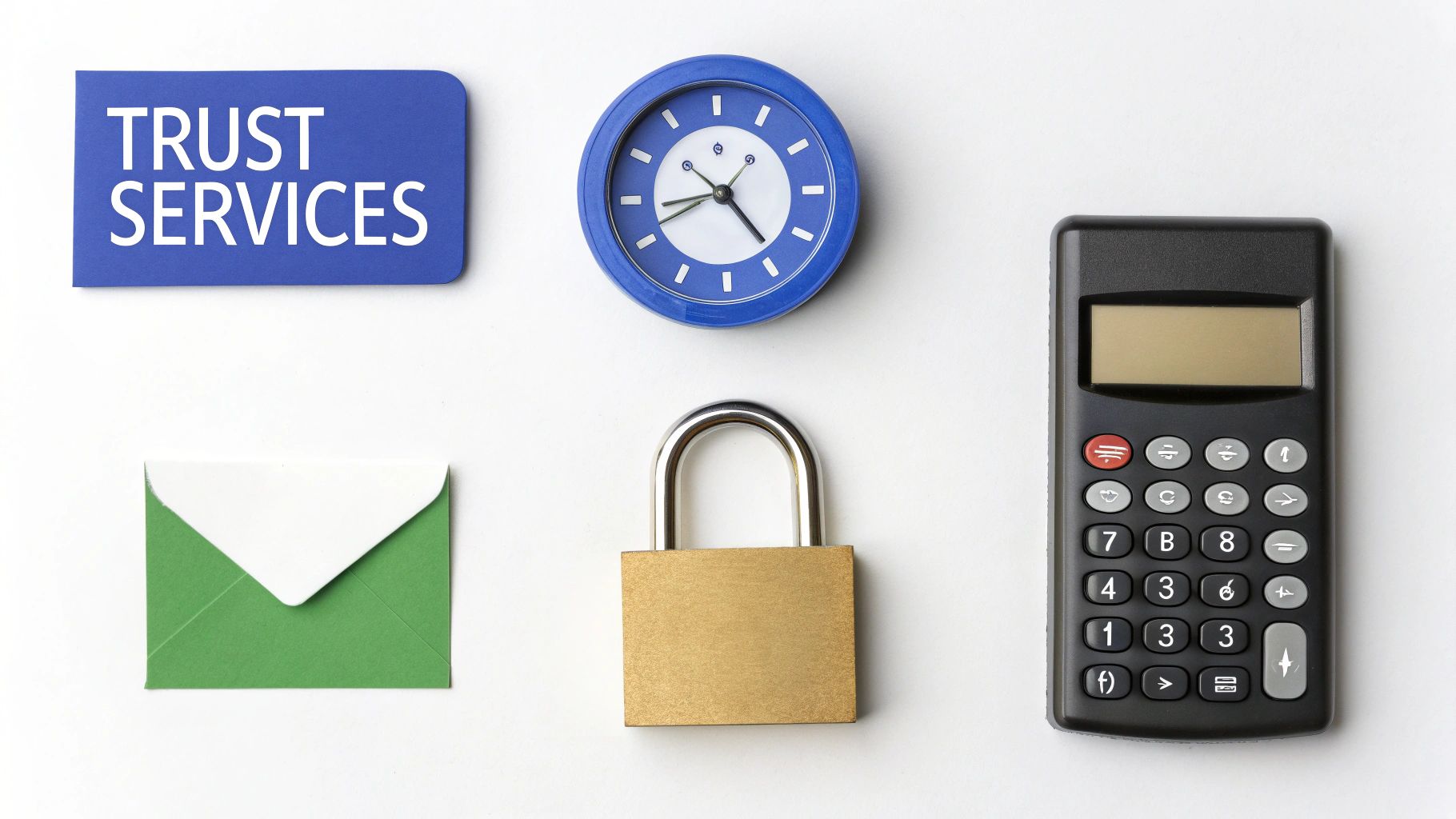
The entire SOC 2 framework hangs on five core principles known as the Trust Services Criteria (TSC). These aren't just technical buzzwords; they're the benchmarks an auditor uses to measure how well a company is actually protecting customer data.
Think of them as the five pillars supporting the entire structure of a company's security program.
Now, here's the interesting part: only one of these five criteria is mandatory for every single SOC 2 audit. The others are chosen based on the specific services a company provides and the promises it makes to its clients. This flexibility is what makes the framework so practical—it isn't a rigid, one-size-fits-all checklist.
Let's break down each criterion with a real-world analogy to make it crystal clear.
Security: The Digital Fortress
Analogy: Picture a bank vault. The Security criterion is everything that protects it—the thick steel door, the complex combination lock, the security cameras, the armed guards, and the access logs tracking who comes and goes. It's the whole system designed to stop a break-in.
This is the non-negotiable, mandatory foundation of every SOC 2 report. It’s all about protecting information and systems from unauthorized access, disclosure, and damage that could compromise the other four criteria.
An auditor is going to look for concrete evidence of controls like:
- Access Controls: Systems making sure only the right people can access sensitive data. This means things like multi-factor authentication (MFA) and role-based permissions are a must.
- Firewalls: The digital gatekeepers blocking malicious traffic.
- Intrusion Detection: Tools that actively monitor for and flag suspicious activity.
- Risk Mitigation: A documented process for finding and fixing security vulnerabilities.
Bottom line: without a rock-solid Security posture, the other criteria are basically meaningless. It’s the bedrock of data protection.
Availability: The Always-On Promise
Analogy: Think of an e-commerce website on Black Friday. The Availability criterion is the promise that the site will stay online, responsive, and accessible to shoppers, even when it’s getting hammered with a massive surge of traffic. It's all about reliability and uptime.
This TSC is absolutely critical for companies whose clients depend on their service being operational 24/7, like cloud hosting providers or online payment platforms. It asks one simple question: Are your systems available for use as you promised they would be?
To prove this, auditors will check for controls like:
- Performance Monitoring: Systems that track uptime and system health to catch problems before they cause an outage.
- Disaster Recovery Plans: A clear, tested plan to get services back online quickly after something goes wrong.
- Network Redundancy: Backup systems ready to take over instantly if a primary system fails.
Availability isn't just about preventing downtime. It's about proving you have a resilient infrastructure that can handle adversity and live up to your service-level agreements (SLAs).
SOC 2 compliance is not just about having security policies written down in a binder somewhere. It's about an independent CPA firm testing those policies to validate that they are not only designed correctly but are also operating effectively day after day.
Processing Integrity: The Accurate Calculator
Analogy: A calculator has one job: give you the right answer, every single time. Processing Integrity is the digital equivalent. It ensures that when your system processes data, the output is complete, valid, accurate, timely, and properly authorized. No weird glitches, no dropped data.
This is vital for any service that handles critical transactions—think financial processing, e-commerce order fulfillment, or data analytics. Any small error in the process could have huge consequences for a client.
Auditors will be digging into controls that govern:
- Quality Assurance: Rigorous testing to make sure system outputs are correct before they're deployed.
- Process Monitoring: The checks and balances that detect and correct errors as data is being processed.
- Data Validation: Rules to ensure that the data being fed into the system is correct and properly formatted in the first place.
This criterion gives your customers assurance that your system does exactly what it's supposed to do, free from accidental or unauthorized manipulation.
Confidentiality: The Signed NDA
Analogy: A signed Non-Disclosure Agreement (NDA) is a legally binding promise to keep sensitive information secret. The Confidentiality criterion is the technical enforcement of that promise, ensuring that information designated as confidential is shielded from unauthorized eyes.
This applies to any data that's meant for a limited audience, such as trade secrets, business plans, intellectual property, or sensitive financial records.
Meeting this criterion means putting real controls in place, such as:
- Data Encryption: Scrambling data so it's unreadable, both when it's stored (at rest) and when it's being sent (in transit).
- Access Restrictions: Strict policies that limit who can view or handle confidential files.
- Secure Disposal: Procedures for permanently and securely destroying data when it's no longer needed.
Privacy: The Personal Data Guardian
Analogy: Privacy is about giving people control over their own personal information, much like you have control over who can enter your home. This criterion governs how an organization collects, uses, retains, discloses, and disposes of personally identifiable information (PII).
While confidentiality can apply to any sensitive company data, privacy is specifically about protecting the information of individuals. It’s where SOC 2 overlaps with regulations like GDPR and CCPA.
Here, auditors will examine controls related to:
- Consent: Do you have explicit permission from people to collect and use their data for a specific purpose?
- Data Minimization: Are you only collecting the personal data that is absolutely necessary?
- User Access Rights: Can individuals easily view, correct, or delete the data you hold on them?
Ultimately, understanding these five criteria is key to understanding what SOC 2 is all about. It’s a deep, verifiable commitment to protecting the data your customers have entrusted to you.
Why SOC 2 Is a Powerful Business Advantage
It's one thing to know the technical ins and outs of SOC 2. It’s another thing entirely to see it for what it really is: a serious business driver. Getting your SOC 2 certification isn’t just a defensive security play; it’s a strategic move that can open up new revenue streams, cement customer trust, and give you a real leg up on the competition.
Think of a SOC 2 report as your company's passport to the enterprise world. For anyone in legal tech, financial services, or SaaS, trying to sell to big companies without one is often a non-starter. These clients just don't have the time to gamble with vendors who can't offer independent, third-party proof that their data is in good hands. A SOC 2 report lets you skip past those monster security questionnaires, cut down your sales cycle, and get to "yes" a whole lot faster.
Building Unshakeable Customer Trust
In business today, trust is everything. And nothing builds it faster than showing, not just telling, a customer you're serious about security. When a prospect sees you have a SOC 2 attestation, you’re not just making a claim—you're backing it up with hard proof.
This validation, coming from a certified public accountant (CPA) firm, shows that your security controls aren’t just words on a page. It proves they’re actually working, day in and day out. This kind of assurance is a game-changer in industries where sensitive information is the norm:
- Lenders and Financial Services: Protecting financial data is the whole ballgame. A SOC 2 report proves you have the right controls to keep that information locked down.
- Legal and eNotary Services: For businesses like BlueNotary, client confidentiality is absolutely non-negotiable. SOC 2 validates the tough controls needed to protect attorney-client privilege and sensitive legal files.
- Real Estate Technology: With huge sums of money and personal data flying around in every transaction, SOC 2 gives partners and clients the peace of mind that their information is safe from start to finish.
Mitigating Financial and Reputational Risk
With the constant drumbeat of cyber threats, being proactive about security isn't optional—it's essential for survival. The SOC 2 framework gives you a clear roadmap to implement and maintain strong controls, which immediately lowers your odds of a security breach. But its value goes even deeper by helping to soften the financial blow if something does go wrong.
The cost of failing to protect data has shot through the roof. The average price tag for a data breach has climbed to a staggering $4.88 million, which is a 10% jump from the previous year. Globally, the cost of cybercrime is on track to hit $10.5 trillion every year. That puts incredible pressure on businesses to get their security right. A SOC 2 certification sends a clear message to insurers, regulators, and customers that you've done your homework. You can dive deeper into the data on SOC 2 requirements and breach costs to see the full financial picture.
SOC 2 certification turns your security posture from a cost center into a strategic asset. It's an investment in your company's reputation that pays dividends in customer loyalty, faster sales cycles, and long-term resilience.
A Framework for Operational Excellence
Here's a benefit that often catches companies by surprise: the journey to SOC 2 compliance makes your whole operation better. The audit process is demanding, and it forces your teams to document procedures, clean up workflows, and get crystal clear on who is responsible for what.
This structured approach leads to a more efficient, consistent, and resilient business. By weaving security best practices into the fabric of your daily work, you build a stronger, more disciplined company from the inside out. That makes SOC 2 more than just a badge of honor—it's a catalyst for building a more mature and successful business.
Your Step-by-Step Roadmap to SOC 2 Compliance
Starting the journey toward SOC 2 certification can feel a bit like standing at the base of a mountain. It’s an intimidating process, no doubt, but breaking it down into a clear, step-by-step roadmap transforms it into a series of manageable milestones. With a good plan, you can navigate the path to compliance with confidence.
It all begins with a single, critical decision that sets the stage for everything that follows.
Phase 1: Define Your Scope and Criteria
Before you write a single policy or implement a new control, you have to define the scope of your audit. What specific systems, services, and data are you including? For a SaaS company, this is usually the production environment that hosts customer data, but probably not your internal development servers.
Once you’ve drawn clear boundaries around your system, you need to select the right Trust Services Criteria (TSC). Security is always mandatory, but you’ll have to decide if Availability, Processing Integrity, Confidentiality, or Privacy are relevant to the promises you make to your customers. A cloud storage provider would absolutely include Availability, for example, while a data processor would need Processing Integrity.
Phase 2: Conduct a Readiness Assessment
With your scope defined, the next step is a readiness assessment. This is essentially a practice audit where you (or a third-party consultant) evaluate your current controls against the TSCs you've selected. Think of it as a diagnostic check-up to find any gaps between your existing security posture and what SOC 2 actually requires.
This phase is absolutely crucial for avoiding nasty surprises during the real audit. The goal is to walk away with a detailed list of every area where your controls are weak, missing, or just not documented properly. A thorough assessment gives you a clear punch list for the work ahead.
A readiness assessment is your most valuable tool for de-risking the audit process. It turns the unknown into a known, providing a clear action plan and preventing costly delays down the line.
Phase 3: Remediate Gaps and Gather Evidence
Now it’s time to close the gaps you found. This is often the most labor-intensive part of the whole process, involving new controls, updated policies, and team training. For instance, if your assessment flagged weak access controls, you might implement multi-factor authentication and formalize your employee onboarding and offboarding procedures.
As you fix things, you have to meticulously document everything and gather evidence. This means collecting screenshots, system logs, signed policy documents, and meeting minutes. This body of evidence is what the auditor will pore over to verify your controls are in place and working effectively. A well-organized approach to security program management is a lifesaver here.
Phase 4: Undergo the Official Audit
After months of prep, it’s showtime. You’ll select an independent, AICPA-accredited CPA firm to conduct the examination. The auditors will review your system description, inspect all your evidence, interview key personnel, and perform tests to validate your controls.
As you navigate this journey, a solid email security audit checklist can be a big help in making sure that specific piece of your security is buttoned up. For a Type I audit, the auditors will assess the design of your controls at a single point in time. For a Type II, they’ll test how well those controls actually worked over a period of 3-12 months.
Once you pass, the CPA firm will issue your official SOC 2 report, giving you the third-party stamp of approval your customers and partners are looking for.
Getting SOC 2 compliant isn't just about checking a box; it's a strategic move that directly fuels business success. The table below breaks down the key milestones you'll encounter on this journey.
SOC 2 Journey Key Milestones
| Phase | Key Activities | Estimated Timeline |
|---|---|---|
| Phase 1: Scoping & Planning | Define system boundaries, select relevant Trust Services Criteria (TSCs), and choose between a Type I or Type II report. | 2-4 weeks |
| Phase 2: Readiness Assessment | Conduct a gap analysis against the selected TSCs to identify missing or weak controls. | 4-6 weeks |
| Phase 3: Remediation | Implement new controls, update policies, train staff, and gather evidence of compliance for every control. | 3-6 months (highly variable) |
| Phase 4: Audit & Reporting | Engage an AICPA-accredited firm for the official audit. For Type II, this includes an observation period. | Type I: 2-4 weeks Type II: 3-12 months (observation) + 4-6 weeks (reporting) |
Each of these steps builds on the last, moving you methodically from planning and preparation to the final, certified report that validates your commitment to security.
The infographic below shows how this hard work pays off.
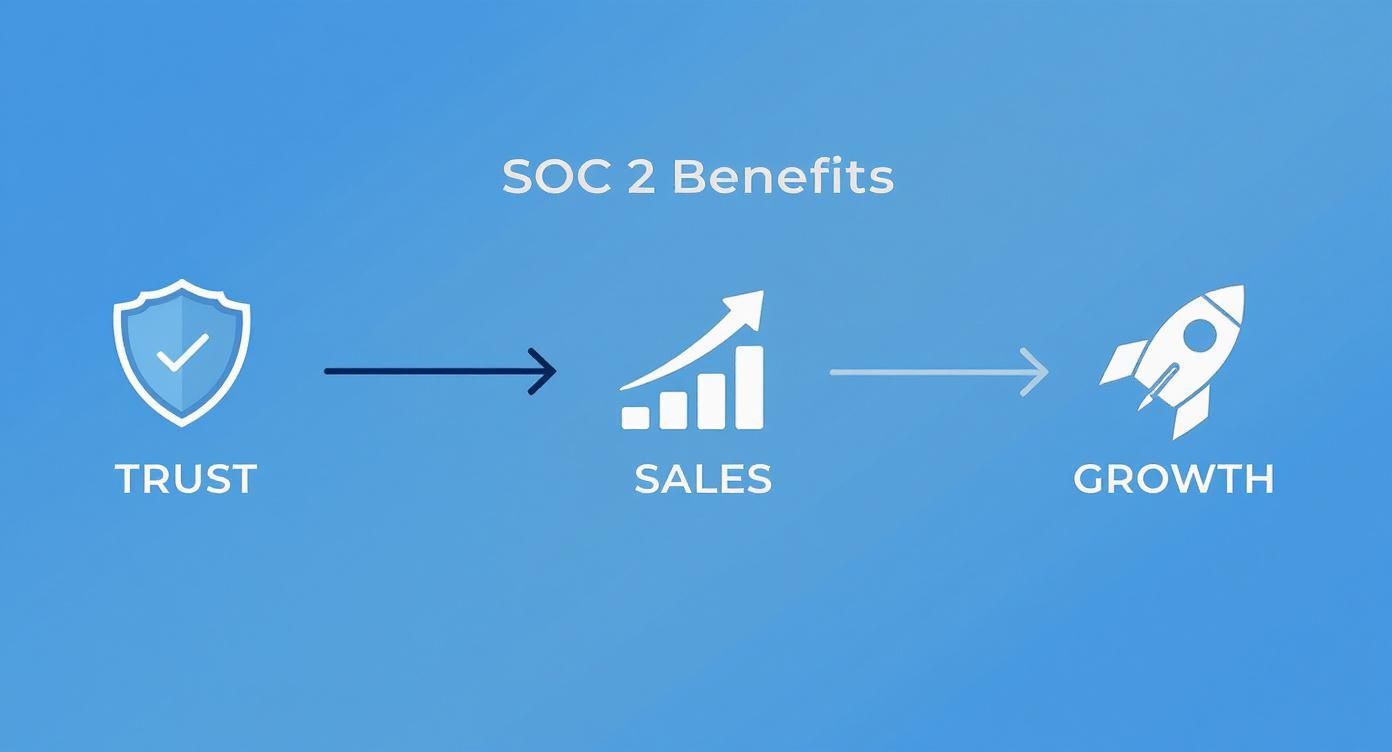
This simple visual makes it clear: the tough process of certification ultimately translates into real business advantages, starting with foundational trust and leading to accelerated, long-term growth.
The Future of SOC 2 in a Tech-Driven World
The world of compliance isn't static, and SOC 2 is no exception. As technology sprints forward, the framework is adapting right alongside it, making sure it remains the gold standard for security assurance. For any business trying to navigate this space, keeping an eye on these trends is the key to staying ahead of the curve.
One of the biggest shifts we're seeing is the rise of compliance automation. Platforms that offer continuous monitoring and real-time alerts are making SOC 2 a much more achievable goal, taking away a lot of the manual grunt work. This is a game-changer, especially for smaller companies.
Instead of a mad dash to gather evidence during an audit window, these tools quietly collect it all year round. This new approach streamlines the whole process, turning what was once a dreaded, disruptive event into a manageable, ongoing practice.
A New Definition of Audit Quality
Alongside automation, there's been a clear shift in how everyone measures the quality of an audit. The old way—relying on an auditor's brand name—is out. Now, it's all about the technical rigor of the audit itself.
Businesses are prioritizing auditors who dig deep. The number of controls tested and the sheer length of the report are now the top indicators of a high-quality audit. With 70% of organizations rating report quality as extremely important, the message is clear: technical excellence and thoroughness are what matter now. You can get a deeper dive into these changing priorities and upcoming SOC 2 changes on OCD-Tech.com.
This means a thin, surface-level report just won't cut it anymore. Your customers and partners expect a comprehensive examination that truly proves your security posture is rock-solid.
The future of SOC 2 is less about a once-a-year scramble and more about a state of continuous compliance. Automation and a focus on technical depth are making security assurance more integrated, transparent, and effective.
Expanding Principles for Emerging Technologies
Finally, the core principles of SOC 2 are stretching beyond their traditional home in cloud services to govern new and emerging technologies. As artificial intelligence and machine learning become baked into everyday business operations, new frameworks are being developed to audit these incredibly complex systems.
This proactive adaptation ensures the foundational ideas of SOC 2—security, availability, and integrity—will continue to build trust in the next wave of tech.
For businesses in specialized fields, like those providing remote online notary services, this evolution is critical. It means the standards they depend on will keep pace with the tools they use. The future of SOC 2 is all about constant adaptation, making sure it stays relevant and powerful in a world of nonstop technological change.
Your Top SOC 2 Questions, Answered
As you get closer to a decision, the practical questions about cost, timelines, and requirements naturally start bubbling up. Let's tackle some of the most common questions we hear about SOC 2, giving you the straightforward answers you need to plan your next steps with confidence.
How Much Does SOC 2 Certification Cost?
There's no single price tag on a SOC 2 audit. The cost can swing pretty widely, typically landing somewhere between $20,000 and over $100,000. The final bill really depends on a few key factors.
The biggest driver is the scope of your audit. A small startup auditing just one system against the mandatory Security criterion will pay a lot less than a large enterprise tackling all five Trust Services Criteria. Other things that move the needle include:
- Company Size and Complexity: More employees, more systems, and more processes simply mean there's more for an auditor to review.
- Report Type: A Type II audit costs more than a Type I. That's because it involves a much longer observation period and way more hands-on testing.
- Readiness Gaps: The amount of work you need to do before the audit even begins can add significant costs, both in internal time and external consulting fees.
How Long Does It Take to Get SOC 2 Certified?
The timeline for SOC 2 is also a "it depends" answer, but a realistic estimate for a first-time Type II audit is anywhere from six to fifteen months. This journey breaks down into two main phases: getting ready, and the audit itself.
The readiness and remediation phase is usually the longest leg of the trip. This is where you identify and fix any gaps in your controls, and it can easily take three to nine months. Once your house is in order, the official audit kicks off. For a Type II report, this involves an observation period of three to twelve months, followed by a few more weeks for the auditor to wrap up testing and write the final report.
Think of the SOC 2 process as a marathon, not a sprint. The upfront investment in getting your readiness and remediation right pays huge dividends in a smoother, more successful audit. Rushing things often leads to a "qualified" opinion—or worse, a failed audit.
Is SOC 2 Certification Mandatory?
Legally speaking, no, SOC 2 certification is not mandatory. You won't find any federal or state law that requires a company to get a SOC 2 report. In the real world, however, it has become an absolute must-have for any B2B service organization that touches customer data.
Big enterprise clients, especially those in regulated fields like finance and healthcare, often make SOC 2 a non-negotiable requirement for their vendors. It’s become the go-to standard for proving you take security seriously. So, while it's technically voluntary, trying to compete for major contracts without it can be a serious uphill battle.
At BlueNotary, our SOC 2 Type II compliance isn't just a certificate on the wall—it's the foundation of the trust our customers place in us for every single secure online notarization. We give you the assurance you need to handle sensitive documents with total confidence. Learn more about our secure and compliant platform.