



At its core, the legality of an electronic signature in the U.S. boils down to two landmark laws: the ESIGN Act and UETA. These pieces of legislation didn't invent e-signatures, but they did give them the same legal muscle as a traditional "wet ink" signature.
The big takeaway? A contract or signature can't be thrown out in court just because it's electronic.
The Laws That Make E-Signatures Official
Before the year 2000, using digital documents for business across state lines was a bit of a legal wild west. Every state had its own mix of rules, which created a ton of uncertainty and really slowed things down.
Imagine trying to build a national highway system where every single state used different traffic signs, road markings, and speed limits. It would be pure chaos. That's essentially what the digital world looked like.
To clear things up, two key laws stepped in to create a unified "rules of the road" for electronic business. What's interesting is that these laws don't get bogged down in the technical details; they don't care what technology you use. They simply established a powerful principle: technology neutrality.
The Federal Foundation: The ESIGN Act
The Electronic Signatures in Global and National Commerce (ESIGN) Act of 2000 was the real game-changer. Passed at the federal level, it set a clear, coast-to-coast standard making electronic signatures legally binding in almost any situation where you'd normally need a handwritten one.
Think of the ESIGN Act as the federal government officially declaring that digital agreements are just as serious and enforceable as paper ones. It specifically covers interstate and foreign commerce, so a contract signed electronically between a company in California and a customer in New York is totally sound.
State-Level Consistency: The UETA
While ESIGN set the national baseline, the Uniform Electronic Transactions Act (UETA) provides the rulebook at the state level. It's been adopted by 49 states, the District of Columbia, and a few U.S. territories, creating incredible consistency across the country.
UETA is built on a simple premise: if a state law requires something to be in writing or signed, an electronic version counts. It works hand-in-hand with the ESIGN Act to create a predictable legal environment. In states that have adopted UETA, it's the primary law that governs. However, ESIGN can still jump in if a state's version of UETA conflicts with the federal law. This dual framework ensures there are very few gaps.
This legal validation is the bedrock of modern digital business. Without the confidence these laws provide, the fast, secure, and convenient transactions we rely on every day just wouldn't be possible. They give businesses and consumers peace of mind that their digital agreements will hold up when it counts.
Here's a quick breakdown of how these two laws compare:
ESIGN Act vs UETA At a Glance
The ESIGN Act and UETA are the two pillars supporting the legality of e-signatures in the United States. While they have the same goal—ensuring electronic records and signatures are legally valid—they operate at different levels of government. The following table provides a quick comparison to highlight their key differences and similarities.
| Feature | ESIGN Act (Federal) | UETA (State) |
|---|---|---|
| Scope | Applies to interstate and foreign commerce. Sets a national baseline. | Applies to transactions within a state's borders. Adopted by 49 states. |
| Primary Goal | To ensure the validity of electronic records and signatures in commerce across the US. | To harmonize state laws with federal standards for electronic transactions. |
| Preemption | Can preempt state law if the state's law (like UETA) is inconsistent with its provisions. | Governs at the state level. States can modify it, but modifications can't contradict ESIGN. |
| Consumer Consent | Includes specific requirements for obtaining consumer consent to use electronic records. | Outlines general consent requirements but can be less detailed than ESIGN. |
| Technology | Technology-neutral; does not prefer one type of e-signature technology over another. | Also technology-neutral, focusing on the legal effect rather than the specific method. |
Understanding this dual framework is crucial for any business operating digitally. It's the reason you can confidently send and sign contracts online, knowing they are backed by the full force of U.S. law. You can see how this foundation extends to more advanced services like remote online notarization, which builds upon these same legal principles.
The Four Elements Of A Legally Binding E-Signature

While ESIGN and UETA gave the green light for using e-signatures, they didn't make every digital squiggle legally sound. For an electronic signature to actually hold up in court, it needs to be built on four essential pillars. Think of these as the legs of a table—if one is missing, the whole thing comes crashing down.
These elements aren't just technical checkboxes; they're the digital equivalent of a formal, in-person signing. Each piece works together to prove the entire process was clear, consensual, and secure, creating an undeniable record of what happened.
1. Intent to Sign
First and foremost, there must be a clear intent to sign. The person clicking the button or typing their name has to know exactly what they’re doing: legally binding themselves to the terms of the document.
This is the "why" behind their action. There can’t be any ambiguity. A vague "Submit" button isn't enough. A well-designed signing process uses clear, action-oriented language like, "Click here to sign and agree to the terms," so no one can later claim they signed by accident.
2. Consent to Do Business Electronically
Just as critical as the intent to sign is the consent to do business electronically. Before anyone even sees the document, all parties have to explicitly agree to use digital records and signatures instead of paper and ink. This is a major consumer protection measure baked right into both ESIGN and UETA.
This consent has to be captured separately from the actual contract. You’ve definitely seen this in action:
- A checkbox you have to tick that says, "I agree to receive and sign documents electronically."
- A clear disclosure upfront explaining your right to request paper copies.
- Instructions on how to opt-out if you’d rather stick with the old pen-and-paper method.
This step guarantees no one is railroaded into a digital process they can't use or don't trust. It makes their agreement to the format a matter of record.
3. Association of Signature with the Record
This one gets a bit more technical, but it's at the very heart of the electronic signature legal requirements. The signature must be logically and securely attached to the document it’s signing. Put simply, you need to be able to prove that a specific signature belongs to a specific, unaltered version of a document.
Imagine signing a paper contract, only for someone to swap out the pages later. The signature is still there, but it no longer applies to the new terms. The digital world prevents this with what is essentially a tamper-evident seal. E-signature platforms use encryption and hashing to create a unique digital "fingerprint" of the document at the moment of signing. If even a single comma is changed after the fact, that fingerprint breaks, instantly flagging the record as tampered with.
An electronic signature system must capture a record that reflects the signing process. This digital audit trail is your evidence, logging every step from document viewing to final signature, including timestamps and IP addresses, to prove the signature's authenticity.
4. Record Retention and Access
Finally, a signed electronic document is useless if it disappears into the ether. The legally binding record must be accurately stored and kept accessible to everyone involved. The system has to ensure a secure, final copy can be reproduced for reference, inspection, or legal challenges down the road.
ESIGN and UETA are clear on this: the final, signed record must maintain its integrity over time. It’s not just about saving a file; it's about making sure all signers get a fully executed copy and that the master version is stored in a secure, unchangeable format for as long as it's required. To learn more about how these standards compare globally, check out this guide on electronic signature law.
Electronic Signatures vs Digital Signatures
You’ve probably heard the terms "electronic signature" and "digital signature" thrown around, often as if they’re the exact same thing. They’re not. While they are related, knowing the difference is absolutely critical for anyone who needs to make sure their agreements are secure and legally sound.
In the simplest terms, think of it like this: an electronic signature is the legal concept. It's any "electronic sound, symbol, or process" that a person attaches to a document to show they intend to sign it. This is a big umbrella term that covers everything from typing your name at the bottom of an email to drawing your signature with a mouse or even just clicking an "I Agree" button.
A digital signature, on the other hand, is the specific technology used to secure that agreement. It’s the high-tech, tamper-proof seal that locks the document down after signing. So, while all digital signatures are a type of electronic signature, not all electronic signatures have the robust security of a digital signature.
The Lock and Key Analogy
Let's make this even clearer. An electronic signature is like verbally telling someone, "I agree to this deal." It shows your intent, which is the foundation.
A digital signature is like putting that agreement into a locked metal briefcase, sealing it with a unique key only you have, and creating an unbreakable record proving the briefcase hasn't been opened or touched since you locked it. The digital signature provides the verifiable proof that backs up your intent.
This extra layer of security isn’t just for show; it comes from sophisticated cryptography, making it essential for high-stakes transactions where you absolutely cannot compromise on identity or document integrity.
How Digital Signatures Add Security
The magic behind a digital signature is a technology called Public Key Infrastructure (PKI). It sounds complex, but the idea is straightforward. PKI uses a matched pair of cryptographic keys—one public, one private—to create a signature that is secure and easy to verify.
- Private Key: This key is known only to the signer. It’s their personal, secret seal used to create the signature.
- Public Key: This key is available to anyone who needs to verify the signature. It can confirm the signature was made by its matching private key, but it can't be used to forge new signatures.
Here's how it works: When someone digitally signs a document, a unique mathematical "hash" (think of it as a digital fingerprint) of the document is created. This hash is then encrypted using the signer's private key. That encrypted hash is the digital signature.
A digital signature effectively binds a signer's identity to a document while simultaneously ensuring the document's integrity. Any subsequent alteration to the document, no matter how small, will invalidate the signature, providing powerful evidence against tampering.
This cryptographic process delivers three essential layers of assurance:
- Authentication: It confirms the identity of the person who signed the document.
- Integrity: It proves that the document has not been altered since it was signed.
- Non-repudiation: The signer cannot later deny having signed the document, since only they have access to their unique private key.
For simple, low-risk documents, you might get by with a basic electronic signature. You can even try out an online signature generator to see how it works. But for any document that carries real legal weight, a platform using true digital signature technology is the only way to go. It's the industry standard for a reason.
When You Still Need A Pen And Paper
As much as electronic signatures have become the go-to for countless deals and agreements, they aren't a silver bullet. The very laws that empower e-signatures—the ESIGN Act and UETA—also pump the brakes on certain high-stakes documents. These still demand the old-fashioned formality of a physical, "wet ink" signature.
This isn't an oversight. It's a deliberate safeguard for life-altering events where the risk of fraud, coercion, or simple misunderstanding is just too high. Think of it as the legal system’s way of saying, "For these specific moments, let's slow down and make absolutely sure everyone is on the same page." Knowing where this line is drawn is a critical part of meeting electronic signature legal requirements.
Key Documents Still Requiring Wet Signatures
While the specifics can shift a bit from state to state, federal law carves out several key areas where e-signatures just won't fly. Using one in these situations could torpedo the entire document, leading to some serious legal headaches.
The most common exceptions fall into a few clear categories:
- Wills and Testamentary Trusts: The creation of wills, codicils, and trusts that decide who gets what after someone passes away almost always requires a physical signature, usually with witnesses present.
- Family Law Matters: Documents at the heart of family relationships are often excluded. This includes things like adoption papers, divorce decrees, and prenuptial agreements.
- Official Court Documents: This covers the formal paperwork of the judicial system—court orders, official notices, pleadings, and other filings.
Why These Exceptions Make Sense
What do all these documents have in common? Their massive personal and legal impact. A will, for instance, is one of the most consequential documents anyone will ever create. The law insists on a high degree of certainty to head off disputes and honor the person's final wishes. Likewise, a court order carries the full weight of the law and needs unambiguous, traditional execution.
These carve-outs aren't meant to throw shade on e-signatures. Instead, they underscore the gravity of certain legal acts, preserving traditional signing ceremonies to protect vulnerable people and ensure the integrity of life-changing agreements.
A handful of specific commercial transactions are also on the exceptions list.
- Notices of Cancellation: This applies to notices shutting off essential utilities like water, heat, and power.
- Default and Foreclosure Notices: Documents related to seizing a primary residence or foreclosing on it require physical delivery and often a wet signature.
- Product Recalls: Official notices for products that pose a major risk to health or safety must be handled the old-school way.
- Certain Negotiable Instruments: Some specific types of promissory notes and checks governed by the Uniform Commercial Code (UCC) are also out.
At the end of the day, a digital-first approach works for the vast majority of business. But knowing when to put down the stylus and pick up a pen is non-negotiable. It keeps your most critical documents shielded by long-standing legal traditions and your business safely on the right side of the law.
Building A Compliant E-Signature Workflow
Knowing the legal framework is one thing, but putting it into practice is where the rubber really meets the road. Building a legally sound e-signature workflow means moving from theory to a repeatable, defensible process that protects your business and gives every signer confidence. Think of it as a roadmap for ensuring every digital agreement you handle is built on a foundation of trust and legal integrity.
A compliant workflow is more than just picking a software platform; it's about taking a holistic approach. It’s a complete system that involves verifying identities, securing crystal-clear consent, and maintaining an unimpeachable digital paper trail. Each step is a critical link in a chain of evidence, ready to prove the signature's validity if it’s ever questioned.
Core Components Of A Compliant Workflow
To meet the high bar set by electronic signature legal requirements, your workflow needs to have several key components baked right in. These aren't just nice-to-have features; they're the essential functions that make every signature verifiable and legally defensible. Consider them the non-negotiable building blocks of your digital signing process.
- Robust Identity Verification: Before anyone even clicks "sign," you need a reliable way to confirm they are who they say they are. A simple email check might be fine for low-risk documents, but for anything substantial, you need stronger methods.
- Clear Consent Language: Just as ESIGN and UETA require, you must get explicit consent from everyone involved to do business electronically. This has to be a clear, affirmative action—not something buried in the fine print.
- Ironclad Record Retention: The final, signed document and its complete audit trail must be stored securely and remain accessible to all parties. Crucially, this record has to be tamper-evident to guarantee its integrity over time.
For higher-stakes transactions, a basic click-to-sign process just won't cut it. This is where more advanced methods like multi-factor authentication (MFA) or knowledge-based authentication (KBA) become absolutely critical. Platforms that offer robust session verification build this higher level of assurance directly into the workflow, which significantly strengthens the legal standing of your signed documents.
The Audit Trail: Your Digital Eyewitness
If there's one thing that matters most in your e-signature workflow, it's the audit trail. This comprehensive log is your digital eyewitness, recording every single action taken during the signing process, from the moment a document is created to the final signature. It’s the primary piece of evidence you would bring to court to defend a signature's validity.
A legally sufficient audit trail has to capture specific data points to paint a complete picture of the transaction. It serves as an independent, time-stamped story that proves the integrity of the entire signing event.
Your audit trail is much more than a receipt; it’s a detailed, chronological record that proves who signed, what they signed, when they signed, and how their identity was verified. It's the cornerstone of non-repudiation, making it extremely difficult for a signer to later deny their agreement.
To be truly effective, the audit trail should meticulously document:
- Document Events: Timestamps for when the document was created, sent, viewed, and signed by each person.
- Signer Information: The signer's name, email address, and the IP address they used to access the document.
- Authentication Details: A clear record of the methods used to verify each signer's identity, like an email confirmation, SMS code, or the results of a KBA quiz.
- Consent Capture: A timestamped entry confirming the signer agreed to use electronic records and signatures.
- Document Integrity: A unique digital fingerprint (often called a hash) of the document before and after signing to prove it hasn't been altered in any way.
When designing your workflow, it's smart to integrate strong principles of compliance and security in automated business processes. This makes sure your e-signature solution doesn't just meet legal standards but also fits securely within your company's broader operations, protecting sensitive data every step of the way.
The infographic below highlights some key documents that are typically excluded from e-signature laws, which is a good reminder that you still need to know when a traditional "wet ink" signature is required.
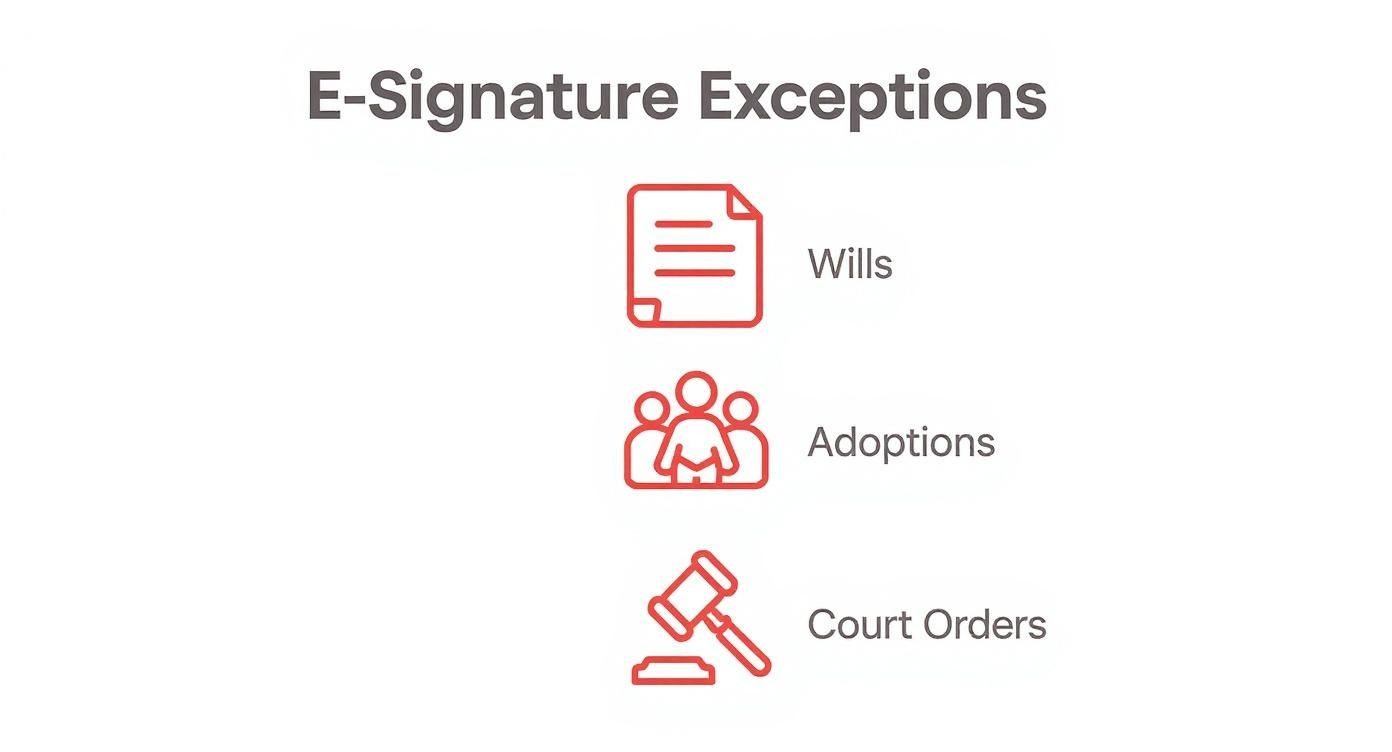
This distinction shows that critical life and legal events—think wills, adoptions, and court orders—often demand the formality of a physical signature for an added layer of legal protection.
Your Top E-Signature Law Questions, Answered
Even after you get the hang of ESIGN and UETA, real-world scenarios always bring up new questions. Let's tackle some of the most common ones that businesses and individuals run into when putting e-signatures into practice.
Are Electronic Signatures Actually Admissible In Court?
Yes, absolutely. This is the entire reason the ESIGN Act and UETA exist. Both laws were specifically written to make it clear that a signature or record can't be thrown out of court or denied legal effect just because it's electronic.
The law doesn't care if a signature was made with a pen or a click. What matters is proving its authenticity.
To successfully use an e-signature as evidence, you need to show who signed the document, when they did it, and—crucially—that the document is the exact same one they signed, with no sneaky alterations. This is where the audit trail from your e-signature platform becomes your best friend.
Think of an audit trail as a digital court reporter. It silently and meticulously records every single action taken during the signing ceremony, giving you the hard evidence needed to prove the signature is legit and enforce your agreement.
This digital log captures everything from IP addresses and timestamps to the specific methods used to verify someone's identity. It creates a robust, verifiable history that is built to stand up to legal scrutiny.
What Officially Makes An E-Signature Valid?
The validity of an e-signature isn't about some fancy, specific technology. You don’t need a retinal scanner for every contract. Instead, its legal power comes from nailing four fundamental concepts during the signing process.
For an electronic signature to hold up, you must be able to demonstrate:
- Clear Intent: The signer had to know what they were doing—that by clicking that button, they intended to sign the document and be bound by its terms. This is why you see clear language like "I agree" or "Click to Sign."
- Explicit Consent: Everyone involved must have agreed to do business electronically before signing. You can't just spring an electronic contract on someone; they have to consent to using electronic records and signatures for that transaction.
- Logical Association: The signature itself has to be securely attached or "logically associated" with the document it's signing. This creates a permanent, tamper-evident link that shows this signature belongs to this document.
- Secure Record Keeping: You need to keep a final, authoritative copy of the signed document and its audit trail. Just as importantly, you must be able to provide copies to all the signing parties if they request one.
This framework is flexible on purpose. It allows everything from a simple checkbox on a website's terms of service to a highly secure signature using complex cryptography to be considered legally binding. The key is always being able to prove those four elements were met.
Can I Use An E-Signature For International Agreements?
This is where things get a bit more complex. The short answer is: maybe. While your U.S.-compliant e-signature is solid on home turf, its power abroad depends entirely on the laws of the other countries involved. Many nations have their own distinct e-signature laws, creating a global patchwork of different rules.
For example, the European Union has its own comprehensive law called the eIDAS regulation. While similar in spirit to ESIGN, it’s not identical. eIDAS defines three tiers of e-signatures—Simple, Advanced, and Qualified—each with progressively tougher security and identity-proofing requirements. A signature that works just fine for a lease in Florida might not meet the "Qualified Electronic Signature" standard required for a major corporate deal in Germany.
You'll often find key differences in areas like:
- Identity Verification Standards: Some countries might require the use of government-issued digital IDs or even in-person verification for certain high-stakes transactions.
- Types of Accepted Signatures: A simple click-to-sign process might not fly where an advanced or qualified signature is the legal standard.
- Accredited Providers: Certain jurisdictions only recognize signatures from government-approved Trust Service Providers (TSPs).
When you're dealing with any significant international contract, it's a must to use an e-signature platform that understands and complies with global regulations. Even better, run it by a lawyer who specializes in international business law. It's a smart move to make sure your agreements are rock-solid, no matter where your partners are.
At BlueNotary, we provide a secure, compliant platform designed to meet stringent U.S. electronic signature legal requirements, complete with robust audit trails and identity verification. Our system ensures your agreements are backed by the evidence you need, giving you peace of mind for every transaction. Discover how you can streamline your signing process at https://bluenotary.us.