





Getting a document notarized sounds simple until you actually need to do it fast. You’re searching for a notary public close to me, and you need someone available today — not next Tuesday.
This guide covers every practical way to find a notary public close to me, what to expect when you get there, what it costs, and when skipping the in-person trip entirely makes more sense.
How to Find a Notary Public Near Me
The fastest way to find a notary public close to me is to check places you already visit. Most people are surprised by how many options are within a few miles.

The Most Reliable Locations
Banks and credit unions are the most consistent source. If you’re a customer, notary services are often free. Call ahead — not every branch has a commissioned notary on duty every day.
UPS Store and FedEx Office locations keep notaries on staff at most locations. No appointment needed at many branches, and they handle a broad range of documents.
Public libraries offer notary services in many counties, often at no charge or for a nominal fee. Hours are limited, so call before you go.
Law offices will notarize documents for existing clients. If you’re already working with an attorney, ask their office.
Real estate offices frequently have notaries on staff because so much of their work requires notarization.
Shipping and postal centers beyond the major chains often have notaries — local pack-and-ship stores are worth checking.
Using Google to Search
Type “notary public close to me” or “notary near me” into Google Maps. Filter by “open now” to see who’s available today. Read the reviews — a notary with 50 reviews mentioning fast service is a safer bet than one with no reviews at all.
The National Notary Association also maintains a notary locator where you can search by zip code and specialty.
What Services Do Local Notaries Offer?
A notary public is a state-commissioned official authorized to witness signatures, administer oaths, and certify document copies. They don’t provide legal advice — that’s a job for an attorney — but they perform a specific and legally required verification function.
Comparison of Common Notary Services
| Service Type | What the Notary Does | Common Use Case |
|---|---|---|
| Acknowledgment | Confirms the signer appeared in person and signed willingly | Deeds, mortgages, powers of attorney |
| Jurat | Confirms the signer swore or affirmed that the document’s contents are true | Affidavits, depositions |
| Copy certification | Certifies a copy is a true replica of the original | Passports, diplomas, licenses |
| Oath administration | Administers a sworn oath for verbal statements | Court proceedings, sworn statements |
| Signature witnessing | Witnesses a signature without verifying document contents | Contracts, agreements |
Most notary public close to me searches are looking for acknowledgments or jurats — the two most common types. If you’re not sure which your document needs, check the notarial certificate block at the bottom of the document. It will specify the type.
What Documents Can Be Notarized?
The list is longer than most people expect. A notary public close to me can handle virtually any document that includes a notarial certificate block.
Common documents include:
- Real estate documents — deeds, mortgage agreements, refinancing paperwork
- Powers of attorney — general, durable, medical, and financial
- Wills and trusts — some states require notarization in addition to witnesses
- Affidavits — sworn statements used in legal proceedings
- Loan documents — vehicle loans, personal loans, business financing
- Adoption papers — many adoption-related forms require notarization
- Immigration documents — USCIS forms often need notarized translations
- Business agreements — partnership agreements, LLC operating agreements
- Medical directives — advance healthcare directives and living wills
Documents that typically cannot be notarized include blank documents, documents with incomplete information, and vital records like birth or marriage certificates (those are certified by government agencies, not notarized).
If you’ve been in a car accident and need to notarize insurance or legal documents, the process for document notarization after car accidents follows the same standard notarization steps — bring your ID and the completed document.
How Much Does Notary Service Cost?
Notary fees are regulated by state law. Each state sets a maximum fee per notarial act, not per document. A single document with three signature blocks means three notarial acts.
State-regulated fees typically range from $2 to $15 per notarial act. California caps fees at $15 per signature. Florida caps at $10. Texas allows up to $6.
Where you go affects the total cost:
- Banks — often free for account holders
- Libraries — free or $1–$5
- UPS Store / FedEx — typically $10–$15 per signature
- Mobile notaries — charge travel fees on top of per-signature fees, often $50–$150 total
- Online notaries — flat session fees, typically lower than mobile notary totals
Key Insight: The per-signature fee is set by state law, but travel fees, convenience fees, and session fees are not regulated. Always ask for the full cost before committing.
Same-Day and Emergency Notary Options
When you need a notary public close to me today, you have a few paths.
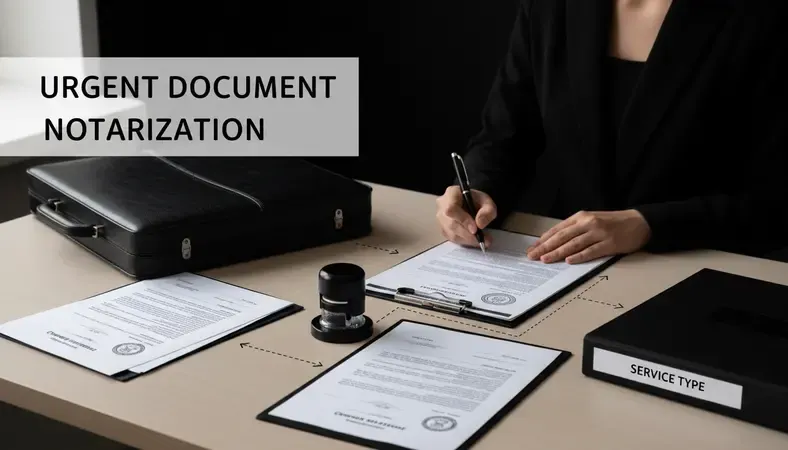
Mobile Notary Services
A mobile notary comes to you — your home, office, hospital, or any agreed location. Mobile notary services are the go-to option for:
- Patients in hospitals or care facilities who can’t travel
- Real estate closings that need to happen at a specific location
- Business executives who need documents signed at their office
- Anyone with mobility limitations
The trade-off is cost. Mobile notary services charge travel fees that vary by distance and urgency. Same-day or after-hours mobile notary services cost more than scheduled appointments.
To find a mobile notary quickly, search “mobile notary services near me” or use the National Notary Association locator and filter for mobile availability.
Hospital and Care Facility Notarizations
Many hospitals have notaries on staff or on call. If you need to notarize a power of attorney or healthcare directive for a patient, call the hospital’s administrative office first. They can often connect you with an in-house notary faster than finding an outside mobile notary.
24-Hour Notary Options
Some mobile notaries advertise 24-hour availability. These are most common in urban areas and near major hospitals. Expect a premium for after-hours service.
Online Notary Services as an Alternative
Remote Online Notarization (RON) is now legal in 46 U.S. states, and it solves the core problem with searching for a notary public close to me: you don’t have to go anywhere.
How Online Notarization Works
- Upload your document — You submit the document through the platform before the session.
- Verify your identity — The platform uses a government ID scan and knowledge-based authentication questions to confirm who you are.
- Connect with a notary — You join a live audio-video session with a commissioned notary.
- Sign and seal — You sign digitally while the notary witnesses in real time. The notary applies their digital seal.
- Receive your document — The completed, notarized document is available immediately as a tamper-evident PDF.
The entire process typically takes 15 to 30 minutes from start to finish.
In-Person vs. Online Notarization
| Factor | In-Person Notary | Online Notarization |
|---|---|---|
| Availability | Business hours, varies by location | 24/7 in most cases |
| Travel required | Yes | No |
| Average time | 30–90 minutes including travel | 15–30 minutes |
| Cost | $2–$15 per act + travel | Flat session fee |
| Legal validity | Valid in all states | Valid in 46+ states |
| Document types | Nearly all | Most common types |
| Same-day availability | Possible, not guaranteed | Yes, on demand |

For most standard documents — powers of attorney, affidavits, loan documents, real estate forms — online notarization is legally equivalent to in-person notarization in states that have passed RON legislation.
Pennsylvania recently expanded its acceptance of electronic notarization, making it easier for residents to use online platforms for a broader set of documents.
BlueNotary offers on-demand remote online notarization at bluenotary.us — you can complete the entire session from any device with a camera, without scheduling an appointment days in advance.
How to Prepare for Your Notary Appointment
Whether you’re meeting a notary public close to me in person or connecting online, preparation makes the difference between a five-minute appointment and a wasted trip.
Before You Go
- Bring a valid government-issued photo ID — driver’s license, passport, or state ID. The notary is required by law to verify your identity. An expired ID will be rejected.
- Do not sign the document beforehand — the entire point of notarization is that the notary witnesses you signing. A pre-signed document cannot be notarized with an acknowledgment.
- Bring all required parties — if the document requires multiple signers, everyone who needs to sign must appear before the notary at the same time (or separately, depending on the document type).
- Check the document for completeness — all fields except the signature line should be filled in. Notaries cannot notarize blank documents or documents with blank fields.
- Know what type of notarization you need — acknowledgment, jurat, or copy certification. When in doubt, check the certificate block on the document or ask the institution that issued it.
At the Appointment
The notary will check your ID, confirm you’re signing willingly and without duress, watch you sign, and then complete the notarial certificate with their signature, stamp, and commission expiration date.
The appointment itself takes five to ten minutes for a single document. Bring everything with you — the notary cannot hold your document while you retrieve missing items.
Common Questions About Finding a Notary Public
Can a notary refuse to notarize my document?
Yes. A notary public can — and must — refuse if they have reason to believe you are being coerced, if your ID is invalid or expired, if the document is incomplete, or if the notarization type requested doesn’t match the certificate on the document. Notaries are not obligated to explain their refusal beyond citing these grounds.
Is a notarized document the same as a legally binding contract?
Not exactly. Notarization verifies the identity of the signer and confirms the signature was made willingly. It does not make an otherwise unenforceable contract enforceable. A notarized document with illegal terms is still unenforceable. Notarization adds an authentication layer — it doesn’t replace the underlying legal requirements of a valid agreement.
What if I can’t find a notary public close to me in my area?
Rural areas sometimes have limited notary access. In that case, mobile notary services can travel to you, or online notarization through a platform like BlueNotary eliminates the geographic problem entirely. You connect with a commissioned notary over video — location doesn’t matter.
Does every document need to be notarized?
No. Notarization is required only when a law, regulation, or the receiving institution specifically demands it. Many contracts, agreements, and personal documents are legally valid without notarization. If you’re unsure whether your document requires it, check with the institution or court that will receive it.
Can I use an online notarized document in every state?
In the 46 states that have enacted Remote Online Notarization laws, yes. A handful of states have more limited acceptance. If your document will be filed in a state with strict requirements, verify acceptance with the receiving institution before your session. Most standard documents — powers of attorney, affidavits, loan paperwork — are accepted across state lines under the Full Faith and Credit Clause of the U.S. Constitution, as detailed in interstate recognition of notarial acts.
Final Thoughts
Finding a notary public close to me is straightforward once you know where to look — banks, libraries, shipping centers, and mobile notaries cover most situations. When time is short or location is a barrier, online notarization through BlueNotary connects you with a commissioned notary in minutes, from any device, without the trip.