 BlueNotary










Does an affidavit need to be notarized, and how do you notarize documents online for one specifically? Yes – unlike some documents where notarization is optional, an affidavit is legally defined by its notarization. Without a notary administering the oath and completing the jurat, what you have is just an unsworn statement, not an affidavit. You can complete that step online in about 10 minutes through a live video session with a commissioned notary.
Does an Affidavit Need to Be Notarized?
Yes, by definition. An affidavit is a written statement sworn to be true in front of a notary, who administers an oath and completes a jurat – without that step, the document is legally just an unsworn written statement, not an affidavit, and most courts and agencies will reject it as such.
There’s one notable exception. federal law, under 28 U.S.C. § 1746, allows an unsworn declaration signed “under penalty of perjury” to substitute for a notarized affidavit in most federal matters. Some states, including Florida under Fla. Stat. § 92.525(1)(b), have similar declaration statutes – but most state courts still require an actual notarized affidavit, so check which one your situation calls for before you sign anything.
How Do You Notarize an Affidavit Online?
To notarize documents online, including an affidavit, you upload the unsigned document, verify your identity, join a live video session with a commissioned notary, take the oath and sign while they witness electronically, and receive the completed, sealed file – typically in about 10 minutes.
- Prepare your affidavit – if you’re not sure how to write an affidavit correctly, start from a template – but don’t sign it yet. The notary needs to witness the actual signing.
- Upload the document to your notarization platform.
- Verify your identity with a government ID scan and a knowledge-based or biometric check.
- Join a live video session, where the notary administers the oath and witnesses your signature.
- Receive your notarized affidavit, complete with the notary’s jurat, seal, and a tamper-evident digital certificate.
If you already have a BlueNotary account, you can start your notarized affidavit request directly from your dashboard without re-entering your information.
What’s the Difference Between an Affidavit and an Unsworn Declaration?
An affidavit requires a notary to administer an oath and complete a jurat; an unsworn declaration under 28 U.S.C. § 1746 skips the notary entirely and instead relies on a specific “under penalty of perjury” statement written into the document itself. Both carry legal weight, but they aren’t interchangeable everywhere.
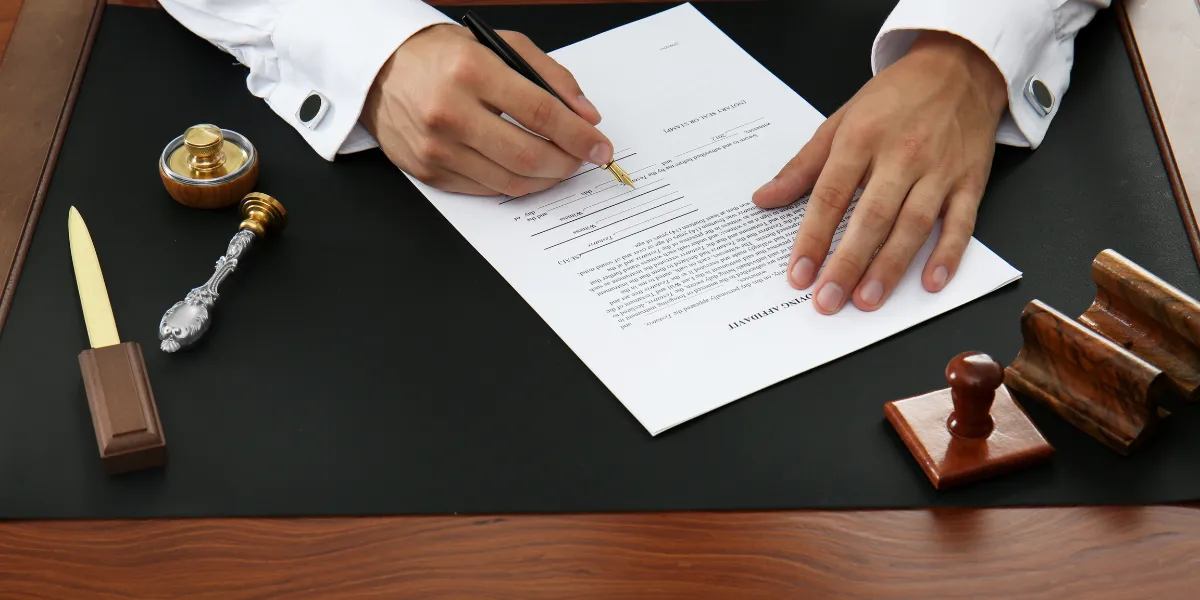
- Federal matters. a declaration under 28 U.S.C. § 1746 is generally accepted in place of a notarized affidavit.
- Some states. Florida and a handful of others have their own statutes permitting unsworn declarations for many of the same purposes.
- Most state courts. still require an actual notarized affidavit rather than a declaration – don’t assume a declaration will be accepted without checking first.
If you’re not certain which one your situation requires, notarizing an actual affidavit is the safer default, since a properly notarized affidavit is accepted virtually everywhere a declaration would be, but not always the reverse.
What Happens During the Notary’s Jurat Process?
During the jurat process, the notary verifies your identity, administers an oath asking you to swear or affirm the contents are true, watches you sign, and then completes and seals the jurat – a certificate stating exactly what occurred during the signing. This sequence is what legally distinguishes an affidavit from any other signed statement.
Because the oath itself is part of the legal record, knowingly swearing to false statements in a notarized affidavit can constitute perjury under federal law (18 U.S.C. § 1621) or an equivalent state statute – which is part of why courts and agencies give affidavits more evidentiary weight than an unsigned or unsworn statement.
Starting from a proper affidavit template helps avoid delays. BlueNotary’s affidavit form templates cover common types, including identity, residency, and support affidavits.
How Much Does It Cost to Notarize an Affidavit Online?
BlueNotary charges $25 for one signer and one stamp, which fits most affidavits because one person swears to the statement. Each additional stamp is $8 and each additional signer is $5. Sessions typically take about 10 minutes.
For businesses or individuals notarizing multiple affidavits regularly, the pricing page lists the plans. Business Pro costs $47 per seat per month for teams that use their own notaries, with $10 sessions and $0 for additional stamps.
For a single affidavit, remote online notarization is generally the fastest way to get it completed correctly the first time.
Have a question about a document in another language? Email BlueNotary at [email protected] and the team will help.
FAQ Section
1. Does an affidavit need to be notarized?
Yes. An affidavit is legally defined by its notarized jurat – without one, the document is just an unsworn statement, not an affidavit.
2. Can you notarize documents online for an affidavit?
Yes, in states that authorize remote online notarization. The process typically takes about 10 minutes, including identity verification and the oath.
3. Can I use an unsworn declaration instead of a notarized affidavit?
Sometimes. Federal law (28 U.S.C. § 1746) and some states allow it, but most state courts still require an actual notarized affidavit – check first.
4. What makes a document legally an affidavit?
A notary administering an oath, witnessing the signature, and completing a jurat. Without that process, it’s an unsworn written statement, not an affidavit.
5. What happens if I lie in a notarized affidavit?
Knowingly swearing to false statements in a notarized affidavit can constitute perjury under federal law (18 U.S.C. § 1621) or an equivalent state statute.
6. How much does it cost to notarize an affidavit online?
BlueNotary charges $25 for one signer and one stamp, plus $8 for each additional stamp and $5 for each additional signer. Sessions typically take about 10 minutes.