 BlueNotary










Do divorce papers need to be notarized, and can digital notarization actually handle it? In most states, at least one divorce document, typically the marital settlement agreement or a financial affidavit, needs to be notarized before a court will accept it. Where that’s the case, you can usually complete it online in about 10 minutes, though not every document in a divorce filing requires a notary.
Do Divorce Papers Need to Be Notarized?
In most states, yes – at least one document in a divorce filing needs to be notarized, most commonly the marital settlement agreement or a financial affidavit. A few states are the exception. Colorado, Oregon, and Pennsylvania don’t require notarized signatures on standard divorce forms, which are signed under penalty of perjury or an unsworn-falsification statement instead.
Not every document in a divorce needs a notary, though. Many petitions and motions only require a signed certification page under oath, affirming the contents are true – which is a different, lighter requirement than full notarization. Financial and settlement documents are where notarization is most consistently required, since they carry direct legal and financial consequences for both parties.
How Do You Notarize Divorce Papers With Digital Notarization?
To notarize documents online, including divorce papers, you upload the unsigned document, verify your identity, join a live video session with a commissioned notary, sign while they witness electronically, and receive the completed, sealed file – typically in about 10 minutes.
- Prepare the document but don’t sign it yet. The notary needs to witness the actual signing.
- Upload the document to your notarization platform.
- Verify your identity with a government ID scan and a knowledge-based or biometric check.
- Join a live video session, where the notary witnesses your signature and completes the notarial certificate.
- Receive your notarized document, ready to file with the court or provide to your attorney.
If both spouses need to notarize the same agreement, most platforms support scheduling each party into a session separately, which can be easier logistically than requiring both to appear at once.
Which Divorce Documents Typically Need a Notary?
The documents most consistently requiring notarization are the marital settlement agreement and financial affidavit, since both carry long-term legal and financial weight. The initial petition and any response typically require less – often just a signed certification rather than a full notarization.
- Marital settlement agreement. commonly requires notarization in many states, and in some, both spouses must sign in front of a notary.
- Financial affidavit. a sworn statement of income, assets, and debts, commonly notarized to confirm authenticity.
- Initial petition or complaint for divorce. requirements vary – some states require notarization, others accept a signed certification instead.
- Response to the petition. follows similar, state-dependent rules as the initial petition.
For a fuller breakdown by document type, see BlueNotary’s guide to getting divorce papers notarized.
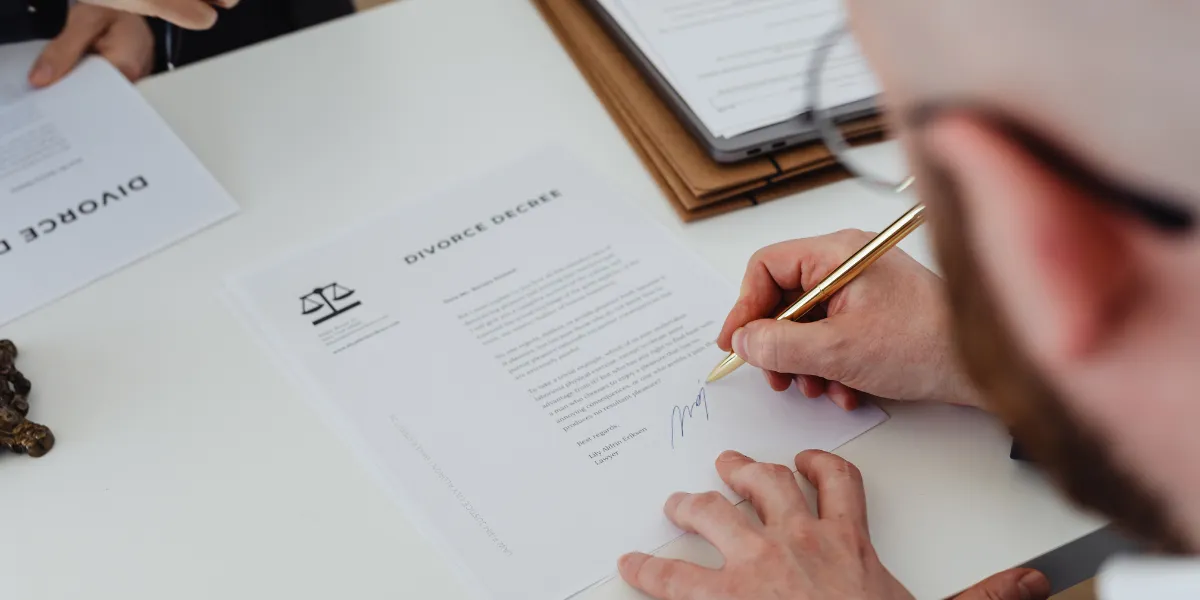
Will the Court Accept an Online-Notarized Divorce Document?
This is worth confirming before you rely on it. even in a state where an online notary public can perform remote online notarizations generally, individual family courts and clerks vary in whether their e-filing systems accept an electronically notarized document. Confirm with your court or attorney before assuming your notarized filing will go through without issue.
- Check your specific court’s e-filing rules rather than assuming state-level RON approval covers it automatically.
- Ask your attorney if you have one – they’ll know exactly which local rules apply to your filing.
- Confirm both-party requirements separately; some states require both spouses to notarize a settlement agreement, not just one.
How Much Does It Cost to Notarize Divorce Papers Online?
BlueNotary, an online notary service, charges $25 for one signer and one stamp. Divorce documents often need two signers, such as both spouses on a settlement agreement, so the typical price is $30 ($25 plus $5 for the extra signer). Each additional stamp is $8. Sessions typically take about 10 minutes.
For attorneys or paralegals handling notarizations for multiple clients, the BlueNotary pricing page lists the plans. For attorneys and law firms, Business Pro costs $47 per seat per month for teams that use their own notaries, with $10 sessions and $0 for additional stamps.
For a single document, using a remote online notary is generally the fastest way to get it notarized – just confirm your court’s filing rules first.
Have a question about a document in another language? Email BlueNotary at [email protected] and the team will help.
FAQ Section
1. Do divorce papers need to be notarized?
In most states, yes – typically the marital settlement agreement or financial affidavit. Colorado, Oregon, and Pennsylvania generally require none on standard forms.
2. Can you notarize divorce papers with digital notarization?
Yes, in states that authorize remote online notarization. The process typically takes about 10 minutes, including identity verification.
3. Do both spouses need to notarize a settlement agreement?
In some states, yes – both spouses must sign the marital settlement agreement in front of a notary. Requirements vary by state, so confirm locally.
4. Does the initial divorce petition need to be notarized?
It depends on the state. Some require notarization; others only require a signed certification under oath, which is a lighter requirement.
5. Will the court accept an online-notarized divorce document?
Usually, but confirm with your specific court first – e-filing systems and local rules vary even within states that permit remote online notarization.
6. How much does it cost to notarize divorce papers online?
BlueNotary charges $25 for one signer and one stamp, plus $8 for each additional stamp and $5 for each additional signer. A settlement agreement signed by both spouses is typically $30. Sessions typically take about 10 minutes.