





Sorting out notarization requirements by state feels like untangling a ball of yarn. Every state has its own rulebook. While the big picture—stopping fraud by making sure a signer is who they say they are—is the same everywhere, the devil is in the details. Things like what ID you can use, how much a notary can charge, and the rules for notarizing online can be wildly different from one state line to the next.
Understanding State Notarization Requirements
At its core, notarization is a critical piece of risk management. A commissioned notary public serves as an impartial witness, confirming a signer's identity and making sure they're not being forced to sign. It’s what gives real estate closings, powers of attorney, and other major transactions a solid layer of legal trust.
The catch is, there’s no single federal law for notarizations. That means each state makes its own rules, creating a patchwork of regulations. For title companies, lenders, and notaries working across state lines, this can be a real headache. A notarization that’s perfectly legal in one state could be completely invalid in another if you don't follow the local script.
Core Compliance Areas to Watch
To make sure every document you handle is legally sound, you've got to know where the state laws diverge. We’ll break down the essentials for all 50 states right here, focusing on the big-ticket items:
- Remote Online Notarization (RON): Is it even allowed? If so, what are the specific tech requirements?
- Signer Identification: What IDs are good to go? When can you fall back on a credible witness?
- Maximum Notary Fees: How much can a notary legally charge for different acts? You'd be surprised how much this varies.
- Notary Journals and Seals: Is keeping a detailed journal mandatory? What specific information has to be on the notary’s official seal?
Think of this guide as your go-to compliance playbook. Notarization laws have been shifting dramatically, especially with the boom in remote services. Just a decade ago, only a handful of states allowed Remote Online Notarization (RON). Now, it’s the vast majority, a change pushed forward by the need for secure, convenient options. For more on this legislative trend, it's worth checking out the congressional records.
Quick Reference Key Notarization Rules by State
To get a quick pulse on things, here's a snapshot of some key rules for five major states. It’s a great starting point for understanding how different things can be.
| State | RON Legal | Max Fee (Per Signature) | Journal Required |
|---|---|---|---|
| California | Yes | $15 (for most acts) | Yes |
| Texas | Yes | $10 (for first signature) | Yes |
| Florida | Yes | $10 (in-person); $25 (RON) | Yes (for RON) |
| New York | Yes | $2 (in-person); $25 (RON) | Yes |
| Illinois | Yes | $5 (in-person); $25 (RON) | Yes |
This table just scratches the surface, but it highlights why you can't assume one state's rules apply elsewhere. Always dig into the specific requirements for the state where the notarization is taking place.
Remote Online Notarization (RON) State Laws
Remote Online Notarization completely changed the game for executing documents, but its legal status is a classic example of how much notarization requirements vary by state. While most states have permanently green-lit RON, the legal landscape is anything but uniform. If you want to stay compliant, you have to know the differences.
Some states jumped on board early, establishing clear legal frameworks for the technology and procedures required. Pioneers like Virginia, Florida, and Texas really set the standard for secure digital notarizations. On the flip side, a few states are still stuck operating under temporary COVID-era executive orders, which creates a lot of uncertainty. California has been the most famous holdout, although recent legislation suggests they’re finally moving toward permanent authorization.
Core Technology and Security Mandates
In states where RON is fully legal, the law is very specific about the technological safeguards required. These aren't just helpful suggestions; they are mandatory for a remote notarization to be valid.
- Two-Way Audiovisual Communication: The platform must let the notary and the signer see and hear each other live, in real time. It’s the law's way of maintaining the "personal appearance" requirement, just in a virtual setting.
- Identity Verification: This is a serious, multi-step process. It almost always involves credential analysis, where a signer’s government ID is scanned and authenticated, plus knowledge-based authentication (KBA). That's where the signer has to answer a series of personal questions pulled from public and private records.
- Secure Record-Keeping: States require a complete, unalterable audiovisual recording of the entire notarization session. This file has to be securely stored, typically for 5 to 10 years, and it serves as the ultimate proof of a compliant notarial act.
This screenshot from the BlueNotary homepage gives you a good idea of how a modern RON platform is built to handle these compliance features right out of the box.
You can see how the interface highlights things like secure eSignatures and identity verification, which are the absolute bedrock of meeting state-level RON laws.
Navigating State-Specific Nuances
Beyond the big tech rules, state laws often get into the weeds on finer points. For instance, a real estate closing in Florida conducted via RON might have different witness requirements than one in Nevada. Some states even go as far as to outline specific security standards for the platform itself, demanding things like SOC 2 compliance to ensure consumer data is protected.
The patchwork of state RON laws means that just hopping on any old video chat software isn't just a bad idea—it's illegal and will invalidate the notarization. A compliant platform is built from the ground up to meet these strict legal demands, from identity proofing all the way to creating a tamper-evident audit trail for every single transaction.
Because the rules are so granular, using a certified platform is non-negotiable for making sure every notarization is legally sound. If you want to dig deeper, you can find more information about how to perform a fully compliant remote online notary session that lines up with all these diverse state laws. A specialized service ensures that whether you're closing a loan in Ohio or executing a power of attorney for a client in New York, the notarization checks every local box.
Acceptable Signer Identification by State
Properly identifying a signer is the single most important job a notary public has. It’s our core defense against fraud, yet the rules for what counts as acceptable ID can change dramatically the moment you cross a state line. This is one of the most critical areas where notarization requirements by state demand your full attention.
Most states publish a list of approved government-issued identification documents. As a general rule, these IDs must be current, unexpired, and contain a photograph, a physical description, and the signer's signature.
Common Forms of Primary Identification
While the specifics can differ, a few forms of ID are almost universally accepted across the board:
- A state-issued driver’s license or non-driver ID card
- A U.S. Passport or U.S. Passport Card
- A U.S. military ID card
- A foreign passport, provided it's stamped by U.S. Citizenship and Immigration Services (USCIS)
- A Permanent Resident Card (often called a "Green Card")
Keep in mind, though, that some states, like California, maintain a very strict, exclusive list of what they'll allow. Others give notaries more leeway. Because of this, you absolutely have to check the latest regulations for the state in question.
Using Credible Witnesses for Identification
So, what happens if a signer shows up without an acceptable ID? Many states have a fallback: using a credible identifying witness (or sometimes two) to vouch for the signer’s identity. But be warned—the rules for this process are highly specific and vary wildly from one state to another.
For example, some states require the credible witness to personally know the notary. The notary then relies on that established relationship to identify the signer. Other states, like Florida, flip this around. There, the witness must personally know the signer but not necessarily the notary. Instead, the witness has to present their own valid ID to the notary and swear an oath confirming the signer's identity.
A common point of failure in notarizations is getting the signer identification wrong. Relying on an expired ID in a state that forbids it, or messing up the credible witness procedure, can invalidate the entire notarial act. This often leads to document rejections and even potential legal headaches down the road.
This chart gives a good visual of the different access levels for notarial services, including Remote Online Notarization, which comes with its own strict identity-proofing standards.
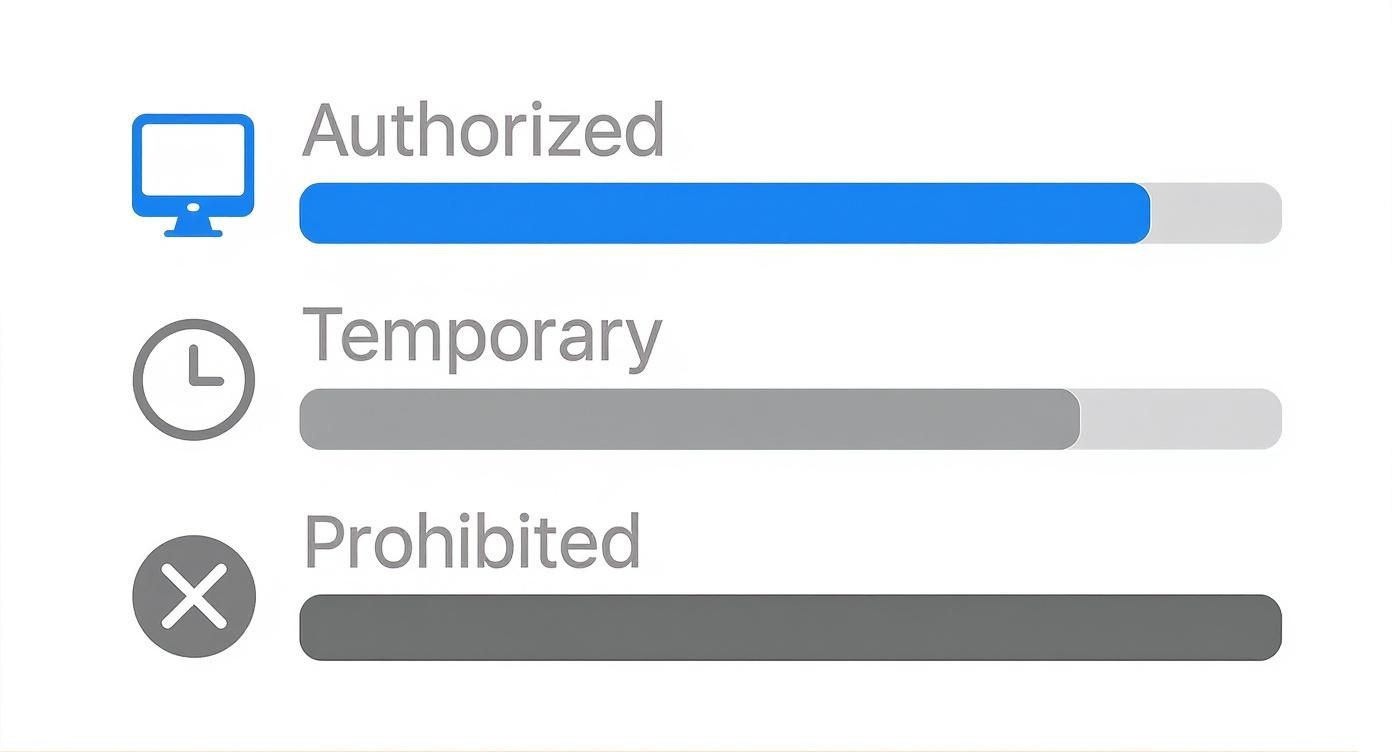
The trend is clear: states are moving toward permanent authorization for modern notarization methods, which means robust and reliable identity verification is more important than ever. Because these rules are so detailed and can change, making sure you have the current standards is non-negotiable for compliance. For a direct link to each state's governing body, this list of Secretary of State websites is an invaluable resource. It's the best way to ensure you have the most accurate, up-to-date information before you start any notarization.
State Requirements for Notary Commission and Bonds
Before you can perform any notarizations, you first need a commission from your state. Think of it as your official license to operate as a notary public. While the exact path varies from state to state, there's a common baseline of requirements most applicants have to meet.
Generally, you'll need to be at least 18 years old, a legal resident of the state you're applying in, and have a clean record with no felony convictions. The process itself usually involves submitting an application to your Secretary of State, paying a fee, and taking an oath of office. Some states also require you to complete an educational course or pass an exam to make sure you're up to speed on your duties. For a good look at how these steps play out in practice, our guide on how to become a notary public in Utah breaks down a typical state process.
Understanding Surety Bonds
A key piece of the commissioning puzzle in many states is getting a surety bond. It's a common point of confusion, so let's clear it up: a surety bond is not insurance for you, the notary. Instead, it's a financial safeguard for the public. It's there to protect people from financial harm if a notary makes a mistake or engages in misconduct.
If a notary's error leads to a financial loss for someone, that person can file a claim against the bond to recover their damages. State law dictates the bond amount, and they're all over the map—from as low as $500 in some states to $25,000 or more in others. This difference really just shows how each state weighs public protection against the financial responsibilities of its notaries.
Maintaining public trust is everything for a notary. Just like in other professions, this means sticking to a strict professional code of ethics. The surety bond provides the financial teeth for those ethical duties, giving the public a real remedy if a notary's actions cause harm.
The Trend Toward Higher Bond Requirements
Lately, we've seen a number of states take a hard look at their bond requirements, mostly driven by rising concerns about fraud. As the transactions we notarize become more valuable and complex, the potential for big financial losses from a single mistake grows right along with them. The result is a clear trend toward beefing up those bond amounts for better consumer protection.
Louisiana is a perfect example. They recently hiked their required bond for non-attorney notaries from $10,000 all the way up to $50,000. That's a huge jump, and it puts Louisiana in the top tier of states with the highest bond requirements. It's also a strong signal of a larger legislative shift toward holding notaries to a higher standard of financial accountability.
Notary Education and Training Mandates
To make sure notaries are up to the task of protecting the public from fraud, a growing number of states are making education a mandatory part of the job. This shift comes from a simple realization: just getting a commission isn't enough. Notaries need to be formally trained on the specific laws and ethical duties that come with the seal.
The exact rules on who needs training, when they need it, and what it covers have become a crucial part of the notarization requirements by state. Some states now demand an approved course for all first-time applicants. Others take it a step further, requiring continuing education before a notary can renew their commission, which keeps them sharp and informed on new laws and practices.
First-Time Applicants Versus Renewals
It's common to see different rules for new and veteran notaries. A state might require a comprehensive, multi-hour course for someone just starting out, but only a shorter refresher class for those renewing their commission.
- Mandatory Initial Training: States like California, New York, and Pennsylvania won't grant a commission until a new notary completes a course or passes an exam. This initial training is all about the fundamentals: state-specific laws, the proper way to perform notarial acts, and professional responsibilities.
- Continuing Education: Jurisdictions like Florida and Missouri require ongoing education to renew a commission. This is a smart way to ensure notaries stay updated on legislative changes, especially with complex topics like Remote Online Notarization (RON) constantly evolving.
- No Formal Mandate: Plenty of states still don't have formal education requirements. In these places, it's entirely up to the individual notary to find their own training and resources to stay competent and compliant.
Mandatory notary education is definitely on the rise. We've seen a big jump in states adding these requirements lately. Texas, for instance, recently joined the list, now requiring all new and renewing notaries to complete a state-approved course. It's part of a much bigger trend, with over half of all U.S. states now mandating some form of education. You can read more about the new 2025 notary laws to see how this push is shaping the industry.
Common Topics Covered in Notary Courses
While the details can vary from state to state, approved notary training programs tend to hit the same core topics that are essential for every notarial act.
The whole point of mandatory education isn’t just memorizing rules; it’s about building a professional mindset. It’s about understanding the "why" behind every step—from identifying the signer to filling out the certificate—to protect the integrity of the document.
You'll almost always find these courses covering the key differences between an acknowledgment and a jurat, how to properly use a notary seal and journal, and the best practices for verifying a signer's identity. They also hammer home the things you absolutely can't do, like giving legal advice or notarizing a document you have a personal stake in. And as technology changes the game, more courses are adding modules on RON procedures, data privacy, and digital security.
Rules for Notary Journals, Seals, and Fees

Beyond just verifying a signer’s identity, a notary's core duties involve meticulous record-keeping and the proper use of their official tools. These everyday tasks—maintaining a journal, affixing a seal, and charging the correct fees—aren't just suggestions; they're governed by strict state laws.
Getting these specific notarization requirements by state right is absolutely critical for staying compliant and protecting the integrity of every single transaction you handle.
A notary journal is your detailed log of every notarial act you perform. Think of it as your best defense if a transaction is ever questioned down the road. It provides concrete proof of the who, what, when, and where for every notarization.
Notary Journal Mandates
When it comes to keeping a journal, state laws are split. Some states mandate it, treating it as an essential part of the job, while others simply recommend it as a professional best practice.
- Mandatory States: Places like California, Texas, and Pennsylvania require notaries to keep a detailed journal for all notarial acts. Entries typically need to capture the date, type of notarization, document title, and the signer's name, address, and signature.
- Recommended States: In many other states, a journal is strongly encouraged but not legally required for traditional in-person notarizations. That said, even in these states, keeping a journal is almost always mandatory for Remote Online Notarizations (RON) to create a clear and complete audit trail.
No matter what your state law says, maintaining a thorough journal is a powerful risk management tool. It protects you, the notary, just as much as it protects the public.
Official Seals and Stamps
A notary's official seal or stamp is their unique mark of office, and its design is heavily regulated. Applying this seal is what makes a notarization official, and the requirements for the seal’s shape, size, and the information it must contain are highly specific to each state.
For example, a Texas seal must be a rectangle and display the notary's name, commission number, and expiration date. Head over to Florida, however, and you'll need a round seal with the notary's name and the words "Notary Public – State of Florida." Using the wrong type of seal or leaving out required information can completely invalidate the notarization.
A common point of failure is an unclear or improperly placed seal. Always ensure the seal is legible and does not cover any text on the document. The goal is to make every detail of the notarial certificate, including your signature and seal, perfectly clear.
Maximum Notary Fees by State
States also set the maximum fees a notary can charge for their services, which prevents overcharging the public. These fee schedules are very specific and can vary dramatically from one state to another. A jurat in New York might have a maximum fee of $2, while the very same act in California could be $15.
These fee structures often have different rates for different types of notarizations. For instance, many states allow a higher fee for RON sessions (often around $25) compared to traditional in-person notarizations to account for the technology platforms involved.
Charging more than the state-mandated maximum is illegal and can lead to serious penalties, including the loss of your notary commission. Always double-check the current fee schedule for the state where the notarization is taking place.
State-by-State Journal and Seal Requirements
To help you navigate these rules, we've put together a table summarizing the journal and seal requirements for various states. This is a quick reference, but always consult your state's official notary handbook for the most detailed and up-to-date information.
| State | Journal Requirement | Seal Requirement | Seal Information Required |
|---|---|---|---|
| California | Mandatory (Physical) | Mandatory (Rectangle) | Name, Commission #, "Notary Public", County, Expiration Date |
| Florida | Recommended (IPN), Mandatory (RON) | Mandatory (Round) | Name, "Notary Public – State of Florida", Commission #, Expiration Date |
| New York | Recommended | Not Required | No official seal requirement, but name and office info must be legible |
| Texas | Mandatory | Mandatory (Rectangle or Round) | Name, "Notary Public, State of Texas", Commission ID #, Expiration Date |
| Pennsylvania | Mandatory | Mandatory (Rectangle) | Name, "Notary Public", County, Commission Expiration Date |
| Illinois | Recommended (IPN), Mandatory (RON) | Mandatory (Rectangle) | Official Seal of Notary Public, Name, State of Illinois, Commission Expires |
As you can see, the requirements can be quite different depending on where you're commissioned. Keeping a compliant journal and using the correct seal are non-negotiable parts of being a responsible and professional notary.
Frequently Asked Questions About State Notary Laws
When you're dealing with notarizations across different states, a handful of practical questions always seem to pop up. Whether you're a business juggling multi-state deals or an individual signing a critical document, you need clear answers to stay compliant and avoid headaches. Let's tackle some of the most common ones we hear.
One of the biggest questions is whether a document notarized in one state holds up in another. The short answer is almost always yes. Thanks to the Full Faith and Credit Clause of the U.S. Constitution, a notarial act that's legally performed in one state must be recognized as valid in all the others.
So, if a document is remotely notarized in a state like Florida, which has well-established RON laws, it should be accepted in California, even though California has been slower to permanently adopt its own RON rules. The key is that the notarization must have been done in full compliance with the laws of the state where the notary was physically located at the time.
Distinguishing Between Key Notarial Acts
Another common point of confusion is the difference between an acknowledgment and a jurat. They might seem similar, but they serve very different functions.
- An acknowledgment is when a signer declares they have willingly signed a document. The notary's job here is simply to verify the signer's identity and confirm their signature was voluntary.
- A jurat is more involved. It requires the signer to swear or affirm under oath that everything in the document is true. For a jurat, the signer must physically sign the document in the notary's presence.
The fundamental difference is the oath. A jurat certifies that the signer has sworn to the truthfulness of the document's contents, while an acknowledgment just confirms the identity of the person who signed it.
Handling Errors and Verifying Commissions
What happens if a notary messes up? If it's a minor error and it's caught before the document gets officially recorded, some states allow the notary to make a correction, initial it, and log the change in their journal. For bigger mistakes, however, the safest—and often required—move is to perform a brand-new notarization from scratch.
An incorrect notarization can have serious consequences and could even invalidate the entire document. This is exactly why Errors & Omissions (E&O) insurance is a must-have for all notaries; it provides a financial safety net against unintentional mistakes.
Finally, how can you be sure a notary’s commission is legit? Most Secretaries of State have an online search tool right on their official website. Just plug in the notary's name or commission number, and you can instantly verify their status, commission expiration date, and any special authorizations they might have, like for performing remote online notarizations. It's a simple check that's a crucial due diligence step for any transaction.
For businesses and individuals who need to ensure every notarization is compliant, fast, and secure, BlueNotary offers a comprehensive platform for on-demand online notarizations 24/7. Connect with a certified notary in minutes and complete your signing from anywhere. Learn more at BlueNotary.