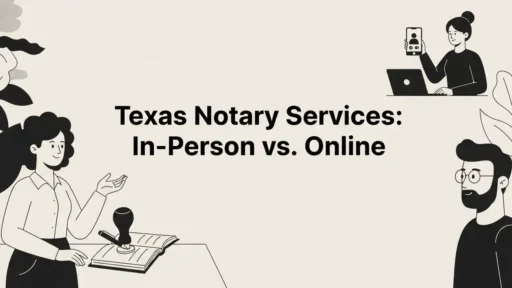






Getting a document notarized in Texas used to mean one thing: find a notary, drive there, wait, sign. Texas now gives you a second option remote online notarization and it changes the math entirely for most people.
If you need a notary in Texas and you’re trying to figure out the fastest, easiest way to get it done, this guide covers both paths, what each costs, what documents qualify, and exactly how to get started.
Your Two Options for Notarization in Texas
Texas is one of the leading states for notary public services, and it offers two distinct paths:
- In-person notarization — You go to a physical location where a commissioned notary public witnesses your signature.
- Remote online notarization (RON) — You connect with a notary via live video call, verify your identity digitally, and sign electronically.
Both are fully legal under Texas law. The right choice depends on your document type, timeline, and personal situation.
Comparing Notary Options in Texas
| Factor | In-Person Notary | Online Notary (RON) |
|---|---|---|
| Location | Must be physically present | Anywhere with internet access |
| Hours | Business hours, limited evenings | 24/7 availability |
| Turnaround | Same day (if you find one) | Minutes |
| Document handling | Physical paper | Electronic document |
| Identity verification | Government ID shown in person | KBA + ID scan + video |
| Legal validity in Texas | Yes | Yes |
| Best for | Simple, quick tasks nearby | Complex documents, remote signers |
Both methods produce a legally valid notarized document under Texas state law. The difference is convenience and access.
How to Find a Notary in Texas
In-Person Options
Finding a notary in Texas in person is straightforward. Common locations include:
- Banks and credit unions — Most major banks (Chase, Wells Fargo, Bank of America) offer free notary services to account holders.
- UPS Store and FedEx Office — Widely available across Texas cities and suburbs.
- Public libraries — Many Texas county libraries offer notary services at low or no cost.
- Law offices — Attorneys often have a commissioned notary on staff.
- Real estate offices — Especially useful for property-related documents.
- AAA offices — Members can access notary services at most Texas locations.
Search “notary in Texas near me” on Google Maps to find the closest option with current hours.
Online Options
For remote notarization, platforms like BlueNotary connect you with a commissioned Texas notary public via secure video call. You don’t leave your home, and the session typically takes under 15 minutes.
Online Notary vs. In-Person Notary: Which Is Right for You?

This is the core decision most people face when looking for a notary in Texas.
When In-Person Makes Sense
Choose in-person notarization when:
- You need a document notarized today and have a bank or UPS Store nearby
- The document is already printed and you don’t want to deal with electronic formats
- The receiving party requires a wet signature (rare but it happens)
- You’re handling a straightforward document like a single affidavit or vehicle title
When Online Notarization Makes More Sense
Choose remote online notarization when:
- You’re traveling, out of state, or outside the country
- You need the document notarized outside normal business hours
- Multiple parties need to sign and they’re in different locations
- You’re dealing with real estate closings, estate documents, or loan paperwork
- You want a digital audit trail and tamper-evident seal
Key Insight: Texas passed its Remote Online Notarization law in 2018, making it one of the first states to fully authorize RON. Every notarized document completed through a compliant platform carries the same legal weight as one signed in a physical office.
A startup founder getting a partnership agreement signed with co-founders in different cities, or a family member managing estate documents for an aging parent — these are exactly the situations where online notarization eliminates real friction.
Types of Notary Services Available in Texas
Texas notary public services cover several distinct acts. Knowing which one your document requires helps you prepare correctly.
- Acknowledgment — The signer confirms they signed willingly. Common for deeds and powers of attorney.
- Jurat — The signer swears an oath that the document’s contents are true. Used for affidavits and sworn statements.
- Copy certification — The notary certifies a copy of an original document is accurate.
- Signature witnessing — The notary witnesses the act of signing.
Most documents you’ll encounter real estate deeds, wills, powers of attorney, loan documents — require an acknowledgment or jurat.
What Documents Can Be Notarized in Texas?
The list of documents that can be notarized in Texas is broad. Common examples include:
- Real estate deeds and mortgage documents
- Powers of attorney (financial and medical)
- Wills and trust documents
- Affidavits and sworn statements
- Loan closing packages
- Business contracts and agreements
- Vehicle title transfers
- Immigration documents
One important exception: vital records like birth certificates and marriage certificates are issued by government agencies and cannot be notarized they’re certified separately through the Texas Department of State Health Services.
For anyone dealing with document notarization after car accidents, an affidavit or sworn statement is one of the most commonly required notarized documents.
How to Get Your Documents Notarized Online in Texas
Getting a notary in Texas online through a platform like BlueNotary takes a few steps:
- Create an account — Sign up at bluenotary.us. No special software required.
- Upload your document — PDF format works for most documents.
- Verify your identity — You’ll complete Knowledge-Based Authentication (KBA), which involves answering questions drawn from public records, plus a government ID scan.
- Connect with a notary — Join a live video session with a commissioned Texas notary public.
- Sign and receive your document — You sign electronically; the notary applies their digital seal. You get a tamper-evident, court-admissible PDF.
The entire process typically takes 10–15 minutes from account creation to completed document.
How Much Does a Notary Cost in Texas?
Texas law caps the fee a notary public can charge. The state of Texas notary fee limit is $6 per notarized signature for in-person services. Many locations banks especially offer it free to account holders.
For remote online notarization, fees vary by platform but are generally modest. Contact BlueNotary directly for current pricing, as rates depend on document type and volume.
Here’s a practical cost comparison:
| Service Type | Typical Fee | Notes |
|---|---|---|
| Bank notary | Free–$6 | Free for account holders |
| UPS Store / FedEx | Contact for quote | Per signature |
| Mobile notary | Contact for quote | Includes travel fee |
| Online notary (RON) | Contact for quote | Platform fee varies |
For complex documents like real estate closings or multi-signature loan packages, online platforms often bundle multiple notarizations into a single session, which can reduce the total cost compared to multiple in-person visits.
Texas Notary Requirements and Laws
The state of Texas notary program is administered by the Texas Secretary of State. Key requirements for commissioned notaries include:
- Must be a Texas resident at least 18 years old
- Must complete a notary application and pay a state fee
- Commission lasts 4 years
- Must use an official notary seal on all notarized documents
- Must maintain a notary record book
For remote online notarization, Texas notaries must additionally:
- Use an approved RON platform that meets state security standards
- Perform identity verification using KBA and credential analysis
- Record the video session and retain it for at least 5 years
- Use a digital certificate that creates a tamper-evident seal
The American Notary Association Texas and similar organizations provide training resources for notaries seeking commission or renewal. For the official rules governing notary public Texas commissions, the Texas Secretary of State notary public office maintains a complete FAQ and application portal.
For a broader understanding of how notarization works across the U.S., the notary public overview on Wikipedia provides useful background on the role and legal authority of notaries.
Common Questions About Notary in Texas
Can a Texas notary notarize documents for use in another state?
Yes. A notarization performed by a notary in Texas is generally recognized in other U.S. states under the Full Faith and Credit Clause of the U.S. Constitution. Some states may require an apostille for international use — a separate certification available through the Texas Secretary of State.
Does Texas allow online notarization for real estate documents?
Yes. Texas explicitly authorizes remote online notarization for real estate transactions, including deeds and mortgage documents. Many title companies and lenders in Texas now accept RON-notarized documents as standard practice.
What ID do I need for notarization in Texas?
For in-person notarization, a government-issued photo ID — driver’s license, passport, or state ID — is standard. For online notarization, you’ll need the same ID plus you’ll complete KBA questions. The notary cannot proceed without verified identity.
Can I notarize a document in Texas if I’m currently out of the country?
Yes, through remote online notarization. As long as you have a stable internet connection, a webcam, and a valid U.S. government-issued ID, you can connect with a Texas notary from anywhere in the world.
Is a digital notary seal legally valid in Texas?
Yes. Texas law explicitly recognizes electronic notarial acts performed under the RON statute. The digital seal created during an online session carries the same legal weight as a physical ink seal.
The Bottom Line
For most people in Texas, remote online notarization is faster, more accessible, and just as legally valid as going in person. Notarize your documents with BlueNotary connect with a commissioned Texas notary in minutes, from anywhere, with a tamper-evident digital seal that meets Texas state requirements. Ready to get started? Visit BlueNotary to learn more.
For any questions, feel free to reach out to us at [email protected].