






Getting a document notarized in Texas used to mean one thing: find a notary, drive there, wait in line, sign. That still works — but it's no longer your only option. Texas now fully supports remote online notarization, which means you can get legally valid notary services Texas residents need without leaving your home.
This guide covers everything: what notary services are, what types exist in Texas, what documents qualify, what it costs, and how to decide between in-person and online notarization.
What Are Notary Services?
A notary public is a state-commissioned official authorized to witness signatures, verify identities, and administer oaths. Their job is to deter fraud — they confirm that the person signing a document is who they claim to be, and that they're signing willingly.
When a notary stamps and signs your document, they're creating a public record that the signing was legitimate. That's what makes notarized documents legally credible for courts, financial institutions, and government agencies.
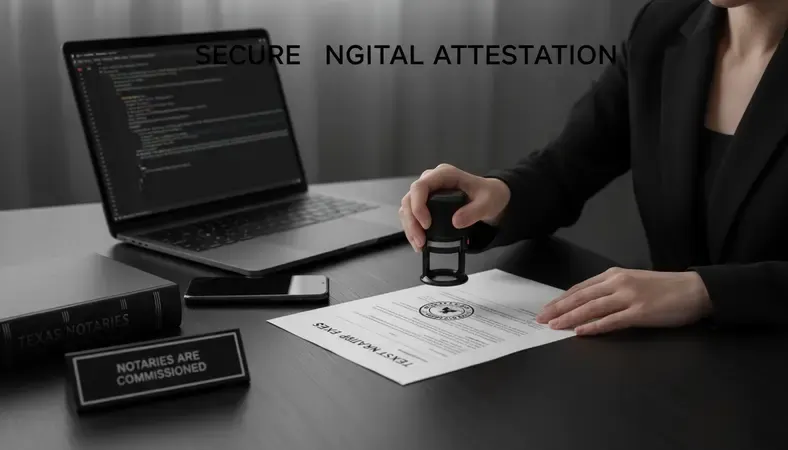
Texas notaries are commissioned by the Texas Secretary of State. They must pass a background check and complete an application process before they can legally perform notarizations.
Key Insight: A notary doesn't validate the content of a document — they validate the identity of the signer. That distinction matters when you're deciding what kind of notarization you need.
Types of Notary Services Available in Texas
Texas offers several distinct types of notary services. Knowing which one you need saves time and avoids rejected documents.
Traditional In-Person Notarization
The original format. You appear physically before a commissioned Texas notary, present a government-issued ID, and sign in their presence. The notary then affixes their seal and signature.
Remote Online Notarization (RON)
Texas passed the Remote Online Notarization Act in 2018, making it one of the earlier states to authorize RON. The entire session happens over a live audio-video call. The notary uses electronic seals and digital signatures. The document is legally equivalent to one notarized in person.
Mobile Notary Services
A commissioned notary travels to your location — your home, hospital, office, or wherever you need them. You still meet in person, but the notary comes to you. Useful for people with mobility limitations or time constraints.
Notary Signing Agents
Specialized notaries trained specifically for real estate closings. They handle loan packages, deeds, and mortgage documents. Many lenders in Texas require a certified signing agent rather than a general notary.
Online vs. In-Person Notary Services
This is the comparison most people searching for notary services Texas actually need to make. Here's how the two main options stack up.
Comparison of Notary Service Methods in Texas
| Feature | In-Person Notarization | Remote Online Notarization (RON) |
|---|---|---|
| Location required | Must travel to notary or use mobile service | Anywhere with internet access |
| Availability | Business hours, scheduling required | Often available same-day or 24/7 |
| Identity verification | Government ID shown in person | ID scan + knowledge-based authentication |
| Document format | Physical paper document | Electronic document |
| Legal validity in Texas | Full legal validity | Full legal validity (since 2018) |
| Turnaround time | Same day if you find a notary | Minutes to hours |
| Best for | Complex real estate closings, wills | Contracts, affidavits, POAs, general documents |
Both methods produce legally valid notarized documents in Texas. The right choice depends on your document type, timeline, and personal circumstances.
When to Choose In-Person
- Your lender or court specifically requires a wet-ink signature
- You're closing on real estate and need a signing agent present
- You don't have reliable internet access
- You're handling an estate matter where multiple parties must sign simultaneously in the same room
When to Choose Remote Online Notarization
- You need a document notarized quickly
- You're out of state or traveling
- The document is digital and will be filed or transmitted electronically
- You want to avoid scheduling conflicts and travel time

What Documents Can Be Notarized in Texas?
Notary services Texas covers a wide range of document types. The most common include:
- Powers of attorney (POA) — including durable and medical POAs
- Affidavits and sworn statements — for legal proceedings or government filings
- Real estate documents — deeds, mortgage documents, closing packages
- Wills and trusts — though Texas has specific witness requirements for wills
- Loan documents — personal loans, business agreements, promissory notes
- Vehicle title transfers — required by TxDMV for private vehicle sales
- Business contracts — partnership agreements, operating agreements
- Adoption and custody documents — family law matters requiring verification
If you've been in a situation involving vehicle damage or personal injury, notarized affidavits are often required — similar to what's covered in guides on document notarization after car accidents, where sworn statements need to be legally authenticated.
One category worth noting: Texas apostilles. If your notarized document needs to be recognized in a foreign country, it requires an additional certification called a texas apostille from the Texas Secretary of State's office. This is common for international business documents, foreign adoption paperwork, and dual-citizenship applications. The notarization comes first; the apostille certifies the notary's credentials for international use.
How to Find a Notary in Texas
Finding notary services Texas residents can access is easier than most people expect.
-
Banks and credit unions — Most major Texas banks (Chase, Wells Fargo, Bank of America) offer free notary services to account holders during business hours.
-
UPS Store and FedEx locations — Most locations have a commissioned notary on staff. No appointment needed at most locations.
-
Public libraries — Many Texas public libraries offer free or low-cost notary services for residents.
-
Courthouses — County clerk offices typically have notaries available during business hours.
-
Online platforms — Services like BlueNotary connect you with a commissioned Texas RON notary via video call. No travel, no scheduling weeks out.
-
Mobile notary directories — The Texas Secretary of State and the National Notary Association both maintain searchable directories for houston notary public and el paso notary public listings.

Notary Requirements and Qualifications in Texas
Texas notaries must meet specific requirements to be commissioned:
- Be at least 18 years old
- Be a legal resident of Texas
- Pass a background check
- Complete the Texas Secretary of State application and pay the filing fee
- Obtain a surety bond (currently $10,000)
- Take an oath of office
For RON notaries, additional requirements apply. They must use a state-approved RON platform, complete identity proofing training, and maintain an electronic journal of all notarizations.
The commission term in Texas is four years. After that, notaries must renew.
How Much Do Notary Services Cost in Texas?
Texas law caps the fees a notary can charge per notarial act. Pricing varies based on service type and provider.
Texas Notary Cost by Service Type
| Service Type | Typical Fee Range | Notes |
|---|---|---|
| In-person (bank/credit union) | Free | Account holders only |
| In-person (retail location) | Contact for quote | Varies by location |
| Mobile notary | Contact for quote | Travel fee often separate |
| Remote online notarization | Contact for quote | Platform fees vary |
| Notary signing agent | Contact for quote | Higher for loan closings |
The Texas Secretary of State sets the maximum fee per notarial act. Notaries cannot charge more than the statutory cap per signature or acknowledgment. Mobile notaries may charge separately for travel.
For RON platforms, pricing typically covers the platform session fee plus the notary's per-act fee. BlueNotary offers transparent pricing with no hidden fees — you can review the full cost before starting your session at bluenotary.us.
Common Questions About Notary Services in Texas
Is remote online notarization legal in Texas?
Yes. Texas has authorized RON since 2018 under the Texas Government Code Chapter 406. Documents notarized via RON carry the same legal weight as those notarized in person.
Can a Texas notary notarize documents for use in other states?
A Texas notary can notarize documents regardless of where they'll be used within the U.S. Interstate recognition generally applies. For international use, you'll need a texas apostille from the Secretary of State's office after notarization.
What ID do I need for notarization in Texas?
You need a government-issued photo ID: driver's license, state ID, passport, or military ID. For RON sessions, you'll also complete knowledge-based authentication — questions drawn from your personal records that only you would know.
Can a Texas notary refuse to notarize a document?
Yes. A notary can refuse if they have reason to believe the signer doesn't understand what they're signing, appears to be under duress, or if the document appears fraudulent. Notaries aren't required to notarize every document presented to them.
Do wills need to be notarized in Texas?
Texas doesn't require notarization for a will to be valid — but a "self-proving" will does require notarization. A self-proving affidavit attached to the will eliminates the need for witnesses to testify in probate court, which is why most Texas estate attorneys recommend it.
Conclusion
Notary services Texas residents need are more accessible than ever — in-person at your local bank or UPS Store, via a mobile notary who comes to you, or online in minutes through a RON platform.
Notarize your Texas documents remotely at BlueNotary — connect with a commissioned Texas notary by video, complete identity verification, and receive your legally valid notarized document without leaving your desk. Ready to get started? Visit BlueNotary to learn more.