






Meta Description: A notary licence (correctly called a notary commission) lets you legally witness signatures and authenticate documents. Here's exactly what it takes to get one.
URL Slug: notary-licence
Primary Keyword: notary licence
Secondary Keywords: notary public license requirements, requirements for notary license
Getting a notary licence — officially called a notary commission in the United States — is one of the more straightforward professional credentials you can earn. No law degree required, no years of school. Most people complete the entire process in a few weeks.
If you're wondering what a notary licence actually authorizes you to do, how much it costs, and whether an online notary certification is different, this guide answers all of it. You'll also find a state-by-state overview of the requirements for notary license applications so you know exactly what to expect before you apply.
Note: "Notary licence" is a common spelling variation — particularly outside the U.S. — for what Americans officially call a notary commission or notary public license. This guide uses both terms interchangeably.

What Is a Notary Licence?
A notary licence is the official authorization that allows a person to act as a notary public — a state-appointed official who witnesses signatures, administers oaths, and certifies documents as authentic.
Think of it as a state-issued stamp of trust. When a notary witnesses your signature, they're confirming three things: you are who you say you are, you signed voluntarily, and you appeared to be of sound mind. That third-party verification is what gives notarized documents their legal weight.
In the United States, notary commissions are issued at the state level. That means notary public license requirements vary from state to state — what qualifies you in Texas may differ from what's required in New York. There is no single federal notary licence.
What a Notary Licence Authorizes You to Do
A commissioned notary public can legally perform these acts:
- Acknowledgments: Confirming that a signer personally appeared and voluntarily signed a document
- Jurats: Administering an oath or affirmation that a document's contents are true
- Copy certifications: Certifying that a photocopy is a true and accurate reproduction of an original
- Signature witnessing: Watching a person sign and verifying their identity
- Oath administration: Swearing in witnesses, affidavits, and other sworn statements
What a notary cannot do is provide legal advice, draft legal documents, or certify the accuracy of the document's content — only the signature and identity.
How to Get a Notary Licence
The process is similar across most states, though the specific steps and fees vary. Here's the standard path from application to commission.
-
Meet your state's basic eligibility requirements: Most states require you to be at least 18 years old, a legal resident of the state, and free of felony convictions. Some states require U.S. citizenship; others do not.
-
Complete a notary education course: About half of U.S. states require mandatory training before you can apply. These courses typically run two to six hours and cover notarial acts, state laws, and proper procedures.
-
Pass a notary exam (if required): States like California require a written exam. Others do not. Check your state's Secretary of State website for current requirements.
-
Submit your application: Applications go through your state's commissioning authority — usually the Secretary of State's office. You'll fill out a form, pay a filing fee, and provide proof of any required training.
-
Purchase a surety bond: Most states require notaries to carry a surety bond — typically ranging from $500 to $15,000 — that protects the public if the notary makes an error. The bond is not insurance for the notary; it protects the people they serve.
-
Take your oath of office: Once approved, most states require you to take an official oath, either in person at a county clerk's office or online. This formalizes your commission.
-
Get your notary supplies: After your commission is active, you'll need a notary seal (stamp or embosser) and a notary journal to record every notarial act you perform.
Notary Licence Requirements by State
Notary public license requirements differ significantly depending on where you live. Here's a comparison of what major states require.
State-by-State Notary Requirements Overview
| State | Training Required | Exam Required | Bond Required | Commission Length |
|---|---|---|---|---|
| California | Yes (6 hours) | Yes | Yes ($15,000) | 4 years |
| Texas | No | No | Yes ($10,000) | 4 years |
| Florida | Yes (3 hours) | No | Yes ($7,500) | 4 years |
| New York | No | Yes | No | 4 years |
| Illinois | No | No | No | 4 years |
| Colorado | Yes (3 hours) | No | No | 4 years |
| Virginia | No | No | No | 4 years |
Requirements change periodically. Always verify current notary public license requirements with your state's Secretary of State office before applying.
A few things stand out in this data. California is one of the most demanding states — mandatory training, an exam, and a $15,000 bond. New York requires an exam but no training course and no bond. Texas and Illinois have minimal barriers to entry.
The one thing that's consistent: every state issues commissions for a fixed term, and you must renew to keep your notary licence active.
How Much Does a Notary Licence Cost?
The total cost of getting a notary licence typically falls between $50 and $200 for most people. Here's where that money goes:
- State application fee: $10–$60 depending on the state
- Notary training course: $20–$100 if required (or optional in states without mandatory training)
- Surety bond: $30–$100 for a four-year bond (the premium, not the bond amount)
- Notary seal/stamp: $15–$50
- Notary journal: $10–$30
California tends to be the most expensive state due to its training and exam requirements. States with no training or exam requirements — like Texas or Illinois — can cost under $75 total.
If you're pursuing a Remote Online Notary (RON) certification on top of your traditional notary licence, expect additional costs for the RON platform, technology requirements, and any state-specific RON application fees.
Notary Licence vs Remote Online Notary (RON) Certification
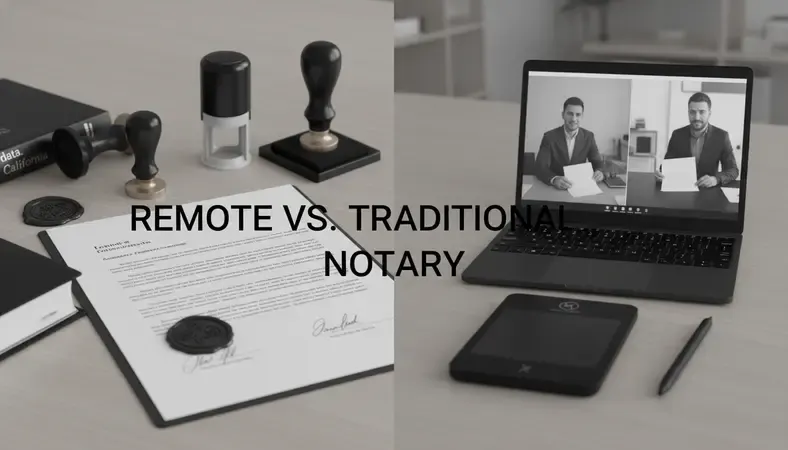
This is where a lot of people get confused. A traditional notary licence and a Remote Online Notary (RON) certification are not the same thing — though you need the first before you can get the second.
Key Insight: A RON certification doesn't replace your notary licence. It's an additional authorization that lets you perform notarial acts over video call rather than requiring the signer to be physically present.
Traditional Notary Licence vs RON Certification
| Feature | Traditional Notary Licence | RON Certification |
|---|---|---|
| Presence required | In-person, same room | Remote, via video call |
| Geographic reach | Limited to your state | Can serve signers nationwide (in RON-authorized states) |
| Technology needed | Seal and journal | Audio-video platform, digital seal |
| Additional training | None beyond commission | Yes — RON-specific training |
| Who issues it | State Secretary of State | State Secretary of State (separate application) |
| Availability | All 50 states | Currently authorized in most U.S. states |
As of this writing, the majority of U.S. states have passed RON legislation, allowing notaries to serve clients remotely. The process for document notarization after car accidents, real estate closings, estate planning, and other time-sensitive situations has become dramatically faster because of RON.
To become a remote online notary, you typically need to:
- Hold an active traditional notary commission in your state
- Complete any state-required RON training
- Submit a separate RON application to your state
- Register with an approved RON platform that meets your state's technology standards
BlueNotary is one such platform — built specifically for notaries who want to offer remote online notarization services to clients anywhere.
How Long Does a Notary Licence Last?
In most states, a notary commission lasts four years. A handful of states use different terms:
- Two-year commissions: Some states, including Maine and South Carolina
- Four-year commissions: The majority of states
- Five-year commissions: A few states, including Indiana
When your commission expires, you don't automatically lose your notary status — but you cannot legally perform notarial acts until you renew. The renewal process is usually simpler than the initial application, though some states require you to retake the exam or complete refresher training.
Mark your expiration date the moment your commission arrives. Missing the renewal window means starting over.
What Can You Do With a Notary Licence?
A notary licence opens up more practical opportunity than most people realize. Here's how people actually use their commission:
- Supplement income: Many notaries charge per notarial act. Loan signing agents — notaries who specialize in mortgage closings — can earn $75–$200 per signing appointment.
- Add value at work: Businesses like banks, law firms, real estate agencies, and title companies often prefer employees who hold a notary commission. It saves clients a trip.
- Start a mobile notary business: Mobile notaries travel to clients' homes, hospitals, or offices. Demand is consistent for wills, powers of attorney, real estate documents, and affidavits.
- Become a remote online notary: With a RON certification, your reach expands beyond your immediate area. You can notarize documents for clients across the country from your home office.
- Serve your community: Notaries often help elderly residents, people with disabilities, and others who struggle to access traditional notary services.
Pennsylvania opens doors to expanded notary services through its RON authorization, which is one example of how states are actively expanding what notaries can do. The profession is growing — demand for notarization services has increased as more transactions move online and require legally verified documentation.
Why It Matters: The notary public system exists to prevent fraud. Every time a notary verifies an identity and witnesses a signature, they're adding a legally recognized layer of protection to that transaction. That's why the credential carries real weight.
Common Questions About Notary Licences
Can I notarize documents for family members?
Technically, most states allow it — but it's strongly discouraged. If you have a financial interest in the document or a direct family relationship with the signer, you should decline. Many states explicitly prohibit notarizing documents where you're a named party or have a beneficial interest.
Do I need a notary licence to use a notary service?
No. If you need a document notarized, you hire a notary — you don't need your own licence. A notary licence is only required if you want to perform notarizations for others.
Can I use my notary licence in another state?
Generally, no. A notary commission is state-specific. If you move to a new state, you need to apply for a new commission there. The exception is that some states have reciprocity agreements, and remote online notaries may be authorized to serve signers in other states depending on those states' RON laws.
Is a notary licence the same as being a notary public?
Yes. When people say "notary public," they mean someone who holds a notary commission — which is the same as what's commonly called a notary licence. The terms are used interchangeably, though the official credential is a commission issued by the state.
How do I find notary public license requirements for my specific state?
Go directly to your state's Secretary of State website. Search "[your state] notary public application" and you'll find the official requirements, fees, and forms. The National Notary Association also maintains updated state-by-state requirement guides.
Can a notary licence be revoked?
Yes. States can revoke or suspend a notary commission for misconduct, fraud, felony convictions, or failure to follow proper notarial procedures. This is why maintaining a notary journal and following your state's rules precisely matters throughout your commission term.
What This Means for You
A notary licence is a low-cost, high-utility credential — and pairing it with a RON certification makes it even more valuable. If you're already commissioned and want to serve clients remotely, complete your first remote notarization at BlueNotary — the platform handles identity verification, audio-video sessions, and tamper-evident digital documents in one place, so you can start notarizing online without the technical setup headache. Ready to get started? Visit BlueNotary to learn more.