






Every time a notary public completes a notarization, they apply something to the document that makes it official. That "something" is either a notary stamp or a notary seal — and most people use those terms interchangeably, even though they refer to different tools with the same job. If you're a notary figuring out what to buy, or someone who needs a document notarized and wants to understand what you're looking at, this guide covers exactly what a notary stamp is, how it differs from a seal, what it must contain, and how digital notarization changes the picture entirely.
What Is a Notary Stamp?
A notary stamp is an official marking tool used by a commissioned notary public to authenticate documents. When a notary stamps a document, they're creating a visible impression — typically in ink — that identifies them as a commissioned officer of the state and confirms the notarization is legitimate.
The notary stamp is one of the most recognizable symbols in legal paperwork. You've almost certainly seen one: a rectangular or round inked impression on contracts, affidavits, real estate documents, and powers of attorney.
Key Insight: A notary stamp doesn't make a document legal on its own. It's the notary's signature combined with the stamp that creates a valid notarization. The stamp identifies who performed the act; the signature confirms they personally witnessed it.
Most states require notaries to use either a stamp or a seal (or both) when completing a notarization. The specific requirements — shape, size, required information — vary by state.
What Does a Notary Stamp Do?
The notary stamp serves three practical functions:
- Identifies the notary: The stamp shows the notary's name and commission details so anyone reviewing the document can verify who performed the notarization.
- Confirms state authority: The stamp includes the state where the notary is commissioned, establishing legal jurisdiction.
- Deters fraud: A proper notary stamp is difficult to replicate. It signals to courts, lenders, and government agencies that the notarization is genuine.
Think of the stamp as the notary's official business card permanently attached to the document. Without it, even a properly witnessed signature lacks the visual confirmation that a commissioned notary was involved.
Notary Stamp vs Notary Seal: What's the Difference?
This is where most people get confused — and understandably so. Here's the straightforward breakdown.
Comparison of Notary Stamp and Notary Seal
| Feature | Notary Stamp | Notary Seal |
|---|---|---|
| Output | Inked impression on paper | Embossed (raised) impression |
| Visibility | Clearly visible in ink | Raised but may not photocopy well |
| Tool type | Rubber stamp (often self-inking) | Crimping or embossing tool |
| Accepted for | Most state requirements | Some states require this specifically |
| Digital use | Not applicable | Not applicable |
| Cost | Generally lower | Generally higher |
| Ease of use | Simple, fast | Requires more pressure/effort |
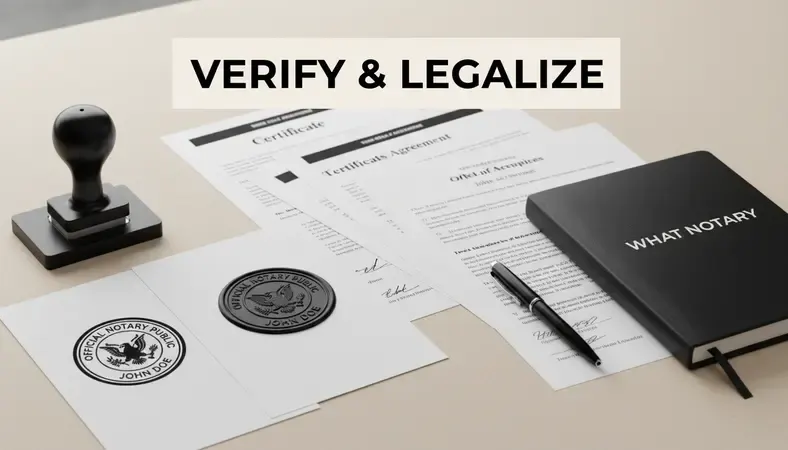
The key difference comes down to how the impression is made. A notary stamp uses ink; a notary seal uses mechanical pressure to create a raised impression in the paper itself.
Historically, wax seals were the standard. Over time, embossing tools replaced wax, and then rubber stamps became the dominant format because they're faster, cheaper, and produce a clear result that photocopies well. Many states now accept either format, but some still specify one or the other.
A self-inking notary stamp — where the ink pad is built into the stamp itself — has become the most popular choice among working notaries. It's faster than a traditional stamp with a separate ink pad, and it produces consistent impressions across hundreds of uses.
What Information Should Be on a Notary Stamp?
State law governs exactly what must appear on a notary stamp. While requirements vary, most states require the following elements:
- Notary's full legal name (exactly as it appears on the commission)
- State of commission (e.g., "State of Texas")
- Notary's commission number (assigned by the state)
- Commission expiration date (the date the commission ends)
- The words "Notary Public"
Some states add additional requirements:
- County of commission
- A state seal or emblem
- The phrase "My commission expires" followed by the date
The National Notary Association maintains state-by-state guidelines on stamp requirements, which is a reliable reference if you're getting commissioned in a new state.
How to Get a Notary Stamp
Getting a notary stamp follows a clear sequence. You can't order one until you're commissioned — suppliers typically require proof of your commission before producing an official stamp.
- Complete your state's notary application: Submit your application, pay the fee, and pass any required exam or background check.
- Receive your commission certificate: Your state will issue a commission document confirming your appointment.
- Order from an approved supplier: Use a reputable vendor — many states have approved supplier lists. The NNA notary stamp program is one of the most widely recognized sources, offering state-compliant stamps for all 50 states.
- Verify the information before ordering: Double-check your name spelling, commission number, and expiration date. Errors on a stamp can invalidate notarizations.
- Register your stamp (if required): Some states require notaries to register their stamp or seal with a county clerk.
A self-inking notary seal from a reputable supplier typically ships within a few days. Renewing a notary stamp works the same way — when your commission renews, your expiration date changes, so you'll need a new stamp reflecting the updated date. Don't use an expired stamp; it can invalidate notarizations after your commission end date.
Notary Stamp Requirements by State
No two states have identical notary stamp requirements. The variation covers shape, size, required text, and even color of ink. Here's a general overview of common patterns:
State Requirement Patterns for Notary Stamps
| Requirement | Common Standard | States That Vary |
|---|---|---|
| Shape | Rectangular or round | Some require rectangular only |
| Ink color | Black or blue | Some specify black only |
| Size | Approximately 1" x 2.5" | Varies; some specify dimensions |
| Commission number | Required in most states | A few states don't issue numbers |
| County | Not always required | California, Florida require it |
| Expiration date | Required in most states | Some states don't expire commissions |
Because requirements change when state legislatures update notary laws, always verify current rules with your state's notary regulatory office before ordering a stamp. Using a non-compliant stamp can render your notarizations legally defective.
Can You Use a Digital Notary Stamp?
Yes — and this is where the notary stamp concept gets a significant upgrade.
Remote online notarization (RON) replaces the physical notary stamp with a digital equivalent. Instead of pressing ink to paper, an online notary applies a digital seal to an electronic document. This digital stamp contains the same identifying information as a physical stamp, but it's embedded in the document's metadata and protected by encryption.
Here's what a digital notary stamp typically includes:
- The notary's name and commission details
- The state of commission
- Commission expiration date
- A tamper-evident digital certificate that locks the document
The digital seal is more secure than a physical stamp in one important way: any alteration to the document after the seal is applied is detectable. A physical stamp can be photocopied and reused on different documents. A digital seal can't be separated from the specific document it was applied to.
As of recent data, 45 U.S. states and the District of Columbia have enacted laws authorizing remote online notarization — meaning digital notary stamps are legally recognized across most of the country.
For notaries working through platforms like BlueNotary, the digital stamp is applied automatically during the RON session. The notary doesn't need to purchase or manage a separate physical tool — the platform handles compliance with state-specific digital seal requirements.
This matters for document notarization after car accidents, real estate closings, or any situation where the signer and notary are in different locations. The digital notary stamp makes those transactions possible without anyone needing to be in the same room.
Common Questions About Notary Stamps
Can a notary use the same stamp in multiple states?
No. A notary commission is state-specific. If you're commissioned in two states, you need a separate notary stamp for each commission. Using one state's stamp for notarizations performed under a different commission is improper and can invalidate the notarization.
What happens if a notary stamp is lost or stolen?
Report it immediately to your state's notary regulatory authority. Most states require notaries to notify the commissioning office and may require you to obtain a replacement stamp and document the incident. Using a lost or stolen stamp is a serious liability issue.
Does the notary stamp expire?
The stamp itself doesn't expire — but the commission information on it does. When your commission renews, the expiration date changes. You must order a new stamp reflecting the updated date. Continuing to use a stamp with an old expiration date after your commission renews is technically incorrect, even if your commission is still active.
Is a self-inking notary stamp the same as a regular rubber stamp?
Functionally, yes — both produce an inked impression. The difference is convenience. A self-inking notary stamp has a built-in ink pad that re-inks automatically with each use. A traditional rubber stamp requires a separate ink pad. For high-volume notaries, self-inking stamps are faster and more consistent.
Can anyone buy a notary stamp?
Reputable suppliers require proof of commission before producing an official notary stamp. You'll typically need to provide your commission certificate or commission number. This requirement exists to prevent unauthorized individuals from creating fraudulent stamps.
Wrapping Up
A notary stamp is a small tool with significant legal weight — it's the visible proof that a commissioned notary authenticated your document. If you need documents notarized remotely without coordinating physical stamps or in-person appointments, complete your notarization through BlueNotary — legally compliant digital notarizations with a tamper-evident digital seal, completed in minutes from anywhere. Ready to get started? Visit BlueNotary to learn more.