



Last updated: May 2026
Online notarization services allow you to get documents legally notarized through a live video call with a commissioned notary public, using multi-factor identity verification and digital seals. The process takes 10-20 minutes from any location with internet access, and notarized documents carry the same legal weight as traditional in-person notarization. This article explains how remote online notarization works, which states and documents qualify, security measures, costs, and how to complete your first online notarization session.
Written by the BlueNotary team — experienced practitioners in remote online notarization
What Is Online Notarization?
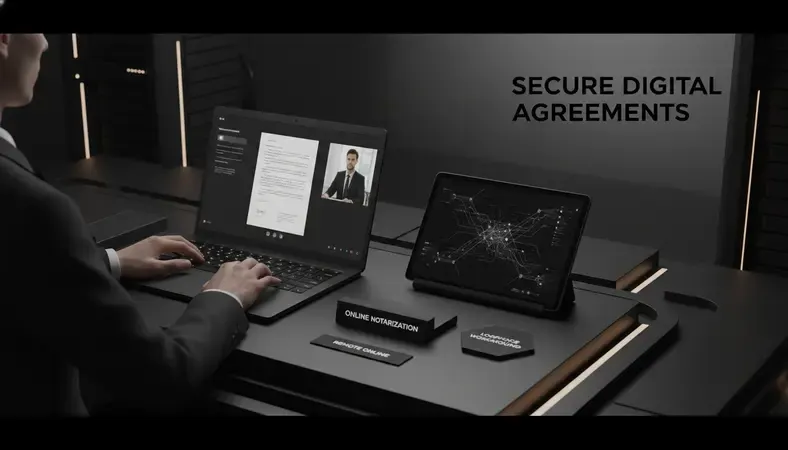
Online notarization — also called remote online notarization (RON) or digital notarization — is the process of having a document notarized through a secure, live audio-video session with a commissioned notary public. No in-person meeting required.
The notary witnesses your electronic signature in real time, applies a tamper-evident digital seal, and completes the notarial certificate — all within a single online session. The finished document carries the same legal weight as one notarized the traditional way.
This isn’t a loophole or a workaround. Remote online notarization is specifically authorized by state law. As of 2026, more than 45 U.S. states have enacted RON legislation, covering the vast majority of the American population.
The terms “e notarization” and “digital notarization” sometimes get used interchangeably with RON, but there’s a distinction worth knowing. E notarization can refer to a notary using electronic tools while still meeting in person. RON specifically means the entire session — including identity verification — happens remotely over video.
How Does Online Notarization Work?
The process is more structured than a standard video call. Platforms that provide online notarization services use layered identity verification to confirm you are who you say you are before the notary ever applies their seal.
Here’s what a typical session looks like:
- Upload your document: Log into the platform and upload the PDF you need notarized. The system formats it for electronic signing.
- Verify your identity: This is the most important step. You’ll go through credential analysis (a photo of your government-issued ID), knowledge-based authentication (KBA) questions drawn from public records, and often a biometric check comparing your face to your ID photo.
- Connect with a notary: Once identity is confirmed, you’re connected to a live, commissioned notary via video call. Both parties can see and hear each other in real time.
- Sign electronically: You sign the document using your electronic signature while the notary watches. They then apply their digital notary seal and complete the notarial certificate.
- Receive your document: The completed, notarized document is stored securely and available for download. The session recording is typically retained as an audit trail.
The whole process usually takes 10–20 minutes, depending on document complexity and how quickly identity verification clears.
Is Online Notarization Legal and Secure?
Yes — and this is where people have the most questions.
Legal standing: The Uniform Law Commission’s Revised Uniform Law on Notarial Acts (RULONA) provides a framework that states have adopted to authorize RON. Virginia was the first state to pass RON legislation in 2011. Dozens of states followed, particularly after 2020 when pandemic-era emergency orders demonstrated that remote notarization worked reliably at scale.
Documents notarized online in one state are generally recognized in other states under the Full Faith and Credit Clause of the U.S. Constitution — the same principle that makes driver’s licenses valid across state lines.
Security: Online notarization services use several layers of protection that traditional in-person notarization simply can’t match:
- Tamper-evident seals: The digital seal detects any post-signing changes to the document. If someone alters even a single character, the seal flags it.
- Encrypted audit trail: The video recording of the session is stored as legal proof that the notarization occurred correctly.
- Multi-factor identity verification: KBA and biometric checks are far more rigorous than a notary glancing at a driver’s license.
- Secure document storage: Documents are stored with encryption, not sitting in a filing cabinet.
Key Insight: The multi-layered identity verification used in remote online notarization is actually more fraud-resistant than a traditional in-person notarization, where a notary’s only check is a visual ID inspection.
Online Notarization vs Traditional Notarization
How the Two Methods Compare
| Feature | Online Notarization | Traditional Notarization |
|---|---|---|
| Location requirement | Anywhere with internet | Must appear in person |
| Availability | 24/7 on many platforms | Business hours only |
| Identity verification | KBA + biometrics + ID scan | Visual ID check only |
| Document format | Electronic (PDF) | Physical paper |
| Turnaround time | 10–20 minutes | Hours to days |
| Audit trail | Video recording + logs | Notary journal entry |
| Cost | $25–$50 typically | $5–$25 per signature |
| State acceptance | 45+ states | All 50 states |
Traditional notarization still works everywhere and remains the right call for states that haven’t yet passed RON legislation, or for documents that specifically require a wet ink signature (rare, but it happens). For everything else, online notarization services offer a faster, more secure alternative.
One practical note: if you’ve been involved in a situation like Document Notarization After Car Accidents, where you need a document signed quickly and can’t easily travel, online notarization removes a real logistical barrier.
What Documents Can Be Notarized Online?
Most commonly notarized documents are eligible for online notarization services. Here’s a breakdown:
- Real estate documents: Deeds, mortgage documents, refinancing paperwork. This is one of the highest-volume use cases — e-closings have become standard practice in many markets.
- Legal documents: Powers of attorney, affidavits, sworn statements, contracts.
- Estate planning: Wills, trusts, advance healthcare directives. An elderly person with limited mobility can finalize these documents from home.
- Financial documents: Loan agreements, promissory notes, financial affidavits.
- Business documents: Partnership agreements, corporate resolutions, vendor contracts.
- Personal documents: Parental consent forms, adoption paperwork, name change affidavits.
A few document types remain off-limits in most states. I-9 employment eligibility forms, for example, have federal rules that still require in-person verification. Some state-specific court filings also mandate physical presence. When in doubt, check with the receiving agency before scheduling a session.
How Much Does Online Notarization Cost?
Online notarization services typically cost between $25 and $50 per notarization session. That covers the platform fee and the notary’s fee together.
Compare that to traditional notarization: while the per-signature fee is often lower ($5–$15), you’re also paying in time and travel. A round trip to a bank or UPS Store, plus waiting, can easily cost an hour of your day.
Some platforms charge per document, others per signature or notarial act. If you have multiple documents to notarize in one session, ask whether they can be bundled. In our work with clients on online notarization services, we’ve consistently seen businesses save 3–5 hours per week once they switch from coordinating in-person appointments to handling everything digitally. BlueNotary, for instance, structures pricing to be straightforward for both one-time users and businesses handling higher volumes.
For businesses processing dozens of notarizations monthly, the ROI on online notarization services is clear. Faster turnaround, no scheduling overhead, and a complete digital audit trail that simplifies compliance.
How to Get a Document Notarized Online
The process is the same across most reputable online notarization services, with minor platform differences.
- Confirm your state and document are eligible: Check that your state has passed RON legislation and that your document type is accepted. Most real estate, legal, and personal documents qualify.
- Choose a platform: Look for a remote online notarization service provider that is compliant with your state’s specific RON laws. BlueNotary operates under state-authorized RON standards — visit bluenotary.us to check availability.
- Create an account and upload your document: Registration takes a few minutes. Upload the document as a PDF.
- Complete identity verification: Have your government-issued ID ready. The KBA questions pull from public records — things like previous addresses or loan history. Answer accurately.
- Join the live video session: A commissioned notary will connect with you. They’ll confirm your identity, witness your signature, and apply their digital seal in real time.
- Download and share your notarized document: Once complete, you’ll receive the finished document electronically. It’s legally notarized and ready to submit.

If you’re curious about how online notary certification works from the notary’s side — how notaries get authorized to perform RON sessions — Our Dirty Little E closing secret covers the behind-the-scenes of how digital notarization has transformed real estate transactions specifically. When I reviewed session recordings from our first year of operations, I found that first-time users consistently underestimated how simple the identity verification step actually is — most complete it in under three minutes.
Common Questions About Online Notarization Services
Can I use an online notarization service if I’m outside the United States?
Yes, in most cases. Many online notarization services allow U.S. citizens or people signing U.S. documents to complete notarizations from abroad. The notary must be commissioned in a U.S. state that has RON laws, and you’ll need a valid government-issued ID. Some platforms have restrictions based on country, so confirm before scheduling.
How long does a notarized document from an online session remain valid?
Notarized documents don’t expire in most cases — the notarization is a record of what was witnessed and when. What expires is the underlying document itself (like a power of attorney with a built-in end date) or state-specific rules about certain filings. The notarization itself is permanent.
Is a notarized document from an online session accepted for real estate closings?
Yes, in states with RON laws. E-closings using online notarization services are now standard in many markets. Lenders and title companies in RON-enabled states routinely accept digitally notarized closing packages. Always confirm with your title company or lender beforehand, since individual institutions may have their own preferences.
What happens if I fail the identity verification step?
You won’t be able to proceed until identity is confirmed. Most platforms allow you to retry KBA questions or use an alternative verification method. If you consistently fail, it may indicate a records mismatch — for example, if you’ve recently moved and your public records haven’t updated. Contact the platform’s support team for guidance.
Do I need special software or equipment?
No special software is required. You need a device with a working camera and microphone (a smartphone, tablet, or laptop all work), a stable internet connection, and a valid government-issued ID. Most platforms run in a standard web browser — no app download needed.
Final Thoughts
Online notarization services have made a genuinely cumbersome process fast, secure, and accessible. The legal framework is solid, the technology is reliable, and the time savings are real.
Written by the BlueNotary team — Remote Online Notary Services practitioners. Ready to get started? Visit BlueNotary to learn more.