



Getting a document notarized used to mean blocking out half your afternoon. You’d find a notary, drive over, wait, sign, and hope they had their stamp handy. Online notarization services have changed that completely — the whole process now takes minutes from your laptop or phone.
If you’re trying to figure out how online notarization works, whether it’s legal, what it costs, or how to actually use it, this resource covers everything you need to know.
What Is Online Notarization?
Online notarization is the process of having a document legally notarized through a secure video call with a commissioned notary public — no in-person meeting required. The notary verifies your identity digitally, witnesses your signature electronically, and applies a digital seal to the document.
This is also called remote online notarization, or RON. It carries the same legal weight as a traditional in-person notarization. The notary is still a licensed professional. The seal is still official. The document is still legally binding.
Key Insight: Remote online notarization isn’t a workaround or a lesser option — it’s a fully regulated process that meets the same legal standards as traditional notarization, just without the commute.
How Does Online Notarization Work?
Here’s what happens when you use online notarization services:
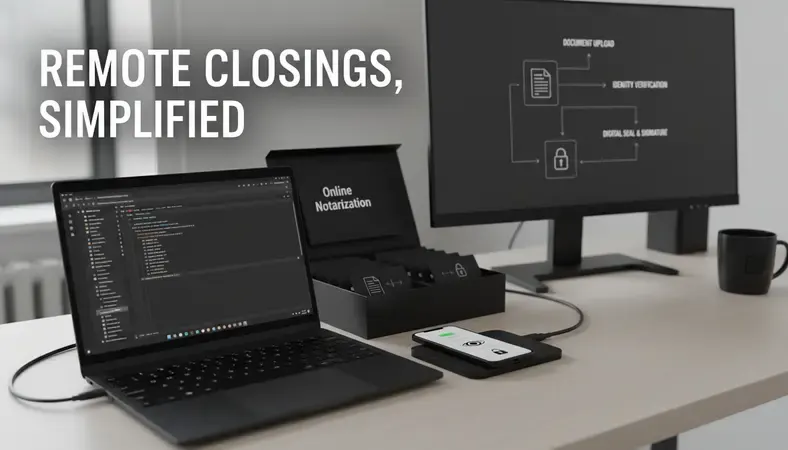
- Upload your document: You submit the document through a RON platform. Most accept PDFs and standard document formats.
- Verify your identity: The platform walks you through identity verification — typically a government-issued ID scan, knowledge-based authentication questions (things like “Which of these was a previous address?”), and sometimes facial recognition.
- Connect with a notary: You join a live video session with a commissioned notary public. They confirm your identity, watch you sign electronically, and apply their digital seal and certificate.
- Receive your notarized document: The completed document is sent to you digitally, with a tamper-evident seal that locks the file after signing.
The entire session is recorded and stored, which actually makes digital notarization more auditable than traditional paper-based notarization.
Is Online Notarization Legal and Secure?
The answer is yes — with some state-specific nuance.
As of now, more than 40 U.S. states have enacted laws explicitly authorizing remote online notarization. Several more allow it under emergency provisions or are in the process of passing legislation. The Uniform Law Commission’s Revised Uniform Law on Notarial Acts has provided a model framework that many states have adopted.
Security is built into every step:
- Identity verification: Multi-factor checks including ID scanning and knowledge-based authentication make impersonation extremely difficult.
- Tamper-evident seals: Once the notary applies their digital certificate, any alteration to the document is immediately detectable.
- Session recording: Every RON session is recorded and stored, creating an auditable record that doesn’t exist with traditional notarization.
- Encryption: Documents are transmitted and stored using industry-standard encryption protocols.
Online Notarization vs. Traditional Notarization
Both methods are legally valid. The right choice depends on your situation.
Comparing Your Options
| Factor | Online Notarization | Traditional In-Person |
|---|---|---|
| Location required | Anywhere with internet | Must appear in person |
| Availability | 24/7 on many platforms | Business hours, by appointment |
| Identity verification | Digital ID scan + KBA | Physical ID check |
| Document delivery | Instant digital copy | Physical paper document |
| Session record | Recorded and stored | No recording |
| State acceptance | 40+ states | All 50 states |
| Typical turnaround | Minutes | Same day to days |
For most personal and business documents, online notarization services are the faster and more convenient option. Traditional notarization still makes sense when a receiving institution specifically requires a wet ink signature and physical seal, or when the document must be filed in a state that hasn’t yet authorized RON.
What Documents Can Be Notarized Online?
Online notarization services handle a wide range of document types. Here are the most common:
- Real estate documents: Deeds, mortgage documents, and property transfer forms are among the most frequently notarized online.
- Powers of attorney: A durable or financial power of attorney can typically be notarized through a RON platform.
- Affidavits and sworn statements: Legal declarations that require a notarized signature work well in a remote setting.
- Business agreements: Contracts, operating agreements, and corporate resolutions are routinely handled online.
- Estate planning documents: Wills and trusts in many states can be notarized remotely — though requirements vary significantly by state.
- Loan documents: Many lenders now accept remotely notarized closing documents, especially for refinances.
Some documents have restrictions. Immigration forms, certain court filings, and documents governed by federal law may have specific requirements that limit or exclude RON. Always check with the receiving institution before assuming a document qualifies.
For situations like document notarization after car accidents — where timing matters and you may be dealing with insurance companies or legal counsel — online notarization services can be a practical solution for affidavits and settlement documents.
How Much Does Online Notarization Cost?
Online notarization services are generally affordable. Pricing varies by platform and state regulations.
Most platforms charge between a flat per-document fee or a subscription model for frequent users. Some states cap the maximum fee a notary can charge per notarial act. Virginia, for example, has historically set a cap of $25 per notarial act for RON.
Factors that affect cost:
- Number of signers: Additional signers on the same document may incur additional fees.
- Platform fees vs. notary fees: Some platforms bundle both; others separate them.
- Subscription plans: Businesses or frequent users often save significantly with monthly or annual plans.
- Document complexity: Multi-page or multi-signature documents may cost more on some platforms.
For reference, traditional notary services at a bank or UPS Store typically run $5–$15 per signature in most states, but require you to show up in person during business hours. The convenience premium for RON is often minimal — and for time-sensitive situations, it’s well worth it.
How to Get a Document Notarized Online
Here’s a straightforward process for using online notarization services for the first time:
- Choose a RON platform: Select a platform that’s authorized in your state and accepted by the institution receiving your document. BlueNotary is a widely used option that serves both individuals and businesses across the U.S.
- Create an account: Most platforms require basic registration. Business users may need to set up an organization account.
- Upload your document: Submit the PDF or document file through the platform’s secure portal.
- Complete identity verification: Follow the platform’s ID verification steps. Have a government-issued photo ID ready.
- Join the notary session: Connect via video call. The notary will confirm your identity, guide you through signing, and apply their digital seal.
- Download your notarized document: Once complete, download the tamper-sealed document. Store a digital copy in a secure location.
The whole process — from upload to completed document — typically takes 15 to 30 minutes for a straightforward document.
Pro Tip: Before your session, confirm that the institution receiving your document accepts remotely notarized documents. Most do, but some older institutions or specific document types may still require traditional notarization.
Common Questions About Online Notarization Services
Is online notarization accepted in all 50 states?
Not yet, but coverage is extensive. Over 40 states have passed laws explicitly authorizing remote online notarization. Several additional states allow it under temporary or emergency measures. The remaining states are generally moving toward adoption. Check your state’s Secretary of State website for current authorization status.
Can I use online notarization services for real estate closings?
Yes, in many cases. Remote online notarization is increasingly accepted for mortgage refinances, property transfers, and real estate closings. However, acceptance depends on both your state’s laws and the lender or title company involved. Confirm with all parties before scheduling a RON session for a real estate transaction.
What ID do I need for online notarization?
You’ll need a valid government-issued photo ID. A driver’s license, state ID, or passport all work. The platform will scan the ID and run it through verification software. Make sure your ID isn’t expired — an expired ID will typically fail verification.
Are online notarized documents legally binding?
Yes. Documents notarized through an authorized RON platform by a commissioned notary carry the same legal weight as traditionally notarized documents. The notary’s digital seal and certificate serve the same function as a physical stamp and signature.
What happens if my state doesn’t authorize RON?
If your state hasn’t passed RON legislation, you may still be able to use online notarization services through interstate recognition. Several states allow their residents to use notaries commissioned in RON-authorized states. This is a developing area of law, so verify current rules for your specific state and document type.
Can businesses use online notarization services at scale?
Yes. Many RON platforms offer business accounts designed for high-volume use — law firms, real estate companies, financial institutions, and HR departments regularly use online notarization services for contracts, compliance documents, and employee paperwork. Platforms like BlueNotary offer API integrations and team management features for organizations that notarize frequently.
Final Thoughts
Online notarization services have made a genuinely inconvenient process fast, accessible, and legally sound. Whether you’re handling a one-off personal document or managing high-volume business notarizations, the tools are reliable and widely accepted.
Notarize your document today at BlueNotary — connect with a commissioned notary by video, get your document sealed and delivered digitally, and skip the trip entirely. Ready to get started? Visit BlueNotary to learn more.