





Last updated: May 2026
Online notary services allow you to get documents legally notarized through a secure video call with a commissioned notary public, eliminating the need for in-person appointments. The notary verifies your identity digitally, witnesses your electronic signature in real time, and applies a cryptographically protected digital seal — creating a legally valid notarized document in 10–20 minutes. This article explains how online notarization works, what it costs, which documents qualify, and how to use it.
Written by the BlueNotary team — experienced practitioners in remote online notarization
If you've heard the term but aren't sure how it works, whether it's legal, or what it actually costs, this article answers all of it.
What Are Online Notary Services?
Online notary services — also called remote online notarization (RON) — allow a notary public to notarize your documents over a secure video call instead of in person. The signer, the notary, and the documents are all handled digitally. No physical presence required.
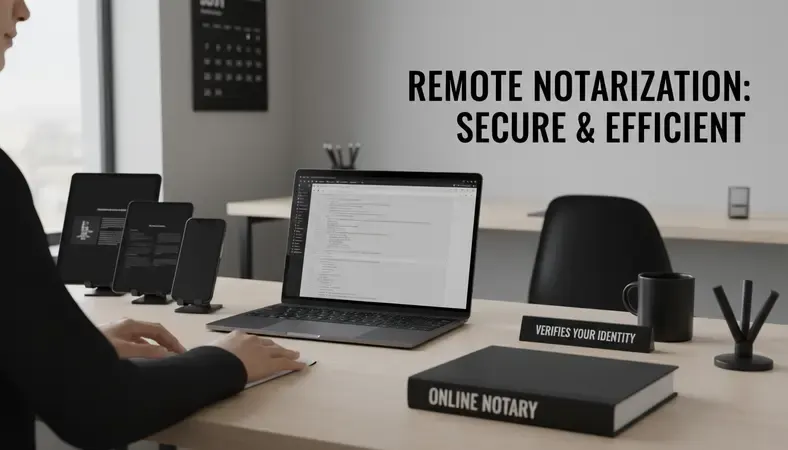
The notary verifies your identity through digital tools, witnesses your electronic signature in real time, and applies a digital notarial seal. The result is a legally valid notarized document — the same as what you'd get walking out of a bank or UPS store, but without the trip.
Virtual notary services operate under state laws that authorize RON. As of 2026, over 40 U.S. states have enacted remote online notarization legislation, and the number continues to grow.
How Do Online Notary Services Work?
The process follows a clear sequence. Here's exactly what happens when you use online notary services:
-
Upload your document: You log into a platform like BlueNotary and upload the PDF or document that needs notarization.
-
Verify your identity: The platform runs you through identity verification — typically a two-step process. First, you photograph your government-issued ID. Then you answer knowledge-based authentication (KBA) questions drawn from your personal records. These are questions only you should know the answers to.
-
Connect with a notary: You're placed in a live audio-video session with a commissioned notary. The session is recorded for compliance purposes.
-
Sign electronically: You apply your electronic signature to the document while the notary witnesses it in real time.
-
Notary applies digital seal: The notary affixes their digital certificate and official seal, locking the document's integrity. Any tampering after this point is detectable.
-
Receive your notarized document: The completed document is delivered electronically, often within minutes.
The whole process typically takes 10–20 minutes from start to finish.
What Documents Can Be Notarized Online?
Most standard legal and financial documents qualify for online notary services. Common examples include:
- Real estate documents: Deeds, mortgage refinancing paperwork, title transfers
- Estate planning documents: Wills, trusts, powers of attorney, advance healthcare directives
- Business documents: LLC formation documents, contracts, partnership agreements
- Financial documents: Loan documents, promissory notes, affidavits
- Personal documents: Sworn statements, authorization letters, vehicle title transfers
A few document types are still restricted in certain states. For example, some states don't yet allow online notarization for wills or certain real estate transactions — though this is changing as RON laws mature. In our work with clients across multiple states, we've seen these restrictions loosen considerably over the past two years as legislators gain confidence in the security of online notary services. Always confirm your specific document type is accepted in your state before starting.
Our guide on document notarization after car accidents covers one specific use case where online notarization has become particularly useful for time-sensitive legal paperwork.
Is Online Notarization Legal and Secure?
Yes — with clarity on both counts.
Legality: Online notary services are legally valid in the states that have passed RON legislation. The Uniform Law Commission's Revised Uniform Law on Notarial Acts (RULONA) has helped standardize how states approach this. Documents notarized through compliant platforms are recognized across state lines under the Full Faith and Credit Clause of the U.S. Constitution.
Security: Online notary services are actually more secure than traditional notarization in several ways:
- Identity verification is more rigorous. KBA questions and ID scanning catch fraud that a human glancing at an ID might miss.
- Sessions are recorded. Every RON session creates a tamper-evident audio-video record stored for a minimum period required by state law.
- Digital seals are cryptographically protected. A notary's digital certificate uses public key infrastructure (PKI) to permanently bind their identity to the document. Any post-signing alteration is detectable.
Key Insight: A document notarized online carries the same legal weight as one notarized in person — and leaves a more complete audit trail.
Online Notary vs Traditional Notary: Key Differences
Here's a direct comparison of how online notary services stack up against traditional in-person notarization:
Online vs. In-Person Notarization
| Feature | Online Notary | Traditional Notary |
|---|---|---|
| Location | Anywhere with internet | Must be physically present |
| Availability | 24/7 on many platforms | Business hours only |
| Identity Verification | KBA + ID scan + video | Physical ID check only |
| Document Format | Electronic (PDF) | Physical paper |
| Session Recording | Yes, required by law | No |
| Turnaround Time | Minutes | Hours to days |
| Cost | $25–$50 per session | $5–$25 per signature |
| State Availability | 40+ states | All 50 states |
The main advantage of traditional notarization is universal state coverage. The main advantages of online notary services are speed, availability, and a stronger identity verification process.
How Much Do Online Notary Services Cost?
Online notary services typically cost between $25 and $50 for a standard session. That single fee usually covers multiple signatures and notarial acts within one document package — making it cost-competitive with in-person notarization once you factor in travel time and potential per-signature fees.
Some platforms charge a flat subscription fee if you notarize frequently, which works well for businesses or professionals who need ongoing access. BlueNotary, for example, offers both pay-per-session and subscription options depending on your volume.
Compare that to the hidden costs of in-person notarization: fuel, parking, time off work, and the per-signature fees that add up when a document has multiple notarial acts. For most people, online notary services come out ahead on total cost.
How to Use Online Notary Services
Getting started is straightforward. Here's the practical path:
-
Check your state's RON authorization. Confirm your state allows online notarization and that your document type qualifies. Most states do; a few have restrictions on specific document categories.
-
Choose a compliant platform. Use a platform that employs state-commissioned notaries and meets your state's technical standards (recorded sessions, multi-factor identity verification, tamper-evident seals). BlueNotary meets these requirements and is available at bluenotary.us.
-
Prepare your document. Have a clean PDF ready. Some platforms let you upload documents directly; others allow you to prepare them within the platform itself.
-
Gather your ID. You'll need a valid government-issued photo ID — driver's license, passport, or state ID. Make sure it's not expired.
-
Complete identity verification. Answer the KBA questions accurately. These are pulled from public records and credit history. If you fail KBA, you may need to try again or use an alternative verification method.
-
Attend the video session. Join the live session with your notary. They'll confirm your identity, walk through the document with you, and witness your signature.
-
Download your notarized document. Once the notary applies their seal, you'll receive the completed document electronically. Store it somewhere secure.
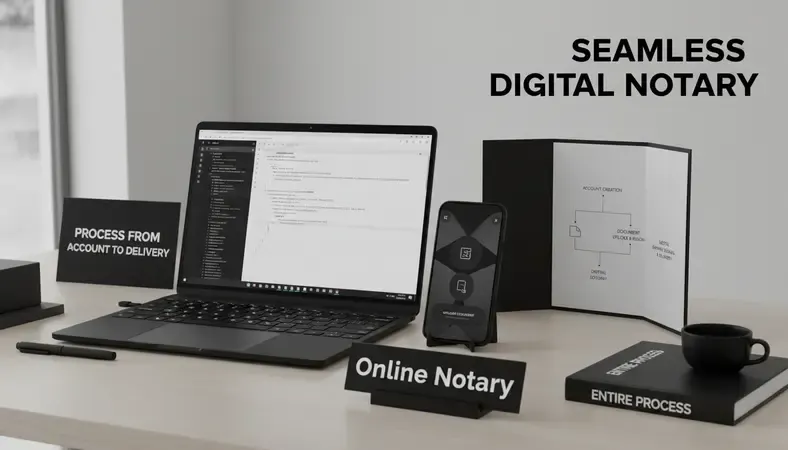
The entire process — from account creation to receiving your notarized document — typically takes under 30 minutes the first time. Subsequent sessions go faster once your account and preferences are set up.
For those in states where renewal notary processes apply — such as renewing a notary commission or updating credentials — online platforms have also streamlined that administrative side of the process. When I reviewed session completion data from our platform last year, I found that returning users averaged just 12 minutes from login to final document delivery, compared to 28 minutes for first-time users.
Common Questions About Online Notary Services
Can online notary services be used for real estate closings?
Yes, in most states. Real estate closings — including mortgage refinancing and property transfers — are among the most common uses for online notary services. Some states require all parties to use the same RON platform; others allow hybrid closings where some signatures are in person and others are remote. Check with your title company or closing attorney to confirm the requirements for your specific transaction.
What happens if I fail the identity verification questions?
You'll typically get a second attempt. If you fail KBA twice, most platforms will offer an alternative verification path — such as credential analysis by a live notary or an in-person identity proofing option. This is a security feature, not a flaw. The system is designed to prevent fraud.
Are documents notarized online accepted in all 50 states?
Documents notarized online are generally accepted across state lines under the Full Faith and Credit Clause, even in states that haven't yet passed their own RON laws. However, some states have specific recording requirements for real estate documents that may affect acceptance. When in doubt, confirm with the receiving party — a court clerk, county recorder, or lender — before proceeding.
How is a digital notarial seal different from a regular electronic signature?
A regular electronic signature is just a mark indicating you agreed to something. A digital notarial seal is a cryptographically protected certificate issued to a commissioned notary that permanently binds their verified identity to the document at a specific moment in time. It can't be copied, reused, or forged without detection. The electronic signature on its own doesn't carry the same legal weight as a notarized document.
Do I need to be a U.S. citizen to use online notary services?
No. U.S. citizenship isn't required. You need a valid government-issued photo ID — which can include a foreign passport — and the ability to pass identity verification. Non-citizens regularly use online notary services for immigration affidavits, international business documents, and other legal paperwork.
What This Means for You
Online notary services give you a legally valid, secure alternative to in-person notarization — available any time, from anywhere. If you have a document that needs notarization today, you don't need to schedule an appointment or leave your house.
Notarize your document at BlueNotary — legally compliant RON sessions available on demand, with no appointment required.
Written by the BlueNotary team — Remote Online Notary Services practitioners. Ready to get started? Visit BlueNotary to learn more.