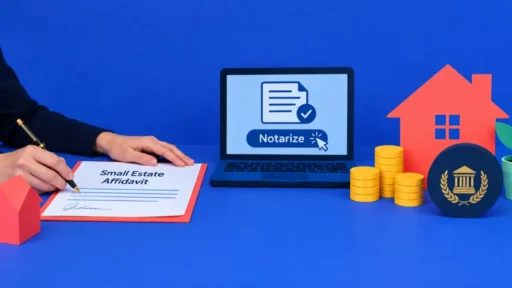






Thinking about turning a notary commission into a real business? Online notarization has made it possible to build a flexible, location-independent income stream with no storefront, no fixed hours, no chasing down clients at the DMV parking lot. But “become an online notary” and “run a successful online notary business” are two different things. The first is a licensing process. The second is a business.
This guide walks through both: what it actually takes to get commissioned as a remote online notary, and what it takes to turn that commission into steady income.
Step 1: Get Commissioned as a Traditional Notary
Before you can notarize anything online, you need a standard notary commission in your state. Requirements vary, but most states ask for the same basics:
- Be at least 18 years old
- Be a legal U.S. resident
- Live or work in the state where you’re applying
- Pass a background check (some states)
- Complete a state-approved notary course
- Pass an exam (in states that require one)
- Purchase a surety bond (amounts vary widely by state)
- Submit your application and fee to the Secretary of State
Because these requirements differ so much from state to state bond amounts, exam thresholds, background check windows it’s worth checking notarization requirements by state before you assume your neighbor’s process will match yours.
Step 2: Add Remote Online Notary (RON) Authorization
Once you’re a traditionally commissioned notary, most states let you apply for a separate Remote Online Notary authorization. This usually involves:
- Completing an additional RON-specific training course
- Passing a short exam (in some states)
- Registering your chosen RON technology platform with the Secretary of State
- Paying a registration fee (commonly $25–$100)
- Obtaining a digital certificate, electronic seal, and electronic journal
If you’re unclear on what “remote online notarization” actually covers versus in-person or hybrid options, it helps to start with the basics of what a remote notary is before picking a platform.

Step 3: Choose Your RON Platform
Your platform is your business infrastructure it’s what connects you to signers, verifies identities, records sessions, and applies your digital seal. Look for:
- State compliance the platform must support notaries commissioned in your state
- Security encryption, tamper-evident seals, audit trails
- Ease of use both for you and for the signer, who may not be tech-savvy
- Pricing model pay-per-notarization vs. subscription vs. hybrid, depending on your expected volume
- Support responsive help when something goes wrong mid-session
BlueNotary lets you bill clients directly at your own rates, which matters more than it sounds; the platform you choose effectively sets your margins.
Step 4: Protect Yourself Bond, Journal, and Insurance
Your surety bond protects the public from your errors; it doesn’t protect you. That’s where Errors and Omissions (E&O) insurance comes in. It’s optional in most states but strongly recommended, a single notarization error that leads to a lawsuit can easily exceed a year’s worth of notary income. Before you start taking on real business volume, it’s worth reading through an Errors and Omissions insurance guide for notaries so you understand what a policy actually covers.
Keep a detailed electronic journal of every notarization you perform. This isn’t just best practice in many states, it’s a legal requirement, and it’s your best defense if a signing is ever disputed.
Step 5: Decide What Kind of Notary Business You’re Building
“Online notary” isn’t one business model it’s several, and picking the wrong lane early can slow your growth.
General on-demand notarizations. Signers come to you through your platform’s marketplace or your own marketing. Volume-driven, lower per-signing revenue, high flexibility.
Loan signing agent work. Real estate closings pay significantly more per appointment than general notarizations often $75–$150+ per session but require specialized knowledge of loan documents. Many successful online notaries build toward this once they’re comfortable with the basics.
B2B / white-label services. Law firms, title companies, and lenders often want a dedicated notary relationship rather than a marketplace lottery. This requires more upfront relationship-building but produces more predictable income.
Hybrid mobile + online. Some notaries offer both remote sessions and in-person mobile appointments, covering clients who need or prefer face-to-face signing.
Step 6: Set Up the Business Side
Getting commissioned is the licensing part. Running a business means:
- Choosing a business structure many notaries operate as sole proprietors initially, though an LLC can offer liability protection as volume grows
- Setting your pricing check your state’s maximum allowable fees, then decide where you land within (or above, for value-added services) that range
- Building a simple website or profile even a one-page site with your credentials, service area, and booking link builds trust
- Tracking income and expenses bond, insurance, platform fees, and equipment are all deductible business costs in most cases; keep records from day one
Step 7: Find Your First Clients
Early on, most of your business will come from three places:
- Your RON platform’s built-in client-matching, if it offers one
- Direct relationships with local real estate agents, title companies, and attorneys who need reliable signing support
- Referrals, once you’ve done a handful of clean, professional sessions
Notaries who treat the first few months as relationship-building not just transaction-processing tend to see faster, more stable growth than those who rely purely on marketplace volume.
What to Expect Financially
Income varies enormously by state, niche, and hustle. A rough sense of the range:
- General online notarizations: often $25–$40 per session, depending on state fee caps
- Loan signing appointments: $75–$150+ per session
- Full-time notaries who build a loan signing or B2B pipeline can earn a solid income; part-timers doing occasional sessions supplement rather than replace other work
Diversifying into higher-value work like loan signings is usually the fastest way to increase revenue without simply doing more sessions. It’s worth reading up on becoming a loan signing agent once you’ve got your first few months of general notary work under your belt.
Common Mistakes to Avoid
- Skipping E&O insurance to save money early, then facing a dispute with no coverage
- Underpricing out of fear of losing business, which makes the work unsustainable
- Ignoring your state’s specific document restrictions not everything can be notarized remotely everywhere
- Treating it purely as a side hustle when the local market actually supports full-time income, and missing the growth window
If working from a dedicated home setup rather than juggling sessions on the go appeals to you, our guide on starting a notary business from home covers the practical setup side equipment, workspace, and scheduling in more depth.
Frequently Asked Questions
Do I need a traditional notary commission before I can notarize online?
Yes, in virtually every state. Remote Online Notary authorization is an add-on to an existing traditional commission, not a replacement for one.
How much does it cost to get started?
Between your state’s traditional commission fees, surety bond, RON training and registration, and platform costs, most people spend a few hundred dollars total before their first paid notarization.
Can I run this as a full side income, or does it need to be full-time?
Both models work. Many notaries start part-time to test demand in their state and niche before deciding whether to scale up.
Is E&O insurance actually necessary?
It’s optional in most states, but strongly recommended. A single claim can cost far more than years of premiums, and your surety bond doesn’t protect you personally.
What’s the fastest way to increase my income as an online notary?
Most notaries see the biggest jump in earnings by moving into higher-value work like loan signing agent appointments, or by building direct B2B relationships instead of relying solely on marketplace volume.
Ready to get started? Register with BlueNotary to begin building your online notary business today.For any questions, feel free to reach out to us at [email protected].