






Should you be in the middle of a business or a personal transaction that has to do with legal documents, you may at some point need to have a notarial certificate for the purpose of confirming the one who signed or acted as a witness to the legal paperwork that was important.
A notarial certificate is a piece of paper that a notary public can give you to make the identification of individuals who are subscribing their names to legal papers possible.
Notaries are the public officers appointed by their state governors to the impartially serve their citizens. Notaries perform the duties of an impartial witness for the public.They can give oaths and affirmations, take acknowledgments, and verify the genuineness of the signatures. The fraud protection and security of legal documents and contracts is increased by obtaining a notarial certificate.
The notary’s seal and signature on a notarial certificate can guard the consent from being forged and deter signers from denying the genuineness of their signature or the contents of the document.
It is usually documents such as deeds, mortgages, powers of attorney, affidavits, and oaths for which notarial certificates are requested.
Developing one’s knowledge of a notarial certificate and notaries’ processes eventually facilitates the provision of properly verified and witnessed important legal paperwork.
What Exactly Is a Notarial Certificate?
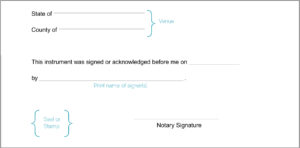
A notarial certificate, also known as a loose leaf certificate might be a notary acknowledgment, jurat (oath), or copy certificate, is a sworn statement by a notary public that verifies a person’s identity and acknowledges that an individual signed a document freely and willingly.
It will look a little something like this:
How is a Notary Certificate different from a Digital Certificate
There is a level of confusion coming from different states referring to Notary Certificates as Digital Certificates. Here is our ultimate guide on Digital Certificates. Essentially they are encrypted files that will go into each document a notary conducts online that to verify they were indeed the notarizing party.
Purpose of a Notarial Certificate
A notarial certificate is created to affirm the notary’s identity and to prove that the signer signing the document is doing so of his or her own free will. It also helps to prevent fraud and holds the signatory to the factual claims that they make. The certificate additionally is the document’s permission to be entered into the record and a means of submitting in court and being evidence.
The inclusion of the notarial certificate not only discourages fraud but also allows the recording of the document for future reference, using it in the court as a piece of evidence.
What’s Included in a Notarial Certificate
A notarial certificate will vary from state to state but will typically contain the following information:
- The venue identifies the state and county where the notarization is taking place.
- The date the notarization is performed.
- A statement confirming the identity of the signer based on government-issued photo ID.
- A sworn statement that the signer personally appeared before the notary, is known to the notary or was identified, and signed the document voluntarily.
- The signature and seal or stamp of the notary public. The seal must match the notary’s name exactly.
In summary, a notarial certificate authenticates documents and the identities of those who sign them.
By signing and sealing the certificate, a notary public swears that proper procedures were followed and the signer appeared and acknowledged signing voluntarily.
This allows businesses, governments, and individuals to have confidence in the legitimacy of the signed documents.
How Is a Notarial Certificate Different From a Notary Public Certification?
A notarial certificate is an official document signed and sealed by a notary public to authenticate the facts of a notarial act.
It contains details about the specific notarization, including the names of the parties involved, the type of notarial act performed, the date, and the place of notarization.
Here is an online signature generator tool for free.
In contrast, a notary public certification is a statement by the State Commissioning office that a notary public has been granted the powers of a Notary Public.
It does not contain specific details about the notarial act but provides authorization to the notary public.
Key Differences
- A notarial certificate is where you can find the notarization details, whereas if a person has a notary public certification it only signifies that your signature on a given document has been notarized.
- If the notarial certificate is the one used, the notary public’s official seal is stamped on it as an additional proof of authentication. A notary public certification generally does not entail the use of a seal.
- A notary certificate is a legitimate and formal paper that serves as proof that notarization has been carried out in a correct manner. A notary public certification, in contrast, is a quite casual and informal way to confirm the legality of the document but there is still a chance that it is not legally accepted.
- The notary public certification verifies that an individual has made an appearance before the notary. The notarial certificate indicates the notarial act performed such as an oath or acknowledgment by the notary public.
In short, a notary public certificate mainly establishes the fact that the signature is genuine, while a notarial certificate significantly extends the scope of authentication to the very substance of a notarial act.
Both of the documents, whether it is a declaration made by an individual or a certificate issued by a notary public, provide reassurance to the parties with respect to the integrity and the genuineness of the notary’s official deeds.
When Performing a Notarization, When Must a Notary Use a Notary Certificate?
As a notary public, there are certain situations where you must complete a notarial certificate to legally authenticate a document or transaction.
When Performing Acknowledgments
When administering an oath or taking an acknowledgment, you must complete a notarial certificate.
An acknowledgment formally confirms the identity of a person signing a document and their willingness to sign said document.
The certificate serves as legal proof that proper notarization procedures were followed.
When Witnessing or Attesting to a Signature
No matter if you are watching or subscribing to someone’s signature on paper, a notarial certificate should be the first thing you need. However, only if the latter can witness that the person actually signed the document in the former’s presence would the former be able to identify the person in the document as well.
When Certifying True Copies
If you are asserting that a photocopy of an original document is indistinguishable from the original, you need to include a notarial certificate as well
This certificate indicates that you have personally inspected both the original and the copy and that the copy is identical to the original.
This allows copies to serve as legally valid documents.
When Performing Jurats
A jurat is a notarization where a person signs a document and swears or affirms that the statements in the document are true.
When administering a jurat, you must complete a notarial certificate.
The certificate serves as evidence that the signer appeared before you, swore or affirmed that the contents of the document are truthful, and signed the document in your presence.
In summary, as a notary you must use a notarial certificate when taking acknowledgments, witnessing signatures, certifying copies, or performing jurats.
The certificate legally validates these notarial acts and the documents they relate to.
Be sure to always include a notarial certificate when performing these types of notarizations.
Notarial Certificate Conclusions
If you have an in-depth understanding of what a notarial certificate contains, you are now in a position to elucidate fully the relevance and the legal implication of the document.
A notarial certificate is a guarantee that the identity of the signer has been verified and that the act of signing the official documents was done by the said person, and this was done to prevent any kind of fraud.
By verifying the signing of the urgent handwritten documents with a notary public, you ensure both your personal and your business interests an extra layer of security and protection.
Do not forget to be attentive during the notarization process and make sure to visit a notary only after you have understood what you are signing and verified all the details on the documents to be true and up-to-date
It is quite possible that notarial certificates are not a big deal for you but indeed they are the supporting factor of the legal status of your most vital personal and business situations, do not forget that!
Ready to Move Your Notarizations Online?
Integrate your Business, Title Company, or Law Firm to Satisfy your Customers and Decrease Turnaround
Meet with an online notary instantly and get notarized in 15 minutes or less!
Discover the Power of BlueNotary:
Integrate your Business, Title Company, or Law Firm to Satisfy your Customers and Decrease Turnaround
Get a document Notarized/Sign-up
Join the Free Notary Training Facebook Group
FAQ
Q1: What is a notarial certificate?
A1: A notarial certificate is a legal document that a notary public provides to confirm the identity of people who are signing a legal document and to make a statement that the signs are done freely and are of his or her free will. It is an affidavit by the notary public.
Q2: How does a notarial certificate differ from a digital certificate?
A2: A notarial certificate is a paper or digital document that a notary public has signed and sealed to prove that notarization has occurred there, whereas a digital certificate is a coded file that is applied for online notarization to check the notary’s involvement. These two certificates achieve different objectives, with the notarial certificate focusing on checking the signature and the digital certificate making sure that online transactions are safe.
Q3: What is the purpose of a notarial certificate?
A3: A notarial certificate is used to confirm the identity of the signer and the notary, to prevent forgery, and to ensure that the person signing the document is signing it with his own free will. In addition, it allows the document to be admitted and used as evidence in a court of law.
Q4: When is a notary required to use a notarial certificate?
A4: A notary is only allowed to have legal actions on behalf of an acknowledgment and witnessing, attesting to signatures, certifying true copies of the documents, and performing jurats. These certificates actually verify the notarial acts and the related documents.
Q5: What are the key differences between a notarial certificate and a notary public certification?
A5: A notarial certificate is a written statement that specifies the details of a notarization act like the names of the parties related and the type of notarial act performed and is the notary’s official seal for further authentication. On the other hand, a notary public certification only certifies that a person has been given the powers of a Notary Public by the State Commissioning office but does not disclose the explicit notarial act.