



Last updated: May 2026
Bank of America offers free notary public services at most branches for account holders, though availability depends on staffing and location. Non-customers may be charged a fee or turned away entirely. Notaries handle standard documents like powers of attorney, affidavits, loan papers, and vehicle titles during branch hours, but no remote options exist through the bank. This article explains how to access Bank of America notary services, what documents they'll notarize, costs, hours, and faster alternatives when branch notaries aren't available.

Does Bank of America Offer Notary Services?
Yes, Bank of America provides notary public services at most of its branch locations, free of charge for customers with an eligible account. This is a genuine perk that many account holders overlook.
A notary public is a state-licensed official authorized to witness signatures, verify identity, and authenticate documents. According to the National Notary Association, more than 4.4 million notaries serve the public across the United States. Banks are among the most common places people access notary services — convenient because they're already trusted institutions with trained staff.
Here's the practical reality with the Bank of America notary public service:
- Account requirement: Notary services are typically available only to Bank of America customers. Non-customers may be turned away or charged a fee.
- No guarantee of availability: Not every branch has a notary on duty at all times. Staff turnover and scheduling mean you could arrive and find no notary available.
- Branch-specific policies: Individual branch managers set some local policies, so what's free at one location might work differently at another.
If you need a document notarized and you're a Bank of America customer, calling ahead is the single most important step you can take.
What Documents Can Be Notarized?
The Bank of America notary public service handles a standard range of common documents. Notarization confirms that the signer appeared in person, showed valid ID, and signed willingly — it doesn't certify that the document's content is accurate or legal.
Common Documents Notarized at Bank Branches
| Document Type | Typical Use Case | Notes |
|---|---|---|
| Power of Attorney | Authorizing someone to act on your behalf | Often required by financial institutions |
| Affidavits | Sworn written statements | Used in legal proceedings |
| Loan documents | Mortgage closings, refinances | High-volume notary need |
| Real estate deeds | Property transfers | May require additional witnesses |
| Wills and trusts | Estate planning | Some states have specific requirements |
| Vehicle title transfers | Buying or selling a car | DMV may require notarized signature |
| Medical authorization forms | Healthcare decisions | Often needed for minors or incapacitated adults |
Bank notaries handle most standard personal and financial documents. They generally won't notarize documents with blank spaces, incomplete information, or documents written in a language they can't read.
One area worth knowing about: if you're dealing with document notarization after car accidents — for insurance claims or legal filings — a bank notary can typically handle those affidavits and settlement documents without issue.
What Services Do Bank of America Notaries Provide?
The Bank of America notary public service covers the core notarial acts recognized in most states:
- Acknowledgments: Confirming you signed a document voluntarily and are who you say you are.
- Jurats: You sign in the notary's presence and swear the document's contents are true.
- Copy certifications: Certifying that a copy of an original document is accurate (availability varies by state).
- Signature witnessing: The notary witnesses your signature and records it in their notary journal.
What bank notaries typically do not handle:
- Apostilles (international document authentication — that's handled by your state's Secretary of State office)
- Notarizing documents for legal proceedings where the bank employee has a conflict of interest
- Mobile or remote notarization services
This last point matters. The Bank of America notary public service requires you to show up in person at a branch. There's no remote option through the bank itself.
Bank of America Notary Hours and Locations
Bank of America operates roughly 3,900 branches across the United States. Most branches are open Monday through Friday, 9 AM to 5 PM, with some Saturday hours. But notary availability doesn't always match branch hours.
Here's how to find a Bank of America notary public near you:
-
Call the branch directly: Use the Bank of America branch locator at bankofamerica.com to find your nearest location, then call before visiting. Ask specifically whether a notary is on duty that day.
-
Use the branch locator filter: The online locator lets you filter by services offered, including notary services. This helps you avoid branches that don't currently have a notary on staff.
-
Schedule an appointment: Some branches allow you to book a notary appointment in advance through the Bank of America app or website. This is the most reliable approach.
-
Arrive during peak staffing hours: Mid-morning on weekdays (10 AM to noon) tends to be when branches are fully staffed and wait times are shorter.
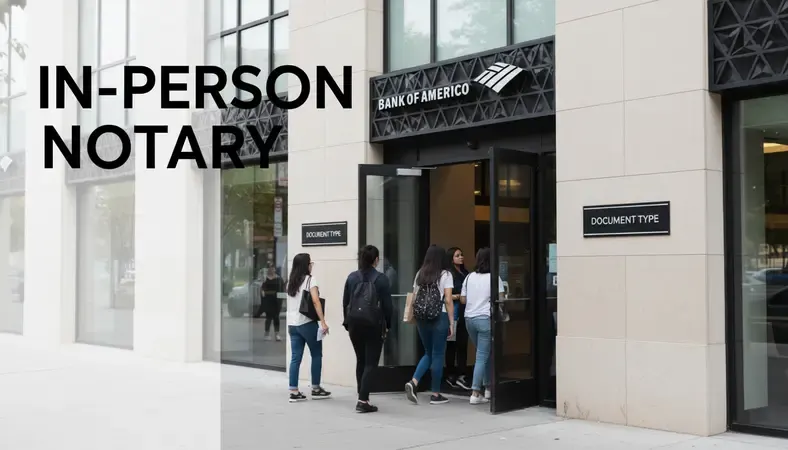
One practical note: if you're searching for a "notary public close to me," the Bank of America branch locator is one tool — but it's not always the fastest. UPS stores, shipping centers, public libraries, and credit unions often have notaries with more flexible scheduling.
How Much Does Bank of America Notary Cost?
The Bank of America notary public service is free for eligible account holders. This includes customers with checking accounts, savings accounts, and most other personal banking products.
For non-customers, the policy varies by branch. Some locations will notarize for a small fee (typically $5–$15 per signature), while others decline entirely. There's no published national policy for non-customers, so you'll need to ask.
Compare this to typical notary fees elsewhere:
- UPS Store: $5–$15 per signature
- FedEx Office: Similar range, varies by location
- Mobile notary: $50–$150+ depending on travel distance and document complexity
- Attorney's office: Often included in service fees, but expensive if you're only there for notarization
- Online/remote notary: $25–$35 per session on most platforms
For Bank of America customers, the free service is a genuine advantage — assuming a notary is available when you need one.
How to Find a Notary Public Near You
When the Bank of America notary public isn't available, you have several solid alternatives. The American Association of Notaries maintains a directory of commissioned notaries by state, which is a good starting point.
Here are the most reliable ways to find notary services quickly:
- Your bank or credit union: Most banks offer the same free notary service as Bank of America. If you have accounts elsewhere, try those branches too.
- UPS and FedEx stores: Walk-in friendly, usually no appointment needed, open evenings and weekends.
- Public libraries: Many offer free notary services to community members — call ahead to check availability.
- AAA offices: Members can often access free notary services at AAA branches.
- Online notary platforms: Remote online notarization (RON) lets you get documents notarized via video call, often within minutes.
In our work with clients navigating bank of america notary public services, we've consistently seen the same frustration: customers arrive at branches only to discover the notary called in sick or left early that day.
Key Insight: Remote online notarization is now legal in over 40 U.S. states. For time-sensitive documents, it's often faster than waiting for an in-person notary appointment.
Alternatives to Bank of America Notary Services
The Bank of America notary public service works well when it's available. When it's not — or when you need something faster, more flexible, or available outside banking hours — here are your real options.
Remote Online Notarization (RON)
Remote online notarization lets you connect with a commissioned notary via live video call. You show your ID on camera, the notary verifies your identity, and you both sign digitally. The entire process typically takes 10–20 minutes.
RON is particularly useful for:
- Documents needed outside business hours
- Situations where traveling to a branch is impractical
- Time-sensitive real estate or legal filings
- Anyone with mobility limitations
Platforms like BlueNotary handle the full process online. You upload your document, verify your identity, and connect with a live notary — no branch visit required. BlueNotary is fully compliant with state RON laws and produces legally valid notarized documents accepted across the U.S.
Mobile Notary Services
A mobile notary travels to your location — your home, office, hospital, or wherever you need them. This is particularly useful for real estate closings, estate documents, or situations where multiple signers need to be present. Mobile notary services typically cost $50–$150 or more, depending on distance and document complexity.
Comparison: Notary Options at a Glance
| Option | Cost | Availability | Best For |
|---|---|---|---|
| Bank of America | Free (customers) | Branch hours, varies | Routine documents, existing customers |
| UPS/FedEx | $5–$15/signature | Walk-in, extended hours | Quick, no-appointment needs |
| Mobile notary | $50–$150+ | Flexible, by appointment | Multi-signer, location-specific needs |
| Remote online (RON) | $25–$35/session | 24/7 on many platforms | Fast, paperless, any location |
| Library/credit union | Free–low cost | Limited hours | Budget-conscious, simple documents |
Our team has processed thousands of remote notarizations for clients who initially tried bank branches, and the pattern is clear: when you need certainty and speed, scheduled remote sessions eliminate the guesswork entirely.
Common Questions About Bank of America Notary Services
Does Bank of America notarize documents for non-customers?
Some branches will notarize for non-customers for a small fee, but this isn't guaranteed. Bank of America's official policy prioritizes account holders, and individual branches have discretion to decline non-customer requests. Call your local branch before making the trip.
Can I get a document notarized at Bank of America without an appointment?
Walk-ins are accepted at most branches, but there's no guarantee a notary will be available. Calling ahead or scheduling through the Bank of America app significantly reduces the risk of wasted travel. Busy branches during lunch hours or Monday mornings are most likely to have wait times.
What ID do I need for Bank of America notary services?
You'll need a current, government-issued photo ID — a driver's license, state ID, or passport. The notary is required by law to verify your identity before witnessing your signature. Expired IDs are not accepted.
Is Bank of America notarization legally valid everywhere in the U.S.?
Yes. A notary public commissioned by any U.S. state produces a legally valid notarization recognized nationwide under the Full Faith and Credit Clause of the U.S. Constitution. A Bank of America notarized document is as legally valid as one notarized anywhere else.
What's the difference between a notary and an apostille?
A notary public witnesses and authenticates your signature for domestic use. An apostille is an additional certification that makes a notarized document valid in foreign countries that participate in the Hague Apostille Convention. Bank of America notaries don't issue apostilles — you get those from your state's Secretary of State office after the document is already notarized.
Wrapping Up
The Bank of America notary public service is a solid free option for account holders with routine documents — as long as you call ahead. When availability is uncertain or you need something faster, remote online notarization through BlueNotary gets your documents notarized in minutes from anywhere, with no branch visit required.
Written by the BlueNotary team — Remote Online Notary Services practitioners. Ready to get started? Visit BlueNotary to learn more.