





Estate planning law is no longer uniform across the country, and the digital shift has widened those gaps. A handful of states now let you sign a will entirely on a screen. Most still require a paper document and in-person witnesses. Layered on top of that is a separate legal question: who gets access to your online accounts after you die? Understanding where your state falls on both questions matters before you sign anything.
Two Separate Legal Questions
Digital estate planning law actually covers two distinct issues that often get blended together:
- Can you create a will or trust electronically? This is governed by state probate code and, in some states, the Uniform Electronic Wills Act (UEWA).
- Who can access your digital accounts after death? This is governed by the Revised Uniform Fiduciary Access to Digital Assets Act (RUFADAA), which nearly every state has adopted in some form.
Keeping these separate helps explain why a state can be “digital-friendly” on one front and traditional on the other.
Which States Allow Electronic Wills
As of 2026, roughly a dozen to fifteen states have passed statutes authorizing fully electronic wills created, signed, witnessed, and stored without ever touching paper. That’s a meaningful jump from just a few years ago, but it still leaves most of the country requiring traditional execution.
States that have adopted electronic wills legislation generally fall into two groups:
- Uniform Electronic Wills Act (UEWA) adopters: Oregon, Utah, Colorado, and North Dakota apply the uniform version of the law.
- States with their own non-uniform statutes: Florida, Arizona, Nevada, Indiana, Illinois, Maryland, and Washington have each passed distinct e-wills laws with their own witnessing and notarization requirements.
New York enacted electronic wills legislation in 2026, though parts of the law are phased in over time rather than taking effect all at once, a reminder that “enacted” and “fully operative” aren’t always the same thing. A growing number of other states have introduced similar bills, so this list is very much a moving target rather than a settled one.
In every state without an e-wills statute, the legal status of a purely digital will is uncertain at best. Courts in a few jurisdictions have upheld electronic wills under unusual circumstances, but that’s the exception, not something to plan around.

How RUFADAA Governs Your Digital Assets
Separate from will execution, RUFADAA addresses a more mundane but increasingly common problem: a locked social media account, an inaccessible cryptocurrency wallet, or a cloud storage account nobody in the family can get into. Nearly all states have adopted some version of this law, and it works on a three-tier priority system:
| Priority | Source of Instruction | What It Means |
| 1 | Platform’s own legacy-contact tool | If the platform offers one (e.g., a designated legacy contact), it overrides everything else |
| 2 | Your will, trust, or power of attorney | Controls only if no platform tool exists or was used |
| 3 | The platform’s terms of service | Default rule if neither of the above applies |
The practical takeaway: an old, forgotten platform setting can legally override a carefully drafted will. This is why estate planning attorneys increasingly recommend a two-step approach to update platform-level legacy settings and include digital asset instructions in formal estate documents.
Where Remote Online Notarization Fits In
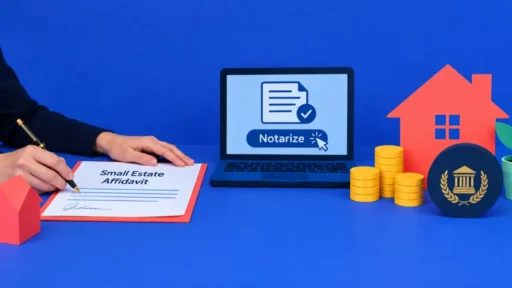
Even in states that don’t allow fully electronic wills, Remote Online Notarization (RON) often still has a role. Many estate documents besides the will itself require notarization, durable powers of attorney, healthcare directives, trust certifications, and self-proving affidavits, among others. In the large majority of states that have passed RON laws, these supporting documents can be notarized remotely by a commissioned online notary, even if the underlying will still needs a traditional ink signature and in-person witnesses.
This distinction trips people up constantly. A self-proving affidavit notarized through RON doesn’t make an otherwise traditional will “electronic” ; it just streamlines one piece of the process. Confirming exactly which documents your state allows to be notarized remotely, versus which require in-person execution, is worth doing before you start signing anything.
At BlueNotary, we handle the identity verification, recorded video session, and tamper-evident audit trail that RON requires for the documents your state permits to be notarized remotely. For documents that require full electronic execution under an e-wills statute, always confirm your state’s specific requirements first, since witnessing and storage rules vary.
Core Documents in Any Estate Plan
Regardless of which state’s rules apply, most comprehensive estate plans rely on the same core set of documents:
- Last will and testament directs asset distribution and names an executor
- Revocable living trust manages and distributes assets, often bypassing probate
- Durable power of attorney authorizes someone to manage financial affairs if you’re incapacitated
- Healthcare directive / living will states your medical treatment preferences
- Healthcare power of attorney names someone to make medical decisions on your behalf
- Digital asset inventory lists online accounts and access instructions for your executor
If you’re weighing whether a living trust makes sense for part of your plan, our piece on the drawbacks of revocable living trusts covers the tradeoffs worth considering first.
Working With an Attorney on Multi-State Assets
If you own property or accounts in more than one state, or you’re an attorney advising clients who do, the patchwork nature of this law is the whole problem. A will valid in one state’s e-wills framework may not be recognized the same way elsewhere, and RUFADAA adoption details differ enough that blanket assumptions are risky. Our guide for law firms handling notarization covers how practices manage this kind of multi-jurisdiction complexity at scale.
For powers of attorney specifically, which show up constantly in estate plans and frequently require notarization regardless of a state’s e-wills status, see our complete guide to notarizing a power of attorney.
Frequently Asked Questions
Do all states allow electronic wills?
No. Only a minority of states roughly a dozen to fifteen as of 2026 have passed statutes authorizing fully electronic wills. Most states still require a traditional paper will with ink signatures and in-person witnesses.
What is RUFADAA and why does it matter?
RUFADAA is a law adopted by nearly every state that gives executors and trustees legal authority to access a deceased person’s digital accounts. Without it, families can face locked accounts and inaccessible digital assets even with a valid will in place.
Can a forgotten Facebook setting really override my will?
Under RUFADAA’s tiered system, yes a platform’s own legacy-contact designation takes priority over instructions in a will. Reviewing and updating platform-level settings is an important, often-overlooked part of digital estate planning.
Does Remote Online Notarization make my will electronic?
Not by itself. RON can notarize supporting documents like a self-proving affidavit or power of attorney in states that allow it, but it doesn’t convert an otherwise traditional will into a legally electronic one unless your state has a specific e-wills statute.
What should I do if I have assets in more than one state?
Review each state’s electronic wills status and RUFADAA adoption separately, since requirements aren’t uniform. Working with an attorney familiar with multi-state estate planning is generally the safest path.