




Getting a document notarized used to mean rearranging your day — finding a notary, showing up in person, and hoping your schedule aligned with theirs. Now you can notarize online from your couch, in minutes, without leaving home.
If you’ve got a document that needs a notary’s stamp and you’re not sure how the online version works, this guide covers everything: what it is, how it works, what’s legal, and exactly how to do it.
What Is Online Notarization?
Online notarization — also called Remote Online Notarization (RON) — is the process of getting a document notarized through a live, two-way video call with a commissioned notary public.
Key Insight: Online notarization is not just uploading a PDF and clicking a button. It’s a live, recorded session with a real commissioned notary who verifies your identity, witnesses your signature, and applies a tamper-evident digital seal to your document.
The notary is a real person, licensed by the state. The difference from traditional notarization is that everything happens over a secure video platform instead of in a physical office. The notary confirms your identity, watches you sign, and applies their official digital seal — all in real time.
When you notarize online, the resulting document carries the same legal weight as one notarized in person. The digital seal is cryptographically linked to the document, so any tampering after the fact is immediately detectable.
How Does Online Notarization Work?
The process is more structured than a typical video call. Here’s what actually happens when you notarize online:
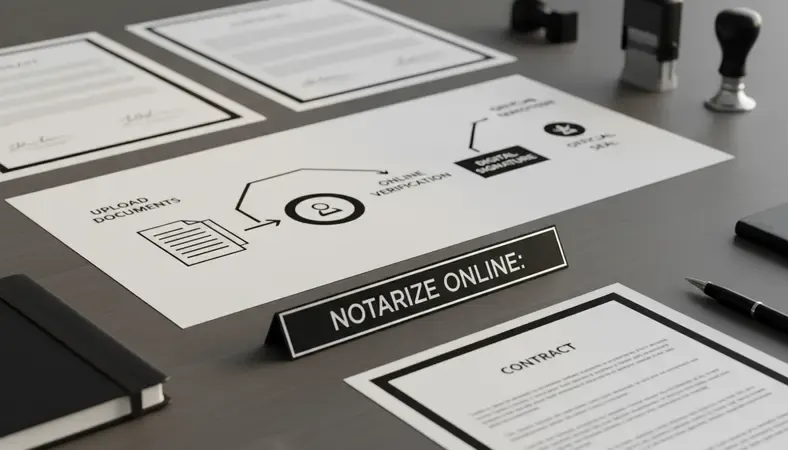
- Upload your document: You upload the PDF to the online notary service platform before the session begins.
- Verify your identity: The platform runs you through identity verification — typically a photo of your government-issued ID, followed by Knowledge-Based Authentication (KBA). KBA asks you questions drawn from your personal records: previous addresses, loan amounts, vehicle history. Only you should know the answers.
- Connect with a notary: You join a live video session with a commissioned notary public. Both of you can see and hear each other clearly.
- Sign electronically: You sign the document digitally while the notary watches via video. This satisfies the legal requirement that a notary witness the signature.
- Notary applies their seal: The notary applies their official digital certificate and electronic seal to the document. This seal is tamper-evident — any change to the document after sealing invalidates it.
- Receive your notarized document: The completed document is available for immediate download. The session is recorded and stored as an audit trail.
The whole process typically takes 15 minutes or less.
Is Online Notarization Legal and Secure?
The short answer: yes, in most of the United States.
As of now, over 40 states have passed laws explicitly authorizing remote online notarization. The remaining states are either in the process of passing legislation or permit it under emergency provisions. Federal law — specifically the ESIGN Act — supports the use of electronic signatures and notarizations in interstate commerce.
Security Measures That Protect You
Online notarization services use multiple layers of protection:
- Identity verification: KBA and government ID checks confirm you are who you say you are before the session starts.
- Live video recording: Every session is recorded and stored, creating a permanent audit trail.
- Tamper-evident digital seal: The notary’s cryptographic certificate locks the document. Any post-signing alteration is detectable.
- Encrypted storage: Documents are stored using bank-grade encryption.
From a security standpoint, online notarization is arguably more secure than in-person notarization. A traditional notary checks your ID visually — an online platform runs automated verification software against it.
What Documents Can Be Notarized Online?
Most common documents that require a notary can be notarized online. These include:
- Powers of attorney
- Real estate documents (deeds, affidavits, mortgage documents)
- Wills and trusts
- Loan documents
- Business contracts and agreements
- Affidavits and sworn statements
- Adoption documents
- Vehicle title transfers
There are exceptions. Some documents — particularly certain court filings or documents that require in-person witnessing under specific state law — may not qualify. Always confirm with the receiving institution that they accept remotely notarized documents before you start.
Online Notarization vs. Traditional Notarization
Side-by-Side Comparison
| Factor | Online Notarization | Traditional Notarization |
|---|---|---|
| Location | Anywhere with internet | Must be physically present |
| Availability | Often 24/7 | Business hours only |
| Identity Verification | Automated ID + KBA + video | Visual ID check |
| Turnaround | Minutes | Depends on scheduling |
| Document Delivery | Instant digital download | Physical copy |
| Audit Trail | Recorded session + logs | Paper journal entry |
| Geographic Limits | Cross-state capable | Typically in-state |
The biggest practical difference is convenience. Traditional notarization requires you to be somewhere at a specific time. Online notarization removes both constraints. You can notarize online from another state, another country, or your living room at 11 PM.
For documents involving document notarization after car accidents or other time-sensitive situations, the ability to notarize online without delays can matter significantly.
How Much Does Online Notarization Cost?
Online notarization services are priced per notarial act. Costs vary by platform and state, but the range is typically lower than you’d expect for the convenience involved. Contact platforms like BlueNotary directly for current pricing, as rates vary based on document type and volume.
For comparison, traditional in-person notaries often charge per signature or per document, and you may pay for travel time or scheduling fees on top of that. With online notarization, the fee covers the session, identity verification, and document storage — all in one.
How to Get a Document Notarized Online
Here’s exactly how to notarize online using a service like BlueNotary:
- Prepare your document: Have your PDF ready. Make sure it’s complete — don’t sign it yet. The notary needs to witness your signature live.
- Create an account: Go to bluenotary.us and create a free account. You’ll enter basic information and agree to the platform’s terms.
- Upload your document: Upload the PDF you need notarized.
- Complete identity verification: Follow the prompts to photograph your ID and complete the KBA questions. This step usually takes 2–3 minutes.
- Connect with a notary: You’ll be matched with an available commissioned notary for a live video session. On platforms like BlueNotary, notaries are often available immediately.
- Sign and notarize: During the session, you’ll sign the document electronically while the notary witnesses via video. The notary then applies their digital seal.
- Download your document: Once the session ends, your notarized document is ready to download immediately.
Common Questions About Online Notarization
Is an online notarized document accepted everywhere?
Most institutions banks, courts, government agencies, title companies — accept documents notarized online in states where RON is authorized. The key is that the receiving institution must accept electronic notarizations. Check with them before you start. Federal agencies and most major financial institutions routinely accept online-notarized documents.
Can I notarize online if I’m outside the United States?
Yes, in many cases. Several online notary services, including BlueNotary, can notarize documents for U.S. citizens located abroad, provided the document is governed by U.S. law and the notary is commissioned in a RON-authorized state. You’ll still need a valid U.S. government-issued ID and a stable internet connection.
What if my document has multiple signers?
Multiple signers can participate in the same online notarization session or in separate sessions, depending on the platform and document type. Each signer completes their own identity verification. The notary witnesses each signature individually, even if everyone is on the same video call.
Do I need to notarize online with a notary from my state?
Not necessarily. Under RON laws in most states, a notary commissioned in a RON-authorized state can notarize documents for signers located anywhere including other states or countries. The notary’s state of commission governs the notarization, not your location. This is one of the major advantages when you notarize online versus using a local notary.
Is online notarization the same as an electronic signature?
No. An electronic signature is simply a digital way to sign a document no notary involved. Online notarization requires a commissioned notary to witness your signature via live video and apply their official seal. It’s a higher standard of authentication. Many documents that legally require notarization cannot be satisfied by an electronic signature alone.
Key Takeaways
Online notarization is legal, secure, and faster than the traditional alternative and it works for the vast majority of documents that require a notary’s seal. Notarize your documents at BlueNotary complete identity verification, connect with a live commissioned notary, and receive your sealed document in minutes, all without leaving home. Ready to get started? Visit BlueNotary to learn more.
For any questions, feel free to reach out to us at [email protected]