




Getting a document notarized used to mean rearranging your day — finding a notary, driving there, waiting, signing, driving back. Online notary services eliminate all of that. You connect with a licensed notary over a secure video call, verify your identity digitally, and walk away with a legally notarized document without leaving your desk.
This guide covers everything you need to know: how online notary services work, what documents qualify, how they compare to traditional notarization, and exactly how to use one.
What Are Online Notary Services?
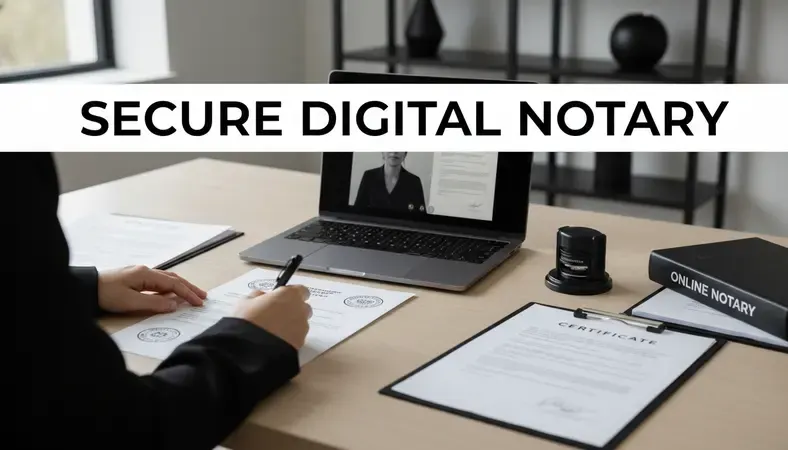
Online notary services — also called remote online notarization (RON) — let you get documents notarized through a secure audio-video connection instead of in person. A commissioned notary public witnesses your signature in real time over a live video session, applies a digital seal and electronic signature, and produces a tamper-evident document that carries the same legal weight as one notarized the traditional way.
Think of it as a high-tech version of the traditional notary stamp. The notary is still a licensed professional. The verification is still rigorous. The document is still legally binding. The only thing that changes is location — you can be anywhere, and so can the notary.
Key Insight: Online notary services are not just a convenience feature. They're a legally recognized process governed by state law, with identity verification requirements that are often more stringent than what you'd experience at a bank or UPS store.
Virtual notary services operate on dedicated platforms that handle identity verification, session recording, and document sealing automatically. Platforms like BlueNotary are built specifically for this — connecting signers with commissioned notaries in minutes, not days.
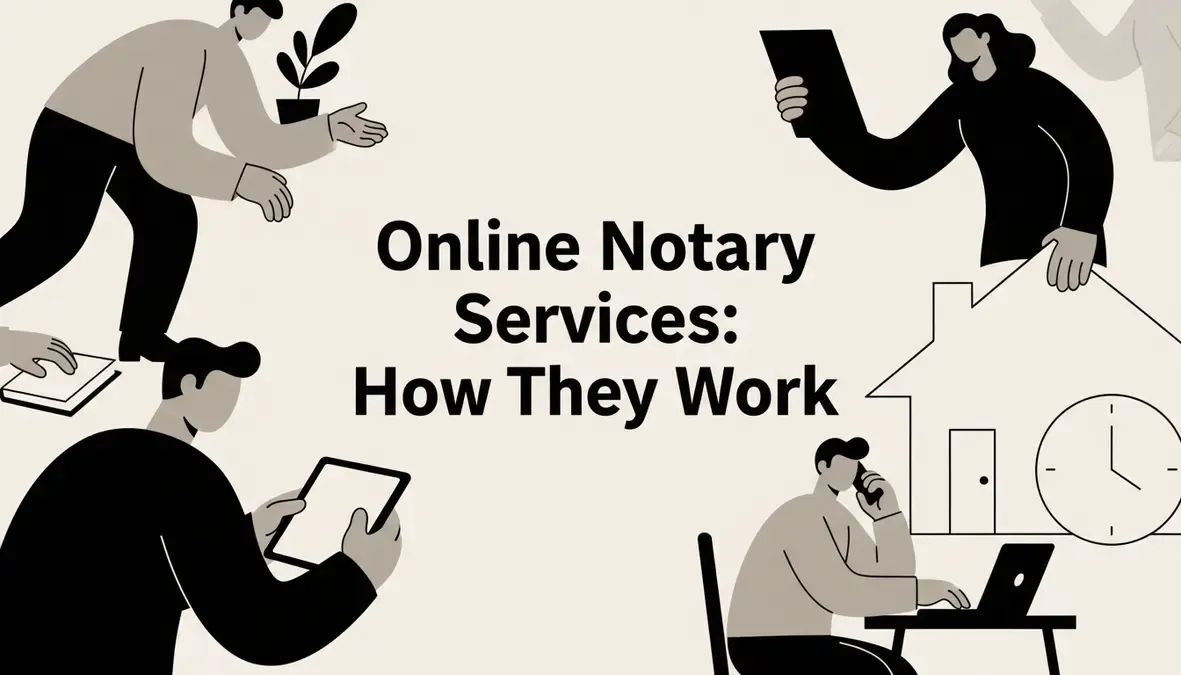
How Do Online Notary Services Work?
The process follows a defined sequence every time. Here's what actually happens during a session.
The Identity Verification Process
Before you ever see the notary on screen, the platform verifies who you are. This typically involves three layers:
- Credential Analysis: You photograph your government-issued ID. The platform's software checks security features, fonts, and formatting against known document patterns.
- Knowledge-Based Authentication (KBA): You answer questions drawn from your personal records — things like previous addresses, loan amounts, or vehicle history. These are questions only you should know.
- Biometric Check: Many platforms compare a live selfie to the photo on your ID using facial recognition.
This multi-layer approach is why online notary services can actually be more secure than walking into a bank branch with a single ID.
The Live Video Session
Once identity is confirmed, you connect with the notary over live video. The notary will:
- Confirm your identity verbally
- Walk through the document with you
- Watch you sign electronically in real time
- Apply their digital notarial certificate and seal
The entire session is recorded and stored. That recording serves as a permanent audit trail — something a traditional paper notarization doesn't provide.
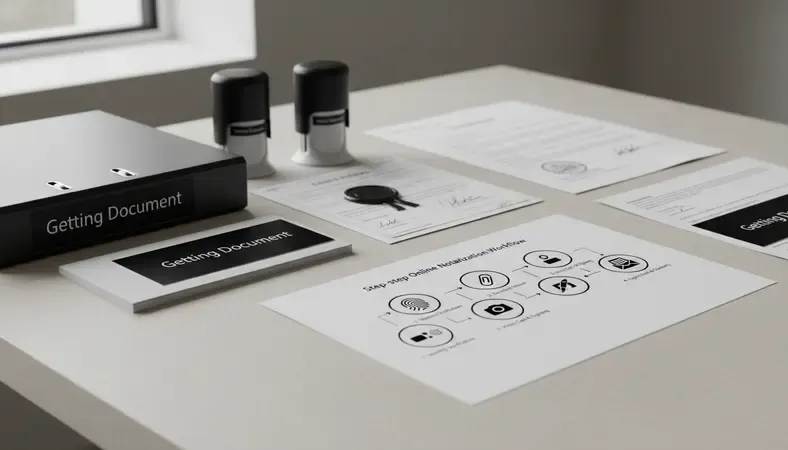
The Finished Document
After the session, you receive a digitally sealed PDF. The seal contains encrypted data that permanently links the notary's credentials to that specific document. Any tampering after the fact is detectable, which makes the document more tamper-resistant than a physical stamp on paper.
Is Online Notarization Legal and Secure?
The answer is a clear yes — with one caveat about where you're located.
As of today, 45 U.S. states and the District of Columbia have enacted laws authorizing remote online notarization. Most states that haven't passed their own RON laws still accept documents notarized in RON-authorized states under interstate recognition rules.
The security side is equally solid. Online notary services use:
- 256-bit AES encryption for document transmission and storage
- Multi-factor identity verification that exceeds what most in-person notaries require
- Tamper-evident digital seals that invalidate the document if any content is altered after signing
- Session recordings stored as a permanent audit trail
From a legal standpoint, electronic signatures and digital notarization are recognized under federal law through the ESIGN Act and the Uniform Electronic Transactions Act (UETA), which most states have adopted.
What Documents Can Be Notarized Online?
Most documents that can be notarized in person can also be notarized online. Common examples include:
- Real estate documents — deeds, mortgages, refinancing paperwork
- Legal documents — powers of attorney, wills, trusts, affidavits
- Business documents — contracts, articles of incorporation, loan agreements
- Personal documents — consent forms, statutory declarations, title transfers
A few categories have restrictions depending on the state. Adoption papers and certain court filings may require in-person notarization in some jurisdictions. If you're dealing with document notarization after car accidents — insurance claims, medical authorizations, settlement agreements — online notary services typically handle all of these without issue.
Always verify your specific document type and destination state before booking a session.
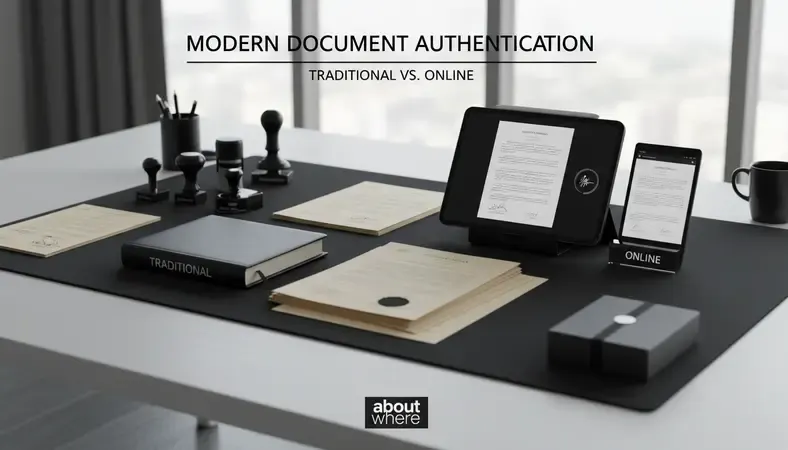
Online Notary vs Traditional Notary: Key Differences
Here's a direct comparison so you can decide which approach fits your situation.
Online vs. Traditional Notarization at a Glance
| Factor | Online Notary | Traditional Notary |
|---|---|---|
| Location | Anywhere with internet access | Must appear in person |
| Availability | 24/7 on most platforms | Business hours, appointment required |
| Identity Verification | Multi-layer (KBA, biometric, ID scan) | Single ID check |
| Document Format | Digital (PDF with electronic seal) | Physical paper with ink stamp |
| Session Recording | Yes — permanent audit trail | No recording |
| Turnaround | Minutes | Hours to days |
| Cost | Typically contact for pricing | Varies by state and provider |
| Legal Standing | Valid in 45+ states | Valid everywhere |
Traditional notarization still makes sense in a few situations — some foreign countries don't yet accept RON documents, and certain state-specific filings may still require ink signatures. For the vast majority of everyday notarization needs, online notary services are faster, more convenient, and equally valid.
How to Use an Online Notary Service
Using an online notary service is straightforward. Here's the step-by-step process using BlueNotary as an example.
-
Create your account: Visit bluenotary.us and sign up. You'll need a valid email address and basic contact information.
-
Upload your document: Upload the PDF you need notarized. The platform will prepare it for electronic signing.
-
Complete identity verification: Follow the on-screen prompts to photograph your ID, answer KBA questions, and complete any biometric checks. This takes about 3–5 minutes.
-
Connect with a notary: BlueNotary matches you with an available commissioned notary. On-demand sessions typically begin within minutes.
-
Sign during the live video session: The notary walks you through the document. You sign electronically while they watch via live video.
-
Receive your sealed document: After the session, your notarized document is delivered as a tamper-evident PDF. You can download it immediately or access it from your account.
What You'll Need Before Starting
- A stable internet connection (wired or strong Wi-Fi)
- A working webcam and microphone
- A valid, unexpired government-issued photo ID (driver's license or passport)
- The document you need notarized, in PDF format
If Pennsylvania opens doors to e-notarization or your state recently expanded RON access, check whether your state requires you to use an in-state notary or if out-of-state notaries are accepted for your document type.
Common Questions About Online Notary Services
How long does an online notarization session take?
Most sessions run between 10 and 20 minutes from start to finish. Identity verification takes the longest — typically 3–5 minutes. The actual video session with the notary is usually under 10 minutes for straightforward documents.
Do I need to print anything?
No. The entire process is digital. You upload a PDF, sign electronically, and receive a digitally sealed PDF back. No printing, scanning, or mailing required.
Is a renewal notary session different from a standard one?
A renewal notary session follows the same process as any other online notarization — same identity verification, same video session, same sealed output. The term "renewal notary" simply refers to notarizing documents related to renewals (licenses, contracts, subscriptions). The platform handles it identically.
What if my document is rejected by a third party?
This is rare for RON-compliant documents, but it can happen with certain foreign agencies or courts that haven't updated their acceptance policies. Before notarizing, confirm with the receiving party that they accept electronically notarized documents. BlueNotary's support team can help clarify requirements if you're unsure.
Can I use online notary services for business documents?
Absolutely. Business contracts, loan agreements, corporate resolutions, and partnership documents are among the most common use cases for online notary services. BlueNotary supports both individual and business accounts, making it practical for teams that regularly need notarized documents.
Conclusion
Online notary services offer the same legal validity as traditional notarization — with a fraction of the hassle. Identity verification is rigorous, documents are tamper-evident, and sessions are recorded for your protection.
Notarize your documents at BlueNotary — connect with a commissioned notary in minutes, sign securely over live video, and receive your sealed document immediately. No office visits, no scheduling delays. Ready to get started? Visit BlueNotary to learn more.